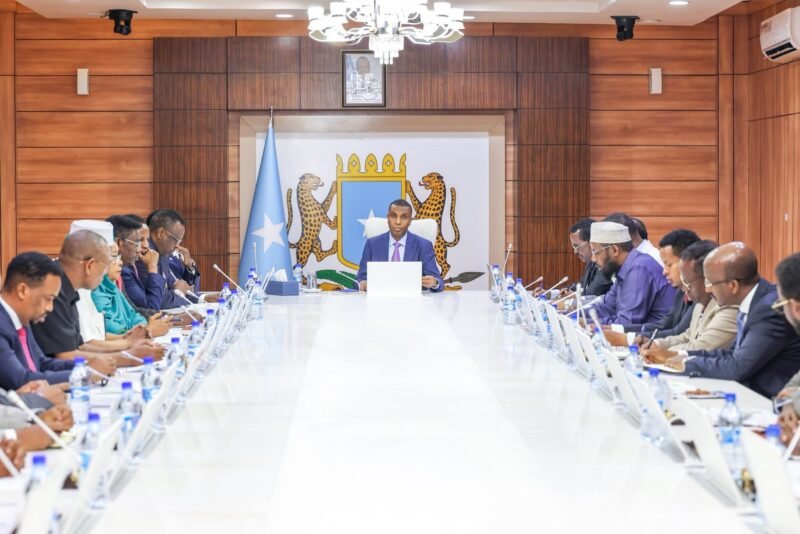
MOGADISHU — The Federal Government’s Council of Ministers has approved the creation of the Halmeel Unified Service Center during its regular weekly session, a strategic move to completely digitize and streamline public administration across the country.
The new central body, operating directly under the Office of the Prime Minister, will consolidate, standardize, and modernize the delivery of all federal public services. The Halmeel Center is engineered to dismantle bureaucratic inefficiencies throughout the state apparatus by integrating inter-agency data sharing, eliminating redundant procedures, and ensuring that Somali citizens are no longer required to submit identical information to multiple government offices. This transition to a unified “one-stop-shop” architecture guarantees that the public receives rapid, efficient, and transparent administrative services from the Federal Government.
The Cabinet’s approval of the Halmeel Center reflects Prime Minister Hamza Abdi Barre’s broader governance philosophy focused on building institutions that work and shifting from paperwork reforms to systems that tangibly affect citizens’ daily lives. The Prime Minister has previously launched a comprehensive review of his cabinet’s performance, emphasizing that his government had delivered significant progress in areas aligned with community needs and national development. The review sought to assess achievements across ministries, identify gaps, and ensure accountability in line with national priorities, with Barre underscoring his administration’s dedication to good governance, inclusive development, and the rule of law.
International Maritime Legislation Approved
In addition to administrative reforms, the Cabinet session, chaired by Prime Minister Hamza Abdi Barre, ratified critical international maritime legislation. The executive council officially approved the UN-backed treaty for the conservation and sustainable use of marine biological diversity in areas beyond national jurisdiction — formally known as the Biodiversity Beyond National Jurisdiction (BBNJ) Agreement, adopted under the framework of the United Nations Convention on the Law of the Sea.
The BBNJ Agreement establishes a legal framework for the conservation and sustainable use of marine biological diversity in areas beyond national waters, commonly referred to as the high seas, which account for nearly two-thirds of the world’s oceans. The treaty introduces mechanisms for the creation of marine protected areas, environmental impact assessments for activities in international waters, and equitable sharing of benefits derived from marine genetic resources. This ratification firmly aligns Mogadishu’s expanding blue economy strategy with strict global conservation protocols.
This maritime approval follows a series of significant steps taken by the government to strengthen Somalia’s maritime governance framework. The Council of Ministers previously adopted the International Convention for the Suppression of Unlawful Acts against the Safety of Maritime Navigation (SUA 2005), along with the 1992 Protocol modifying the International Convention on Civil Liability for Oil Pollution Damage. The adoption of these international maritime safety conventions directly supports Mogadishu’s recent historic milestone of relaunching the national ship registry and aggressively expanding the country’s “blue economy.”
Maritime Registration Reform and National Ship Registry
The Cabinet has previously approved the Marine Transport Registration Regulation, creating a comprehensive and unified legal framework for registering vessels operating under the Somali flag. The regulation enforces strict safety standards, improves monitoring procedures, and safeguards the reputation of Somalia’s national flag in international waters while ensuring full compliance with binding international maritime conventions.
The Ministry of Ports and Marine Transport has officially registered the commercial vessel Guney under the Somali flag, a historic milestone described as the first such national registration since the country’s state collapse in 1991. This registration marks a massive advancement in Somalia’s ongoing efforts to rebuild its lucrative maritime sector, which had remained severely underdeveloped for decades due to historical conflict, institutional breakdown, and the prolonged lack of a functional national registry.
Security Assessment and Cabinet Commendations
During the session’s conclusion, the Prime Minister praised the Somali National Army. After a detailed security assessment, the Cabinet confirmed a significant decrease in internal security incidents, validating that the government’s multi-front security operations are successfully maintaining territorial control and protecting the nation.
The Cabinet previously devoted substantial time to reviewing current operational conditions across the country, expressing strong appreciation for the Somali Armed Forces’ dedicated service in protecting citizens. The Council particularly emphasized the significant victory secured in Kudhaa, where the National Army successfully repelled an attack by Al-Shabaab militants, with ministers noting that the security forces’ prompt and professional response eliminated the threat, safeguarding local residents and re-establishing stability in the Lower Juba region.
Previous Cabinet Decisions on Anti-Smuggling and Postal Policy
The Council of Ministers has consistently advanced governance and institutional reforms in recent months. The Cabinet formally endorsed the Somali Airports Authority Bill, modernizing national aviation regulations, and sanctioned the Anti-Smuggling and Human Trafficking Bill to aggressively combat illegal cross-border activities. Additionally, the Cabinet endorsed a Memorandum of Understanding on Port State Control for the Indian Ocean region to improve maritime safety standards and regulation, while also approving the National Postal Policy (2025–2030) to modernize the nation’s postal services and incorporate them into the digital economy.
Budget Regulation and Security MoUs
The Council of Ministers has previously approved the 2026 Budget Quota Regulation, aiming to enhance fiscal discipline, ensure transparent allocation of national resources, and align spending priorities with the government’s development agenda. The session also ratified critical Memoranda of Understanding with the State of Qatar focusing on security cooperation, and with the Republic of Uganda addressing migration management and labor mobility.
Commitment to Governance and Stability
Prime Minister Barre has unveiled major reforms concerning public sector employment, revealing that the government is completing legislation to transform the hiring process. Going forward, all government roles will be allocated through an open, competitive selection grounded entirely on competence and expertise, providing fair chances for all citizens.
Prime Minister Barre has also officially inaugurated the First National Justice Forum, a pivotal event aimed at fortifying the rule of law, boosting accountability, and restoring public confidence in the nation’s judicial bodies. In his address, the Prime Minister noted that Somalia is navigating a vital phase of state-building, demanding an independent, transparent, and dependable justice system to address citizens’ needs.
“The approval of the Halmeel Unified Service Center represents a significant step forward in Somalia’s efforts to build efficient, transparent, and accountable government institutions. By consolidating federal public services under a single integrated platform, the government aims to enhance citizen access to essential services while eliminating bureaucratic inefficiencies that have long hindered service delivery.”
The ratification of the BBNJ Agreement underscores Somalia’s commitment to sustainable ocean governance and aligns the nation’s blue economy development with international conservation standards. With its extensive coastline along the Indian Ocean, Somalia stands to benefit from stronger global governance of marine ecosystems, particularly in combating illegal fishing and preserving biodiversity critical to coastal livelihoods.
The approval by the Council of Ministers paves the way for the next procedural steps, including ratification by the federal parliament, after which Somalia would formally become a party to the BBNJ Agreement. The agreement is widely regarded as a milestone in international environmental law, complementing existing ocean governance frameworks while addressing gaps in the protection of biodiversity in areas beyond national jurisdiction.