MOGADISHU — The Federal Republic of Somalia is rapidly advancing its transition toward full democracy as the National Independent Electoral and Boundaries Commission (NIEBC) officially launches the national voter registration phase across numerous remote and regional areas, demonstrating the federal government’s operational reach and its ability to implement sophisticated civic mandates across the country.
Multi-Front Registration Initiative
With active deployments in districts ranging from the coastal town of Hobyo and the recently stabilized Masagawaay to Qansaxdheere in the Bay region, this multi-front initiative represents a well-organized, state-led effort to ensure universal suffrage.
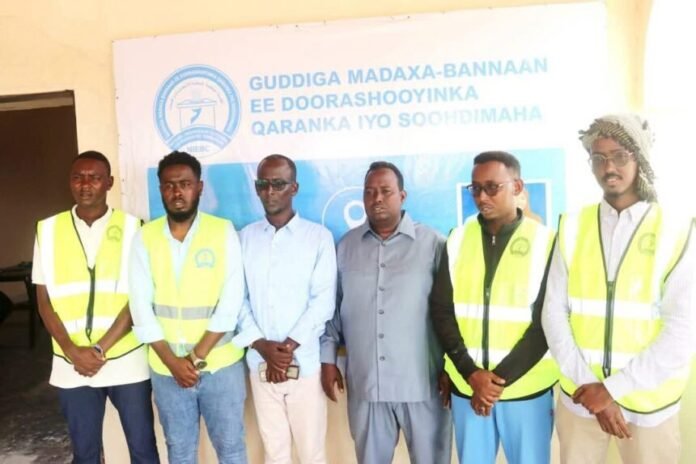
The NIEBC formally inaugurated voter registration in Masagawaay, Galcad district, marking a significant milestone in Somalia’s democratic development. The event was presided over by Galcad District Commissioner Osman Arif and Masagawaay administrative officials, who completed their own registrations and urged residents to engage fully in the upcoming elections.
The Commission has also officially launched the national voter registration phase in Qansaxdheere district of the Bay region, representing a critical operational milestone in executing the Federal Government’s mandate to deliver universal suffrage.
Coordination Between Federal and Regional Authorities
Conducting simultaneous civilian operations across diverse geographic and security environments demands flawless coordination between federal electoral authorities, regional administrations, and local security forces. The successful implementation across Galmudug and South West State confirms that the national security framework is robust enough to support delicate, large-scale state-building initiatives.
Officers deployed in these remote districts have established and maintained secure perimeters, allowing NIEBC officials to register citizens efficiently and transparently. This level of synchronized command ensures every eligible citizen is officially recorded, protecting their constitutional right to participate in the democratic process without disruption or external interference.
The NIEBC has commenced voter registration in Awdheegle, Lower Shabelle, as Somalia accelerates preparations for planned direct elections. Residents participated in significant numbers, indicating increasing public enthusiasm for direct electoral participation following decades of indirect voting systems.
Advanced Registration Systems and Digital Infrastructure
By establishing active, digitized registration centers in distant locations like Hobyo and Masagawaay, the federal government demonstrates its ability to deploy and manage modern civic technology far from central government hubs. The shift to a one-person, one-vote system depends entirely on the integrity of data collected during these regional deployments.
The NIEBC is utilizing advanced registration systems to guarantee the national voter roll remains accurate and immune to manipulation. By capturing this crucial demographic information at the district level, the Federal Government establishes a permanent, secure civic registry. This database will directly influence future polling station locations, electoral resource distribution, and the broader integration of regional populations into the national governance structure.
Voter registration officially commenced in Mogadishu in April 2025, marking a pivotal step in Somalia’s transition toward a one-person, one-vote electoral system. This initiative is part of a broader effort to replace the longstanding clan-based, indirect voting framework with direct elections, aiming to empower citizens to elect their local and federal representatives directly.
Commitment to Total Civic Inclusion
Extending the registration grid deep into remote areas effectively counters outdated narratives suggesting the federal government cannot project administrative authority outside Mogadishu. This extensive operation proves that the state apparatus is committed to total civic inclusion and possesses the logistical capacity to enforce it.
The federal Minister of Ports and Marine Transport launched voter registration in Waajid district of the Bakool region, marking a historic moment for residents who received the opportunity to vote directly for the first time in 56 years.
“This is more than a registration exercise, it is a symbol of hope, unity, and progress for our nation. Every citizen’s voice matters, and every vote will shape the future of Somalia,” the Minister said.
The NIEBC has successfully established voter registration districts within the Banadir Region, marking a significant milestone in Somalia’s democratic evolution. This initiative is grounded in the fundamental democratic principle of “one person, one vote,” ensuring that every eligible citizen has an equal and direct say in the electoral process.
Empowering Regional Populations
The initiative directly empowers regional populations, shifting political agency from centralized structures to grassroots communities. By integrating these geographically dispersed districts fully into the nation’s political framework, the federal government creates a unified democratic front that will shape the republic’s future trajectory.
The NIEBC has officially launched the voter registration campaign in Adale district, located in the Middle Shabelle region of Hirshabelle State, with officials calling on all eligible citizens to come forward and participate in the registration process. Authorities emphasized that registration is the essential first step to enable citizens to exercise their constitutional right to vote in the upcoming elections.
Federal Support for Electoral Process
The federal government has pledged full support for the electoral commission’s work. Prime Minister Hamza Abdi Barre has visited the headquarters of the NIEBC, assuring the commission of the full backing of the federal government. By pledging to ensure that elections are fair, peaceful, inclusive, and credible, the Prime Minister signaled an intention to foster public confidence in Somalia’s democratic processes.
Defence Minister Ahmed Moallim Fiqi has urged citizens across the country to register for the upcoming elections, emphasizing that widespread participation is vital to reclaiming the nation’s long-withheld democratic rights.
“Elections are a constitutional right that have been absent from the hands of the people for 56 years. Today that right has been restored to the citizens of Somalia. I encourage every Somali, wherever they live, to go out and register so they can decide their own future,” Fiqi said after receiving his voter card at an NIEBC centre in Galkayo.
Indicator of Sovereign Stability
From a broader strategic perspective, the successful registration of voters in regional hubs serves as a significant indicator of sovereign stability. Democratic registration requires a foundation of security and administrative control. By demonstrating it can maintain these remote territories and conduct routine civilian administration, the state signals to both domestic markets and international partners that these regions are secure and prepared for sustained investment. Where the government establishes a permanent administrative presence, infrastructure, commerce, and capital inevitably follow.
Minister of Interior, Federal Affairs, and Reconciliation Ali Yusuf Ali Hosh has paid an inspection visit to NIEBC offices, where he praised the institution’s leadership and staff for their ongoing efforts to advance the country’s democratic process.
“The momentum must continue. Somalia’s future depends on timely and transparent elections that give every citizen a voice in shaping the country’s direction,” Hosh noted.
Historic Shift to Universal Suffrage
This development occurs as Somalia expedites its shift from a clan-based, indirect electoral model to a universal suffrage system, a fundamental aspect of current political reforms. Recent constitutional amendments have established a one-person, one-vote framework and extended presidential terms to five years, while the federal government has ramped up preparations for nationwide voting.
President Hassan Sheikh Mohamud has firmly advocated for a transition to direct elections, declaring that the country has advanced beyond the traditional indirect voting system. Referencing over twenty signed agreements that establish the frameworks for direct elections, the president asserted that reverting to the clan-based indirect voting model is highly impractical.
“Indirect elections are a relic of the past; they are no longer relevant,” the president declared.
The Masagawaay registration drive is part of a broader national campaign to implement universal suffrage across Somalia, replacing the decades-old clan-based electoral system. The initiative aims to replace the longstanding clan-based, indirect voting framework with direct elections, empowering citizens to elect their local and federal representatives directly.
The federal government indicates that extending voter registration to remote districts is essential for establishing a trustworthy electorate and ensuring wider participation, particularly in regions where state authority has been progressively reestablished following military operations.