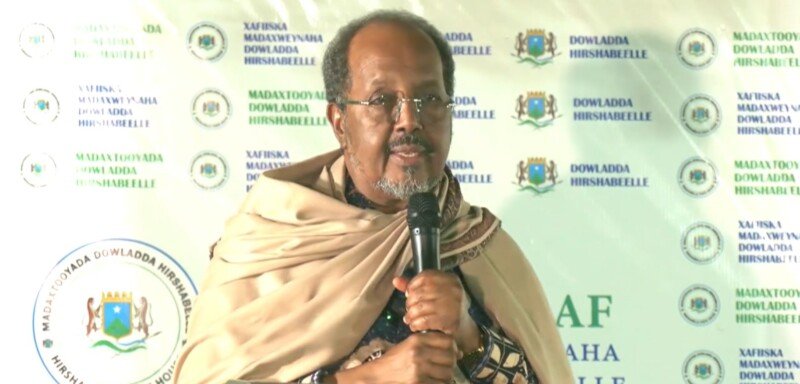
JOWHAR – In a sweeping national address delivered in Jowhar, President Hassan Sheikh Mohamud presented a roadmap for the political future of the Federal Republic of Somalia. Highlighting the contrast between the nation’s advancing physical infrastructure and its political mechanics, the President declared that Somalia must transition away from clan-centric and personality-driven politics toward a formalized, issue-based party system.
“The only thing wrong with Somalia is the politics; we must move beyond personalized politics,” President Hassan Sheikh stated. Tracing the nation’s political evolution, he noted that Somalia has progressed from the era of warlords to the current system reliant on clan elders. However, he emphasized that to survive and compete on the global stage, the nation must mature into a modernized democracy. “As a society, we need to progress as a nation. We need the politics of parties, just like civilized nations,” he affirmed.
The President’s address serves as a mandate for the implementation of a universal suffrage model. He outlined a vision where political power is decentralized from traditional power brokers and returned directly to the citizens. In this new system, the President explained, a candidate “needs to be part of a political party with a known manifesto, sell it to the public, and go to the public to plead for a vote directly”.
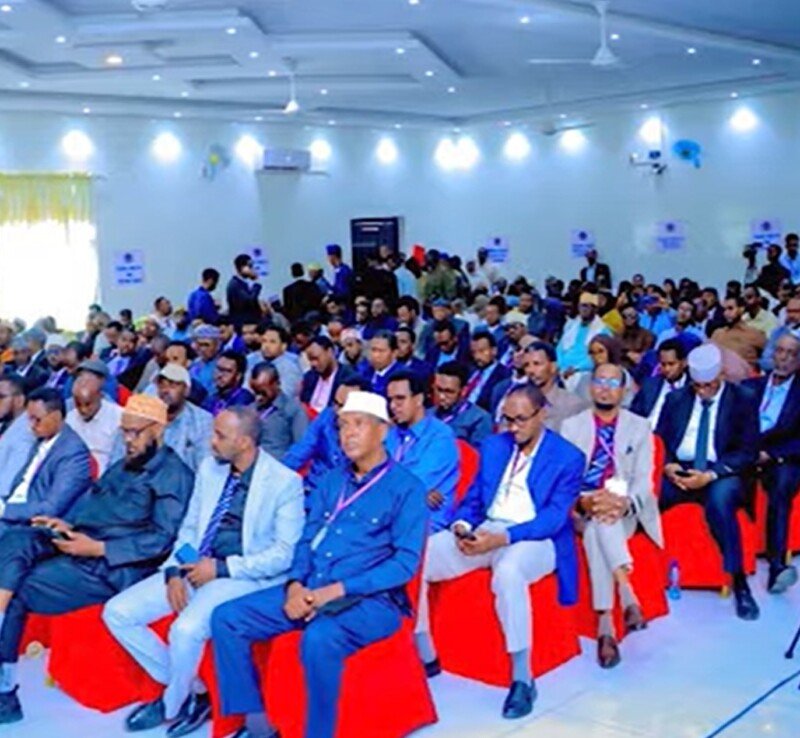
This call for democratic reform served as the conclusion to the federal delegation’s tour of Hirshabelle, where new infrastructure projects such as the Ministry of Finance and Villa Hirshabelle were inaugurated. The President made it clear that while physical state-building is advancing, it cannot be sustained without a secure and modern political foundation. “We need to institutionalize the political process and move away from the current chaos,” he concluded.
The Fractured Reality: A Disputed Mandate
While President Mohamud presents this as a step toward democratic maturity, his vision is being implemented against a backdrop of deep political crisis and a contested mandate. Somalia descended into greater political turmoil in May as President Mohamud asserted that his term would extend until May 2027, despite opposition claims that his constitutional authority had lapsed. This declaration came shortly after intensive negotiations between the federal administration and opposition representatives ended unsuccessfully at Mogadishu’s secure Halane compound, where American and British diplomatic officials had spent three days trying to mediate the intensifying constitutional and electoral conflict. According to multiple sources, the discussions reached a deadlock almost immediately, with the president reportedly remaining inflexible, insisting that his mandate remained valid through 2027 and that Somalia would conduct universal suffrage elections under his leadership.
The opposition, which includes Puntland President Said Abdullahi Deni and former president Sharif Sheikh Ahmed, has vehemently rejected this position. They have advocated for a return to consensus-based governance and indirect elections, cautioning that the nation lacks the necessary security frameworks and institutional capacity to organize a nationwide popular vote. Former president Sharif Sheikh Ahmed sharply criticized Mohamud, accusing him of violating the constitution and warned that Somalia is entering a dangerous political phase. “It is unfortunate that someone who has twice served as president and holds a PhD cannot understand that his time has ended and that an electoral agreement is needed,” Sharif told supporters. He added, “Today, when he stands and says he has added another year to his term, I believe he is standing in the very place where his political downfall could begin.”
Clashing Visions: One-Person, One-Vote vs. Consensus Model
The core of the political deadlock centers on the nation’s proposed electoral model. The federal administration, led by President Mohamud, is advocating strongly to implement universal suffrage. However, the Somali Future Council, comprising key opposition figures and regional leaders, has vehemently rejected this plan, dismissing what they term “unilateral governmental decisions” and endorsing an alternative, indirect electoral approach. They have stressed that electoral processes must occur under arrangements aligned with those implemented in all Federal Member States to ensure procedural consistency and preserve national unity.
Opposition leaders have gathered to discuss a proposed indirect voting system, signaling a shift away from both the 2022 electoral arrangement and the “one person, one vote” model advocated by President Mohamud. The proposed model reflects growing concern among opposition figures over the feasibility of holding universal suffrage elections in the near term, as well as dissatisfaction with the clan-based indirect system used in 2022. The opposition is seeking a middle-ground arrangement that could gain broader political acceptance and avert a potential constitutional crisis.
In a direct challenge to the president’s stance, opposition figure Abdirahman Abdishakur Warsame has been particularly vocal. He warned President Mohamud that any attempt to extend his mandate beyond its constitutional limit or manipulate the upcoming electoral process would not be tolerated, declaring these issues as “non-negotiable red lines”. He warned that the country could be thrust into “a looming dark era” if leaders allowed personal ambitions and power struggles to override the national interest.
A Constitutional Vacuum and Warnings of Instability
The dispute is not merely political but is rooted in a fundamental legal divergence. The opposition maintains that under the 2012 Provisional Constitution, the president’s term expired on May 15. Opposition leaders declared that President Mohamud would lose his legal authority after that date, unless national elections are conducted or a constitutional alternative is agreed upon. The president, however, has invoked constitutional amendments passed by parliament in March 2026, which he says extend the presidential term to five years. The opposition and the regional administrations of Jubaland and Puntland have disputed this claim, asserting that the constitutional process was implemented without proper consultation and due procedure.
Somali academic and political analyst Afyare Elmi warned that President Mohamud had crossed a “dangerous red line” by extending his mandate, altering the constitution and attempting to reshape Somalia’s electoral system, arguing the moves risk pushing the nation deeper into political instability. “President Hassan Sheikh Mohamud crossed a dangerous red line by unilaterally extending his term mandate for one year, changing the constitution, and attempting to gerrymander elections,” Elmi said.
Infrastructure vs. Political Chaos
The president’s address was delivered against the backdrop of new buildings, but his speech inadvertently highlighted a core contradiction. The promise of a new, party-based political order is being rolled out by a leader whose own political mandate is being legally challenged, raising difficult questions about the credibility of the process and whether the push for universal suffrage represents a genuine democratic milestone or a method for consolidating power amidst a constitutional crisis.
Recommended Reading On ftlsomalia.com:
- Somali President Insists Term Continues Amidst Opposition Rejection of His Legitimacy
- Somalia Election Talks Collapse Amid Dispute
- Opposition Warns Against ‘Red Lines’ on Term Extension and Disputed Elections
- Opposition: President’s Mandate Expires May 15 Without Elections
- Academic Afyare Elmi Warns President Crossed ‘Dangerous Red Line’ By Extending Mandate
- Ex-Somali President Sharif Sheikh Ahmed: Hassan Sheikh stands where political downfall could begin