WASHINGTON – A quiet but ferocious war is being waged in the corridors of Washington, D.C., not with bombs or bullets, but with lobbying contracts, media appearances, and multimillion-dollar influence campaigns. On one side stands the Federal Government of Somalia, spending hundreds of thousands of dollars to defend its sovereignty. On the other, the breakaway region of Somaliland, backed by Emirati petrodollars and a network of Republican operatives, is waging an aggressive campaign for international recognition.
The battle for the soul of U.S. foreign policy in the Horn of Africa has escalated dramatically over the past decade. Where once there was little more than diaspora activism, there is now a sophisticated, well-funded lobbying war that reveals as much about the transactional nature of American foreign policy as it does about the desperation of the Somali state.
2015: A Modest Presence
In 2015, lobbying on behalf of Somali interests in the United States was a niche affair. The Federal Government of Somalia, still in its infancy, had yet to establish a significant presence on K Street. The most notable representation was not for the government in Mogadishu, but for private commercial interests.
According to a 2018 report by The Washington Times, Roger Stone, a self-proclaimed “dirty trickster” and longtime Republican operative, began lobbying for Capstone Financial Group, a New York-based firm, on May 1, 2017. Stone’s work, which he described as “casual conversations” with a single member of Congress about “the status of the insurgency and the security of Somalia,” focused on “commodity rights and security” in Somalia. According to The Hill’s reporting on the matter, the contract involved spending of about $30,000.
As The Washington Times reported, Stone’s lobbying coincided with the Trump administration’s escalation of U.S. military operations in Somalia, including a major increase in drone strikes and the deployment of over 500 troops. “The Al Queda off-shoot [sic] Al Shabaab is quite violent and deadly,” Stone told The Daily Beast at the time. “The topography of Somalia unlike Afghanistan lends itself to a successful drone based US campaign against the insurgency.” Stone’s work, however, was not for the Somali government but for a private company with commercial interests in the country.
2026: A Multi-Million Dollar Influence War
By 2026, the lobbying landscape had been completely transformed. Both sides are now spending hundreds of thousands, and in some cases millions, of dollars to shape U.S. policy.
Somalia’s Counter-Offensive
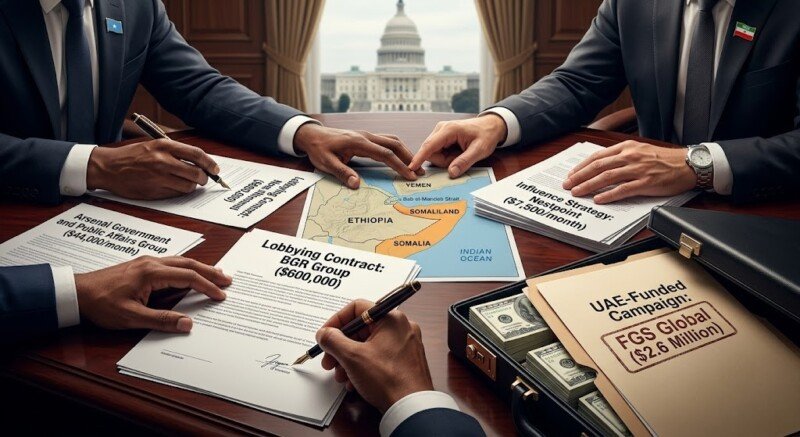
In a bid to counter Somaliland’s diplomatic offensive, Somalia has hired two U.S. lobbying firms. First, in November 2024, Somalia’s embassy in Washington signed a $600,000 lobbying contract with BGR Group, one of the most powerful firms in the United States. The firm, founded by prominent Republican figures including former Mississippi Governor Haley Barbour, was tasked with providing “government affairs services.” The contract was signed by Somalia’s Ambassador to the United States, Dahir Hassan Arab.
A more recent contract, signed on September 10, 2025, is with the Arsenal Government and Public Affairs Group (AGPAG). According to FARA filings obtained by DropSite News, Somalia is paying AGPAG a monthly retainer of $44,000 for a year-long contract, totaling over $528,000. This contract includes a provision for AGPAG to facilitate meetings with U.S. officials and to secure media opportunities for President Hassan Sheikh Mohamud. The firm has already delivered, arranging an interview for the president on Newsmax on October 15, 2025, where he praised the Trump administration’s counterterrorism policy.
Even more striking is the involvement of political consultant Roger Stone Jr., who is listed as an adviser working with the Somali government on outreach efforts. According to DropSite News, Stone has since publicly denied a formal role, stating the inclusion of his name “took me by surprise.” Nevertheless, his presence on the filing underscores the deep and enduring ties between Trump-world operatives and Somali lobbying efforts.
Somaliland’s Offensive
Somaliland’s lobbying campaign is even more aggressive. In December 2025, Israel became the first nation to recognize Somaliland. Bolstered by this, Somaliland has hired multiple firms to push for U.S. recognition.
As DropSite News first reported, Somaliland has retained Nestpoint, a Dallas-based firm with deep ties to the Republican Party, for a one-year contract worth $7,500 per month. Nestpoint is tasked with “engaging U.S. government stakeholders” to “develop and execute a comprehensive strategy to secure international recognition.” The firm is run by prominent GOP strategists, including Stuart Jolly, former national field director for Trump’s 2016 presidential campaign. According to DropSite News, Jolly, who Trump personally congratulated on stage for his first primary win in New Hampshire, also previously ran the pro-Trump Super PAC, Great America PAC.
However, the real financial weight behind the campaign comes from the UAE. According to DropSite News and other reports, the United Arab Emirates has been bankrolling a multi-million dollar lobbying campaign, executed by the powerhouse firm FGS Global, with the single objective of legitimizing the secession of Somaliland. Records show Abu Dhabi paid FGS nearly $2.6 million in just six months. The UAE’s objective is not to support Somali self-determination, but to advance its own geopolitical interests in the Horn of Africa. By bankrolling a campaign to dismember Somalia, the UAE is actively undermining the country’s sovereignty and territorial integrity.
A Tale of Two Lobbies: Comparative Overview
| Entity | 2015 Activity | 2026 Activity | Annual/Total Cost |
|---|---|---|---|
| Somalia | Limited; private sector interests (Roger Stone for Capstone Financial Group) | BGR Group (2024: $600,000) AGPAG (2025: $44,000/month) |
~$1.1 million+ |
| Somaliland | Glover Park Group; diaspora efforts | Nestpoint ($7,500/month) FGS Global (UAE-funded) |
~$5 million+ (UAE-funded) |
A Democratic Deficit
This lobbying war is a stark illustration of the democratic deficit in Somali politics. While the government in Mogadishu spends hundreds of thousands of dollars to lobby U.S. officials, the Somali Parliament, the body that is supposed to represent the Somali people, is systematically excluded from these processes. Somali legislators have been denied access to the texts of key bilateral agreements, including a controversial oil and gas deal with Turkey.
The use of lobbying firms, while legal, raises serious questions about accountability and transparency. The government is effectively outsourcing its foreign policy to American political operatives, many of whom have no connection to Somalia beyond their monthly retainers. This is not diplomacy; it is a rent-seeking exercise that benefits a small coterie of political elites while doing little to address the needs of ordinary Somalis.
The UAE’s Puppet Strings
The UAE’s role in funding the Somaliland campaign is perhaps the most troubling aspect of this influence war. Abu Dhabi’s objective is not to support Somali self-determination, but to advance its own geopolitical interests in the Horn of Africa. By bankrolling a campaign to dismember Somalia, the UAE is actively undermining the country’s sovereignty and territorial integrity.
This is not a benign act of diplomatic engagement; it is a blatant intervention in the internal affairs of a sovereign state. The UAE’s goal is to secure a foothold on the Red Sea, to counter Turkish and Qatari influence, and to create a client state that will serve its interests. The Somali people are merely pawns in this geopolitical game. As a Mogadishu-based analyst told DropSite News, the lobbying campaign “is now bigger than Somalia”, a struggle over the control of the Bab el-Mandeb Strait, through which nearly 15 percent of global trade passes.
A War of Attrition, Not Diplomacy
The lobbying war has escalated to the point where it is now a war of attrition, with both sides spending vast sums of money to influence a handful of policymakers. Yet, for all the money spent, the fundamental issues remain unresolved. Somalia remains fragmented, weak, and dependent on foreign aid. Somaliland remains unrecognized by the international community.
The Trump administration has repeatedly disparaged Somalia, with the president referring to it as “not even a country” and its people as “crooks” and “garbage.” Yet, both sides are competing for the attention of this same administration, hoping to secure a favorable outcome through lobbying and influence-peddling rather than through genuine state-building and reform.
Way Forward
The lobbying war between Somalia and Somaliland is a symptom of a deeper malaise. It reflects the failure of the Somali state to build a coherent foreign policy, the desperation of its leadership to secure external support, and the willingness of foreign powers to exploit Somalia’s weakness for their own ends.
For the Somali people, this campaign is a distraction from the real issues that affect their lives: insecurity, poverty, and a lack of basic services. The millions of dollars spent on lobbying could have been used to build schools, hospitals, and roads. Instead, they have been funneled into the pockets of American political consultants.
Until Somalia’s leaders prioritize the needs of their people over their own political survival, and until the international community stops treating Somalia as a geopolitical chessboard, this lobbying war will continue to serve as a tragic illustration of a nation that has lost its way.