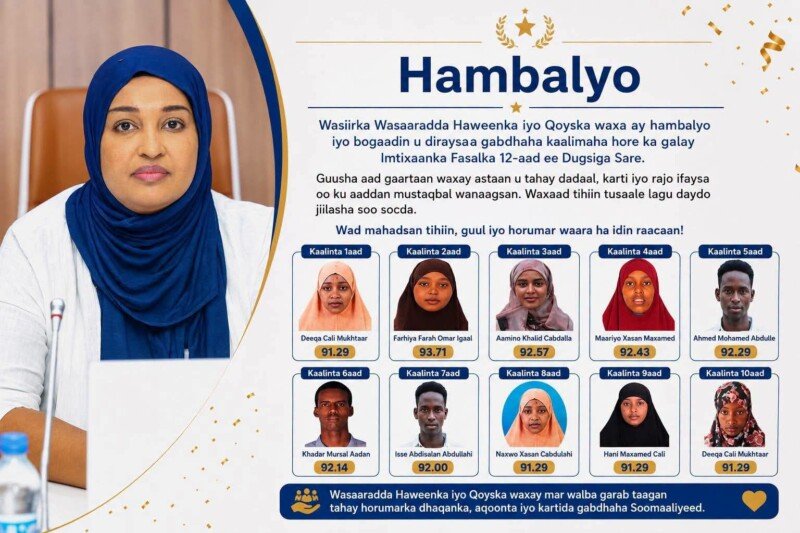
MOGADISHU — The Minister of Women and Human Rights Development, Ambassador Khadiija Mohamed Al-Makhzoumi, has extended her congratulations to the Somali girls who achieved top positions in the National Secondary School Certificate Examination, describing their success as a source of pride and honour for all Somali women.
The Minister noted that six of the top ten students in the exam, which was taken by over 40,000 students, are girls. She said this achievement clearly reflects the active role Somali girls are playing in education and society. The Minister expressed special appreciation to Somali parents who have understood the importance of educating their daughters, noting that this success demonstrates the fruits of efforts to raise awareness and expand educational opportunities for Somali girls.
Girls have previously dominated the top positions in the Banaadir region’s Grade 8 certificate examinations, securing nine out of the top ten spots, with Sumayo Hassan Abshir Aadan achieving a score of 96.88%.
Over 44,000 students passed the Grade 8 exams in Mogadishu, with a pass rate of approximately 96.8 percent and girls accounting for 45.47 percent of successful candidates.
Girls’ Education in Somalia
Girls’ education has been a key priority for the government and international partners. The government has announced plans to award scholarships to 3,000 female students who excelled in national exams, promoting gender equity in education.
The Ministry of Education has listed several key achievements, including the recruitment of 3,000 additional teachers, scholarships for 3,000 girls, and the development of the first-ever Higher Education Act.
The National Education Consultation Conference recently brought together federal and state-level education ministers to coordinate and strengthen Somalia’s education sector.
Critical Note
While the success of female students in the national exams is a positive development, it also highlights the significant challenges facing Somalia’s education sector. Despite the participation of over 40,000 students in the national exams, millions of children across the country remain out of school due to conflict, displacement, poverty, and lack of infrastructure. The education system continues to face severe resource constraints, with many schools lacking basic facilities, qualified teachers, and learning materials.
The Minister’s emphasis on girls’ education is welcome, but it must be accompanied by sustained investment in schools, teacher training, and community engagement to ensure that all children have access to quality education. The international community, while supportive of education initiatives, must also increase its financial commitments to ensure that the gains made in education are not reversed.