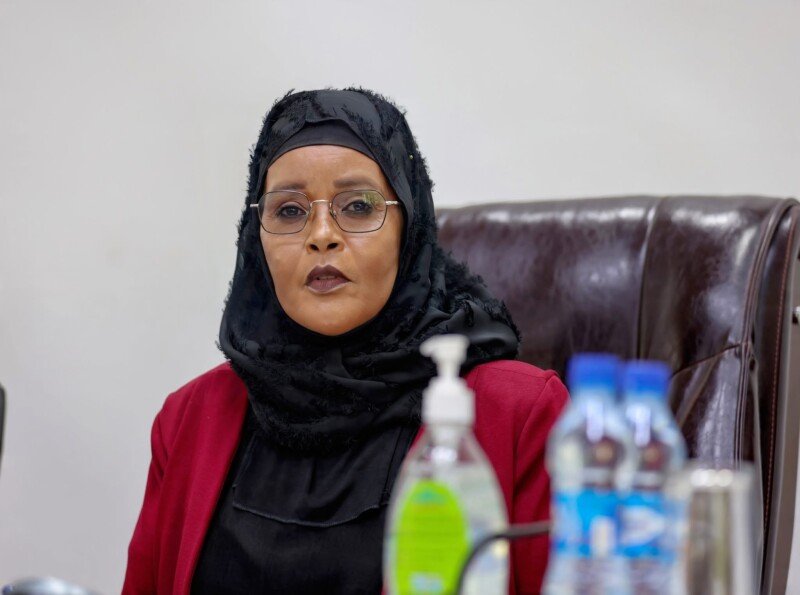
MOGADISHU — The Banadir Regional Court of Appeal has commenced hearings on the appeal filed by Sacdiya Macalin Ali, widely known as Sacdiya Bajaaj, who is seeking to overturn a three-year prison sentence handed down by the Banadir Regional Court in June 2026. The case has drawn significant public attention and sparked debate over freedom of expression, judicial independence, and the limits of online speech in Somalia.
During Sunday’s hearing, defense lawyers presented legal arguments challenging the lower court’s ruling, asking the appellate court to review both the legal basis of the conviction and the sentence imposed. Advocate Zakariye Ismail Nur, one of the defense lawyers, outlined what he described as the legal grounds for the appeal, arguing that the trial court’s decision should be reconsidered. The defense urged the court to examine the issues raised in the appeal before reaching a final determination.
Background of the Case
Sacdiya Bajaaj, a 27-year-old tuk-tuk (bajaj) driver and social activist, was arrested on April 12, 2026, by officers of the National Intelligence and Security Agency (NISA) in Mogadishu’s Hodan district and transferred to Mogadishu Central Prison two days later. She had been detained for 74 days before the court delivered its ruling.
On June 25, 2026, the Banadir Regional Court sentenced her to three years in prison after convicting her on charges including “insulting state institutions” and “incitement to commit an offense.” The charges stemmed primarily from videos she posted on social media criticizing Somali President Hassan Sheikh Mohamud and members of his family. Prosecutors also accused her of posting information about how positions in the Banadir regional administration were distributed among clans and organizing public protests against the government.
Throughout the trial, Sacdiya’s legal team maintained that prosecutors had failed to produce sufficient evidence to support the accusations, arguing that the case lacked a legal basis for conviction. Her lawyers said the court convicted her only on the charge of insulting leaders and announced they would appeal the ruling.
Defense Arguments and Personal Circumstances
In a handwritten letter released from Mogadishu Central Prison, Sacdiya insisted she is innocent of the charges against her and called for an independent judicial review of her conviction. She argued that her three-year prison sentence stems from the peaceful expression of her political views rather than any criminal conduct.
Sacdiya, a mother of a 12-month-old child, said her infant requires constant maternal care and urged the court to take her parental responsibilities into account. She also revealed that she suffers from asthma and claimed she has not received adequate medical treatment since her detention. She requested access to an independent medical examination and appropriate healthcare while awaiting the outcome of her appeal.
Her legal team has argued that the welfare of her child should be considered as part of the appeal proceedings. According to her letter, Sacdiya also questioned the handling of her trial, claiming that the judge initially assigned to hear the case was replaced before the verdict was delivered and that the Chairman of the Banadir Regional Court ultimately presided over the proceedings that resulted in her conviction.
Rather than seeking a presidential pardon, Sacdiya said she wants an independent appeals court to review the evidence, court procedures, and legal basis of her conviction. She stressed that requesting a pardon would imply an admission of guilt, something she firmly rejects.
Wider Implications and International Concern
The case has attracted widespread attention in Somalia, where many social media users have followed the proceedings closely and debated whether the charges reflected a legitimate legal case or an attempt to silence criticism. Human rights advocates have increasingly raised concerns over due process, freedom of expression, and the handling of cases involving online activism.
Amnesty International previously described her detention as arbitrary and said she was being targeted solely for exercising her right to freedom of expression. The rights group urged Somali authorities to release her or ensure that, pending release, she was held in conditions that met international human rights standards.
Sacdiya also appealed to her supporters not to exploit her case to promote clan divisions, hate speech, or acts of revenge. She emphasized that her case should remain focused on justice and the rule of law rather than political or social conflict.
She argued that Somali citizens have the constitutional right to criticize the government and speak openly about issues such as unemployment, corruption, poverty, and inequality without fear of criminal prosecution. According to her letter, laws should protect citizens’ freedoms rather than be used to silence dissenting voices.
Critical Note
The Sacdiya Bajaaj case has become a flashpoint in the ongoing tension between Somalia’s legal framework and the protection of fundamental rights. While the government has emphasized the need to maintain public order and protect state institutions from defamation, the prosecution of a tuk-tuk driver and social activist for criticizing the president raises uncomfortable questions about the space for dissent in Somalia’s fledgling democracy. The defense’s claims of procedural irregularities, including the replacement of the presiding judge and the denial of adequate medical care, suggest that due process may have been compromised. The appellate court’s handling of this case will be a critical test of Somalia’s judicial independence and its commitment to international human rights standards. If the conviction is upheld without a convincing legal rationale, it will send a chilling message to journalists, activists, and ordinary citizens who seek to hold their leaders accountable through peaceful expression. The government would be well advised to ensure that the appeal process is transparent, impartial, and free from political interference, lest it further erode public confidence in the rule of law.
Recommended Reading On ftlsomalia.com
- Banaadir Court to Hear Case Against Social Media Personality Sacdiya Bajaaj
- Goobjoog Condemns Journalist Arrest, Demands Release
- 11 Somali Journalists Detained in Mogadishu Over Opposition Interviews
- 17 Arrested in Mogadishu for Security Violations, Including Security Officers
- Justice Ministry Assesses Key Projects, Advances Post-Constitutional Reform Agenda
- Somalia Detains Puntland Presidential Adviser in Mogadishu Amid Heightened Tensions