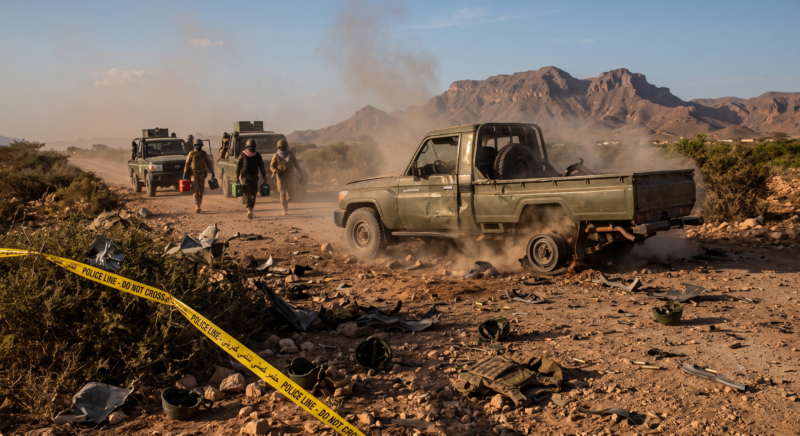
BOOSASO — At least eight soldiers are reported dead and several others wounded after a landmine explosion targeted a military vehicle in the Bari region, according to preliminary reports from local sources. The attack occurred as Puntland authorities were hosting high-level security talks with US Africa Command (AFRICOM) officials in the port city of Bosaso.
The blast caused significant casualties, with sources indicating that most of the soldiers aboard the targeted vehicle perished at the scene. The exact number of casualties remains unconfirmed, as Puntland authorities have yet to issue an official statement detailing the toll or the circumstances surrounding the attack. Efforts to independently verify the casualty figures have been hindered by limited access to the affected area.
Security Talks Amidst Escalating Violence
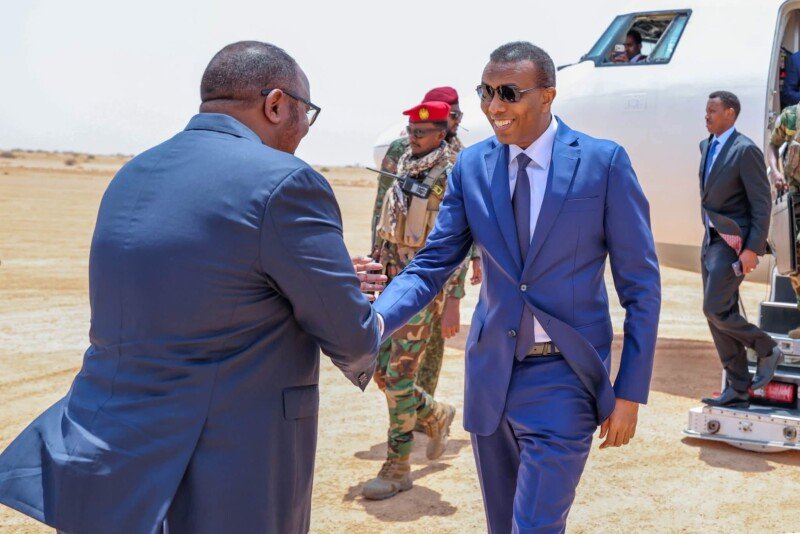
The attack comes at a sensitive moment for Puntland’s security apparatus, as President Said Abdullahi Deni and senior officials are currently engaged in meetings with a high-level U.S. delegation in Bosaso, focusing on expanding counterterrorism cooperation, maritime security, and the modernization of regional security forces[reference:1]. Discussions have centered specifically on the ongoing campaign against ISIS affiliates entrenched in the Cal Miskaad mountains and the role of international support in those operations[reference:2].
The timing of the attack—occurring while Puntland’s leadership is engaged with American military officials—raises questions about the militants’ ability to strike at moments of apparent political vulnerability. A similar pattern was observed in May 2026 when President Deni met with a U.S. delegation in Garowe to discuss security collaboration and counterterrorism efforts against extremist organizations[reference:3]. The parallel engagement with regional administrations has fueled mistrust and accusations of divide-and-rule[reference:4].
Cal Miskaad Campaign and Shifting US Engagement
Puntland forces have been engaged in an extended military campaign against ISIS strongholds in the Cal Miskaad mountain range, where the group has maintained a presence for years. The United States has previously conducted airstrikes against ISIS positions in the region, but reports indicate that Washington has recently reaffirmed its commitment to regional security while shifting its operational approach[reference:5]. Ambassador Richard Riley and SOCAF Commander Major General Claude Tudor held talks with President Deni in Bosaso, emphasizing that “it is local forces that are on the front lines, leading the charge against threats”[reference:6].
The United States has backed Puntland in its battle against ISIS and maritime threats, with talks highlighting the shared priority of securing the Gulf of Aden and the wider Indian Ocean corridor[reference:7]. Observers have noted that sustained support is critical to degrading the group’s capabilities, and any interruption could embolden militants to test Puntland’s defenses.
Troop Movements and Security Vacuum
In the days leading up to the attack, Puntland authorities had reportedly redeployed a significant number of troops from forward operating areas to participate in the 28th anniversary celebrations of the state’s founding, which took place yesterday. It remains unclear whether these troop movements created a security vacuum that was exploited by militants, though the timing of the attack has prompted questions about operational readiness and the prioritization of ceremonial functions over frontline commitments.
Security analysts had previously warned of heightened risks during the anniversary period, noting that major events often provide opportunities for militant groups to stage attacks designed to embarrass authorities and undermine public confidence in state security institutions.
Critical Note
While Puntland authorities have positioned themselves as a reliable partner in the global fight against terrorism, the persistent ability of militant groups to inflict casualties on government forces exposes significant gaps in intelligence-gathering, operational coordination, and force protection. The apparent troop redeployments for anniversary celebrations, if confirmed, would suggest a troubling prioritization of political optics over security imperatives. Additionally, the shifting nature of US engagement, while framed as a strategic recalibration, raises uncomfortable questions about the sustainability of Somalia’s counter-terrorism strategy when reliant on external support that can be scaled back or withdrawn at short notice. The attack also underscores that despite years of international assistance and training, Somali security forces remain vulnerable to asymmetric tactics employed by their adversaries. Authorities have yet to provide a transparent accounting of the incident, and without full disclosure, the public is left to rely on unverified reports that may obscure the true scale of the losses.
Recommended Reading On ftlsomalia.com
- U.S. Delegation Meets Deni in Bosaso to Expand Counterterrorism Cooperation as Federal-State Rift Deepens
- Puntland President Meets U.S. Delegation in Garowe
- US Backs Puntland in Battle Against ISIS, Maritime Threats
- Prime Minister Hamza Congratulates Puntland on 28th Anniversary Amid Federal-State Tensions
- Puntland Accuses President Mohamud of Arming Militias as Federal-State Tensions Reach Boiling Point
- Puntland Withdraws Recognition of Federal Government Over Constitutional Dispute