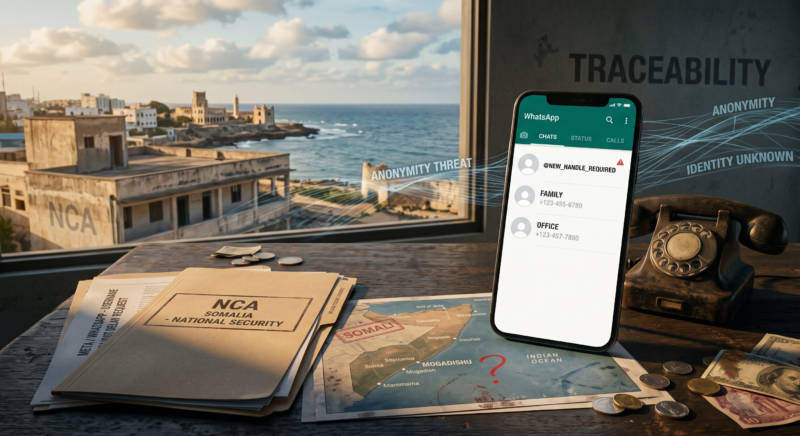
MOGADISHU – The National Communications Authority (NCA) of Somalia has formally demanded that Meta, the parent company of WhatsApp, delay the rollout of its new username feature in the country, warning that the privacy-focused update could inadvertently empower terrorist groups, facilitate financial fraud, and undermine national security.
The NCA’s request makes Somalia the second country, after India, to formally oppose the feature. Mustafa Yasin Sheikh, Director-General of the NCA, told Bloomberg that replacing phone numbers with usernames could hinder Somali security agencies’ ability to identify individuals involved in terrorism, organised crime, and other illegal activities.
“Somalia is following India’s example,” Sheikh said, listing concerns about the impersonation of government institutions and public officials, financial fraud targeting Somalia’s mobile money ecosystem, and the misuse of anonymous communications by groups such as Al-Shabaab.
The NCA has a history of engaging with major tech companies to resolve connectivity and security issues, having previously worked with Apple to resolve FaceTime and iMessage functionality for Somali users.
India’s Lead: A Global Dispute Over Digital Traceability
On July 1, 2026, India’s Ministry of Electronics and Information Technology issued a notice to Meta, asking the company to halt the rollout of the username feature. The Indian government warned that the feature could “materially increase the incidence of online fraud, phishing, digital arrest scams and impersonation attacks”.
India, which is WhatsApp’s biggest market with over 600 million users, also warned that the feature could facilitate impersonation of individuals, government authorities, financial institutions, and public agencies. The government cited provisions of India’s Information Technology Act and gave Meta three days to respond, barring the rollout until consultations were concluded.
In response, Meta submitted a written reply to the Indian government on July 9, which is currently under review. A Meta spokesperson previously stated that the company had built multiple safeguards into the feature, including reserving high-profile usernames for public figures and government entities to prevent impersonation.
Somalia’s Unique Vulnerabilities
Somalia’s concerns are compounded by its unique security landscape. The country has been battling the Al-Qaeda-linked Al-Shabaab insurgency since 2006, a conflict that has killed thousands and displaced millions. The government treats any loosening of digital traceability as a security question first.
The NCA warned that the feature could be particularly dangerous in Somalia, where mobile money is the backbone of the economy. According to the NCA’s statement, approximately 155 million mobile money transactions are recorded monthly, worth about $2.7 billion, with over 70 percent of adults using the service regularly.
“The substitution of phone numbers may hinder Somali security agencies’ ability to identify individuals involved in terrorism, organized crime, and other illegal activities,” the NCA Director-General said. The agency specifically cited concerns about the impersonation of government institutions and public officials, as well as misuse of anonymous communications by Al-Shabaab.
The NCA has previously worked with the Central Bank to regulate digital financial services in the country to ensure they remain safe and secure for all Somalis.
The Feature and Its Defenders
WhatsApp began allowing its roughly three billion users to reserve unique handles on June 29, 2026, with the feature expected to go live later in the year. A phone number is still needed to open an account, but once a handle is set, new contacts no longer have to see the number behind it.
A WhatsApp spokesperson has defended the feature, stating that it would not replace phone-number-based identity and that usernames are an optional way to connect without revealing personal numbers. There will be no public username directory, search suggestions, or discovery feed; instead, someone will need to know a user’s exact username to message them.
“To protect against impersonation, we have held the highest-profile names—think public figures, government entities, celebrities, verified Meta accounts—so they can only ever be claimed by their legitimate owners and lookalike derivatives of known names are held as well,” the spokesperson said.
A Broader Push Against Messaging Anonymity
The dispute over WhatsApp usernames sits alongside a broader global pushback against anonymity features in messaging apps. India has previously sent similar notices to Telegram and Signal about their own username systems. The government has also blocked Telegram channels over leaked exam papers in previous incidents.
In Somalia, the NCA’s stance reflects a growing recognition that digital platforms, while essential for communication and commerce, also present significant security challenges in fragile states. The agency has made it clear that it is not opposed to technological innovation but insists that any new service must align with the country’s security realities.
Way Forward
The NCA has demanded that Meta engage in technical consultations and implement robust safeguards before the feature is activated in Somalia. The agency is seeking guarantees on identity verification, mechanisms to prevent abuse, and systems to monitor usernames to prevent impersonation of individuals or official entities.
As India continues to review Meta’s response, the outcome of the consultations in both countries could set a precedent for how global tech companies balance privacy innovations with national security concerns in developing nations. For Somalia, the stakes are particularly high, given the country’s ongoing fight against terrorism and its heavy reliance on mobile money for daily life.