MOGADISHU – The United Nations Transition Mission in Somalia (UNTMIS) has issued a statement detailing its role in facilitating ongoing political dialogue between the Federal Government of Somalia and opposition groups, as international partners intensify efforts to resolve the country’s protracted electoral and constitutional deadlock.
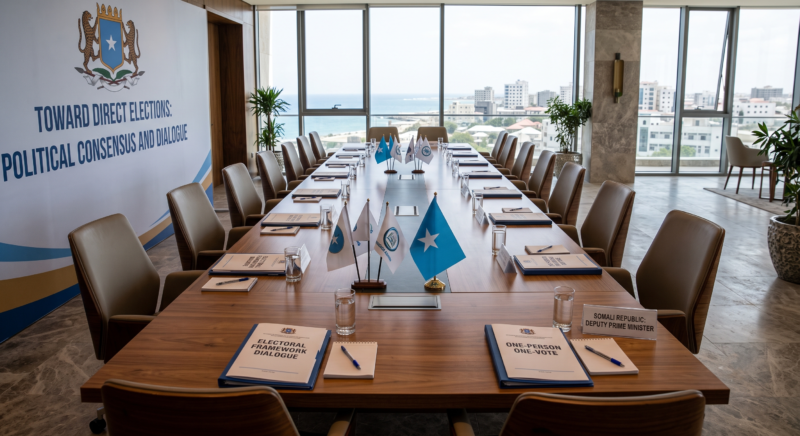
The talks, which began on July 7, are focused on the electoral framework and contested constitutional amendments. Villa Somalia has maintained its position in favour of a one-person, one-vote system, while the opposition has presented an alternative “Expanded Indirect Election” model that blends direct voting with the 4.5 clan power-sharing formula.
The new round of talks follows the collapse of previous negotiations at Mogadishu’s Halane compound in May, where disputes over the electoral model and the president’s mandate persisted. The negotiations were facilitated by American and British diplomats but ended without a breakthrough.
International Community Welcomes the Dialogue
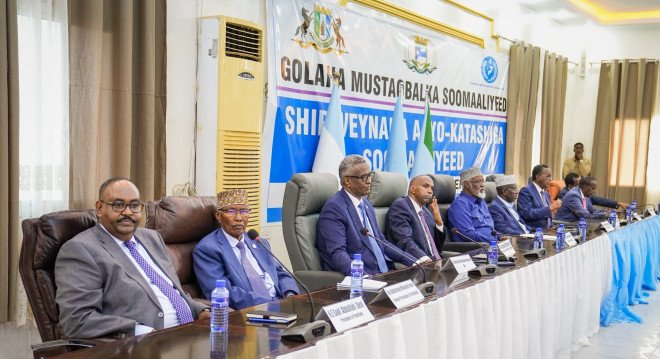
In a statement released on July 9, UNTMIS confirmed it had facilitated a meeting between the Federal Government and members of the opposition, with representatives from the European Union, the UK Embassy, the US Embassy, and the Turkish Embassy in Somalia also in attendance. The mission described the talks as having taken place in a “friendly and constructive atmosphere” and said they addressed issues related to Somalia’s political future.
“We are honoured to have facilitated and observed the dialogue between the Federal Government and opposition groups. The meetings were held in a constructive atmosphere, and both sides discussed issues related to the political future of Somalia,” the statement read.
UNTMIS posted on social media, stating that the talks are “an important step towards reaching a consensus on electoral issues.” The mission emphasised the importance of continued dialogue between Somali political stakeholders to achieve lasting stability.
Previous UN Engagement and Warnings
The mission’s involvement builds on a series of previous engagements. In May 2026, UNTMIS called on leaders to continue political dialogue after three days of talks failed to resolve key disputes. The mission had previously expressed disappointment that negotiations ended without a breakthrough, while noting that the parties had committed to continuing talks and seeking a constructive path forward.
The UN mission has consistently urged the Federal Government to engage all stakeholders in order to build agreement around “a practical and unifying” electoral framework. The mission has also appealed for national unity to confront worsening humanitarian conditions and the continued threat posed by armed militant groups.
International Coalition Pressures for Consensus
A coalition of Western embassies and the UN mission has released joint statements urging all Somali political leaders to return to negotiations and quickly establish an electoral plan. The statement was endorsed by numerous missions including the British Embassy in Mogadishu, the EU Delegation to Somalia, and embassies from Norway, Sweden, Germany, France, Ireland, Italy, the Netherlands, Belgium, Austria, Finland, Portugal, Spain, Switzerland, and Poland.
The signatories expressed grave concern about the current situation and called on Somali leaders to prioritise national interests, emphasising that “We urge all parties to immediately resume dialogue and quickly agree on an electoral roadmap for the benefit of the Somali people.”
Somalia and European Union member states have reaffirmed their support for constitutional reforms and democratic transition, with the EU urging Somalia’s political actors to immediately resume talks aimed at resolving the ongoing dispute over the nation’s electoral mechanism.
Two Possible Outcomes
Political observers tracking the negotiations have identified two possible scenarios. The first is a breakthrough agreement that would break the political deadlock and pave the way for a consensus-based electoral framework. The second is a collapse of the talks, potentially leading to the international community withdrawing its mediation efforts and leaving Somali stakeholders to resolve their differences independently.
Analysts have emphasised that both sides face significant pressure to compromise, given the sensitive transition period the country is undergoing. The failure of the previous round of talks highlighted the deep divisions between the government and the opposition, particularly on the electoral model and the constitutional amendments.
The Core Dispute
The core of the deadlock remains the electoral model. President Hassan Sheikh Mohamud’s official term expired on May 15 under the 2012 Provisional Constitution, though he maintains that constitutional amendments passed in March have extended his mandate by one year. The federal parliament passed amendments extending presidential and parliamentary terms from four to five years, delaying elections until 2027.
Opposition leaders have drawn sharp battle lines against what they describe as “illegitimate term extensions” and “disputed elections,” warning the government not to push the country into another cycle of political turmoil.
The opposition has previously unveiled a detailed electoral roadmap that it says could break the political stalemate, featuring a constituency-based system in which citizens directly elect parliamentary representatives while retaining the clan allocation formula.
Way Forward
The talks come against the backdrop of escalating political tensions and security incidents in Mogadishu. As Somalia enters what the UN has described as a transitional political period, the mission has called on all stakeholders to engage constructively and in good faith, emphasising that the interests of all Somali citizens must remain the foremost priority.
The outcome of the talks remains uncertain. The coming days will determine whether the parties can reach a compromise or whether the country will face further instability. As one observer noted, the Somali people are watching closely, hoping that the talks will yield a sustainable solution that ends the cycle of political crises and allows the country to focus on its broader challenges.
Recommended Reading On ftlsomalia.com:
- New Round of Talks Opens Between Somali Government and Opposition as International Mediators Step In
- Somali Government and Opposition Enter Second Day of Talks Amid Deep Electoral Divisions
- International Community Calls for Somalia to Resume Dialogue Amid Political Standoff
- UN Urges Somalia Leaders to Reach Electoral Consensus Following Failed Talks
- EU and Somalia Advance Constitutional Reforms and Direct Elections