NAIROBI – The Federal Government of Somalia has commenced preparations for the second cycle of the United Nations Convention against Corruption (UNCAC) review process, a mechanism designed to assess the country’s compliance with international anti-corruption standards. The process, however, unfolds against a backdrop of entrenched corruption, weak institutional capacity, and persistent governance failures that have long undermined public trust and donor confidence.
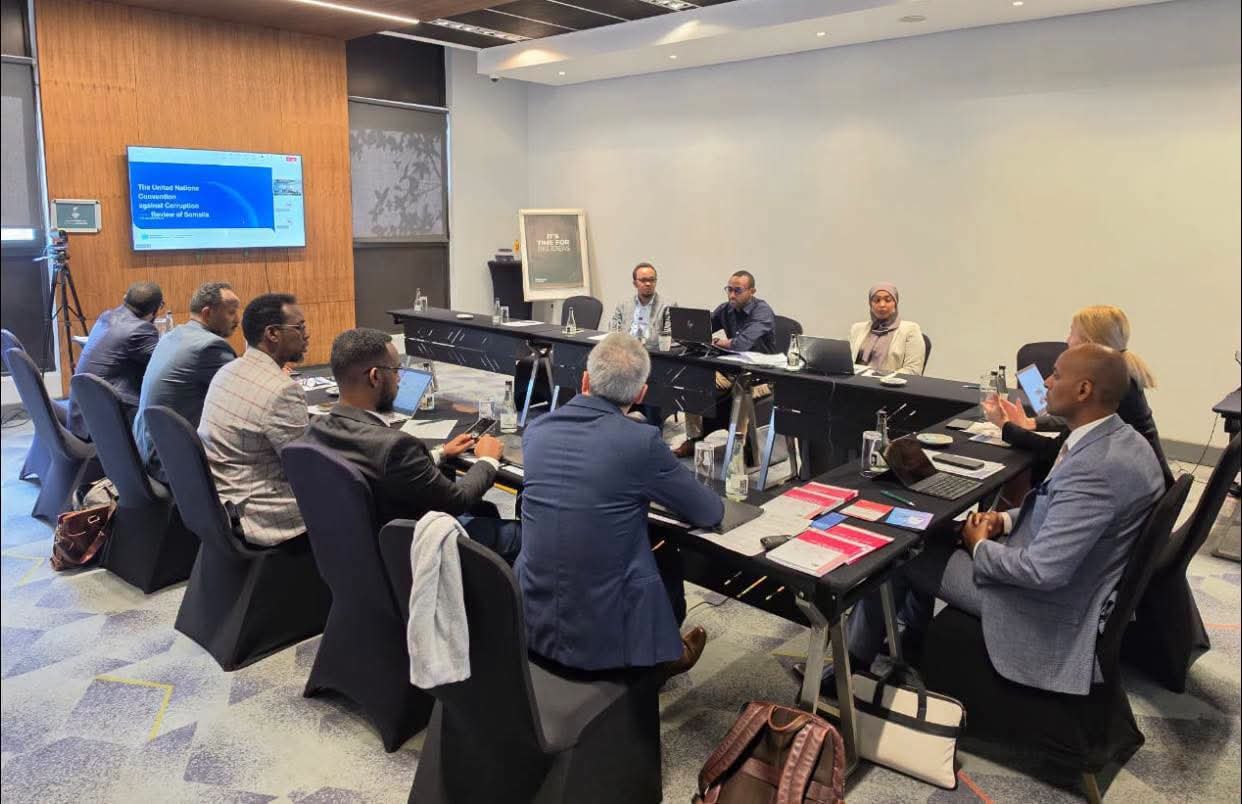
The Permanent Secretary of the Ministry of Justice and Constitutional Affairs, Faisal Adan Hassan, officially opened a knowledge-sharing workshop in Nairobi aimed at preparing for the self-assessment phase of the UNCAC review. The workshop brought together representatives from various Somali government agencies to focus on corruption prevention and asset recovery—areas that the ministry described as central to strengthening efficiency, accountability, and the rule of law.
Somalia has previously adopted a National Anti-Corruption Strategy for 2026-2030, which the Ministry of Justice validated following an End-Term Review and a National Corruption Risk Assessment. That process identified vulnerabilities in public finance, government contracting, public services, and oversight agencies. Yet the gap between strategy and implementation remains vast.
The credibility of Somalia’s anti-corruption efforts has been repeatedly called into question. The Auditor General has accused the judiciary of blocking a $2 million audit, undermining efforts to build credible public financial management. Civil society groups have warned that such obstruction erodes public trust and damages donor confidence.
A Somali lawmaker has described the justice system as being at a breaking point, casting a stark light on corruption, clan-driven favoritism, and the misuse of authority by officials. The lawmaker pressed for urgent reforms rooted in transparency and accountability, calling for leaders willing to confront entrenched interests and for oversight mechanisms capable of resisting corruption.
The Self-Assessment: A Critical Test of Political Will
Permanent Secretary Hassan described the self-assessment as an opportunity to strengthen institutional reform, enhance transparency, and accelerate national efforts to combat corruption. However, the process requires more than technical preparation. It demands a genuine political commitment to confront the systemic corruption that has pervaded Somali institutions for decades.
Opposition leaders have warned of “trickle-down corruption” in the Somali government, arguing that real change requires more than policy announcements. “Corruption is not only about laws—it is about leadership by example,” a prominent opposition figure has said. The warning comes at a time when Somalia is striving to strengthen its democratic institutions amid economic recovery efforts and ongoing security challenges.
Deep-seated corruption and weak oversight have also been exposed in the country’s passport system, with a well-known Somali figure warning that the failures are undermining national security and eroding public trust. The official urged Somali authorities to launch urgent reforms, including stricter verification procedures, enhanced monitoring, and accountability mechanisms to curb insider corruption.
Somalia ranks among the most corrupt countries globally, with Transparency International consistently placing it at the bottom of its Corruption Perception Index. The Auditor General’s own legal battles with the judiciary highlight the challenges of combating corruption in a politically fragmented and clan-driven environment.
Systemic Obstacles to Effective Anti-Corruption Enforcement
While the workshop in Nairobi is a procedural step toward fulfilling Somalia’s obligations under the UNCAC, the broader context raises serious questions about the effectiveness of anti-corruption efforts. The Ministry of Justice and Constitutional Affairs serves as the national focal point for the UNCAC review, coordinating with the UN Office on Drugs and Crime (UNODC). Yet the ministry itself operates within a system where corruption is deeply entrenched.
The United States has raised serious concerns over dirty money from Somalia, noting that corruption within Somali institutions further complicates efforts to combat money laundering and illicit financial flows. Weak governance structures hinder the implementation of effective anti-money laundering and counter-terrorism financing measures.
The UNCAC review process offers a framework for assessing progress, but its impact will depend on whether Somali authorities are willing to act on its findings. Past reviews have often resulted in recommendations that are ignored or only partially implemented. The second cycle of the review provides an opportunity to move beyond rhetoric and demonstrate tangible progress—but skepticism remains high.
A Pattern of Broken Promises
The Federal Government has repeatedly committed to fighting corruption, yet tangible results have been elusive. Corruption allegations have even rocked the selection process for Somalia’s representatives to the East African Legislative Assembly, with critics alleging that the nominated roster favors individuals with close ties to the country’s top leadership.
The United Nations has previously welcomed Somalia’s anti-corruption measures, but such endorsements have often been followed by little meaningful change. The gap between international praise and domestic reality remains wide.
Way Forward
The UNCAC review process is a necessary step in Somalia’s anti-corruption journey, but it cannot substitute for genuine reform. The government’s ability to translate its commitments into action will be the true test of its seriousness. Without meaningful enforcement of anti-corruption laws, protection of whistleblowers, and accountability for high-level offenders, the review process risks becoming another exercise in symbolism. For ordinary Somalis, who bear the brunt of corruption’s consequences, the question remains: will this review lead to real change, or will it be yet another missed opportunity?
Recommended Reading On ftlsomalia.com:
- Somalia Approves New Anti-Corruption Strategy for 2026-2030
- Auditor General Accuses Somali Judiciary of Blocking $2 Million Audit
- A Lawmaker’s Warning: Somalia’s Justice System at a Breaking Point
- Opposition Leader Warns of “Trickle-Down Corruption” in Somali Government
- Somalia’s Auditor-General Summoned by Mogadishu Court
- US Raises Serious Concerns over Dirty Money from Somalia