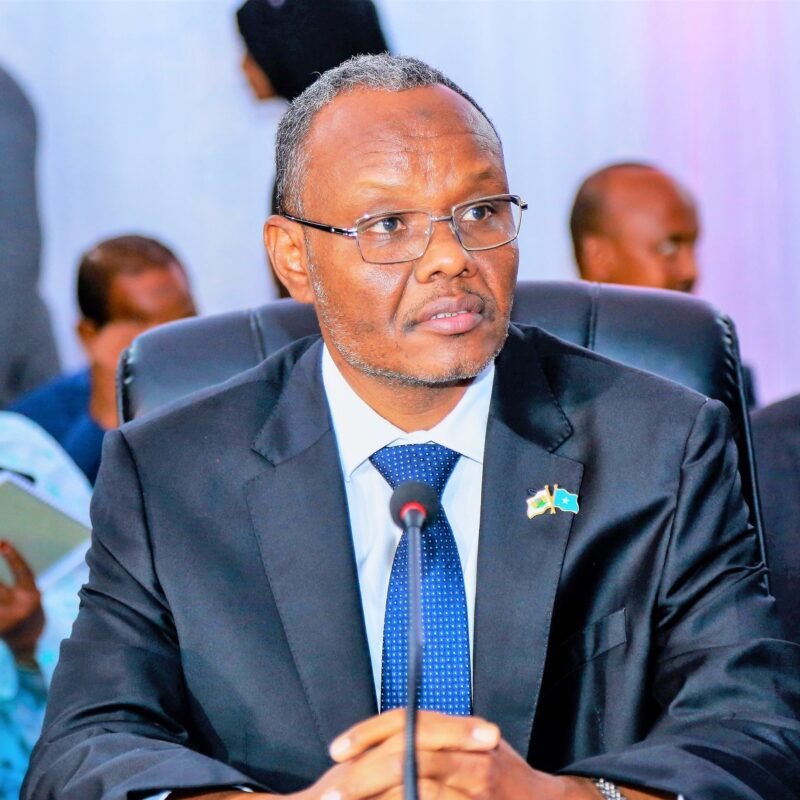
NAIROBI – Somalia’s ousted South West State president, Abdiasis Laftagareen, has forcefully renewed his claim to office, declaring in a wide-ranging interview that he remains the lawful regional leader following his March 28 re-election, which he says complied fully with both federal and regional constitutional frameworks.
Laftagareen secured his re-election on March 28, receiving 66 votes from the regional parliament in a vote that the federal government swiftly denounced as illegal and unconstitutional. Just two days later, heavily armed federal forces entered Baidoa, the regional capital, prompting Laftagareen to resign and depart for Nairobi, Kenya.
In his interview, Laftagareen offered an extensive account of the circumstances surrounding his removal, portraying it as an externally driven power shift rather than a legitimate political transition. He said his decision not to militarily defend Baidoa, despite commanding more than 5,000 troops – was guided by a calculation to avoid devastating civilian casualties in an urban confrontation.
Laftagareen emphasized that fighting inside Baidoa would have inflicted severe harm on residents, framing his restraint as a deliberate effort to safeguard the population. He contrasted that stance with sharp criticism of President Hassan Sheikh Mohamud, whom he accused of showing disregard for civilian lives.
Expanding his criticism, Laftagareen pointed to the demolition of Siinaay market in Mogadishu as an example of policies he said harmed vulnerable communities, including people from the president’s own sub-clan who depended on the market for their livelihoods.
Operational Details of the Baidoa Takeover
Providing operational insight into the takeover, Laftagareen said South West forces had established defensive positions in the Burjed area, about 10 kilometers from Baidoa. He alleged that foreign aerial surveillance identified those fortifications and relayed intelligence to federal troops, enabling them to alter their advance and enter the city through an unexpected route, catching regional forces off guard.
He said that once federal forces entered Baidoa, he ordered his troops to remain in their bases and avoid confrontation, later instructing them to withdraw entirely before his own departure. He described the sequence as a controlled disengagement aimed at preventing escalation and civilian harm.
Throughout the interview, Laftagareen used terminology historically associated with militia groups that operated after Somalia’s state collapse in 1991 when referring to federal forces, underscoring the depth of his grievances against Mogadishu.
Pressure, Mediation, and Political Positioning
He also accused the president of exerting personal pressure to force his compliance, alleging that former custodial corps commander Mahad Abdirahman – whom he identified as both a relative and in-law – was used as an intermediary to compel him to accept terms that included leaving Baidoa, issuing a resignation letter, and endorsing an interim administration.
Addressing his past political positioning, Laftagareen said his cooperation with Mohamud had been pragmatic rather than rooted in alliance, intended to shield South West state from instability even as other regional leaders, including Puntland President Said Abdullahi Deni and Jubaland leader Ahmed Mohamed Islam Madobe, broke with the federal government.
Reports have indicated that Laftagareen is preparing to return and re-establish his administration, with a spokesman stating that efforts were underway to revive what he described as the legitimate regional administration. Forces loyal to the former president have reportedly relocated to the Gedo region, raising concerns among residents and political observers.
Federal Transition Plans
The remarks come as federal authorities move to install parliamentary Speaker Adan Mohamed Nur (Madobe) as South West’s next president through a vote widely viewed as lacking robust competition after key candidates withdrew under political pressure. Madobe, a veteran politician and senior figure in the Justice and Solidarity Party (JSP), was received in Baidoa by Acting Leader Jibril Abdirashid Haji amid a heightened security presence.
President Mohamud has remained stationed in Baidoa alongside cabinet ministers and key federal officials to direct the region’s fragile political transition. The National Independent Electoral and Boundaries Commission (NIEBC) has announced a delay in the submission deadline for candidate applications while confirming the polling date for the upcoming regional elections.
The competing claims to authority highlight mounting uncertainty over South West state’s political trajectory. With Laftagareen retaining support within the region and command over loyal forces, the standoff risks deepening tensions and further straining Somalia’s delicate federal system.