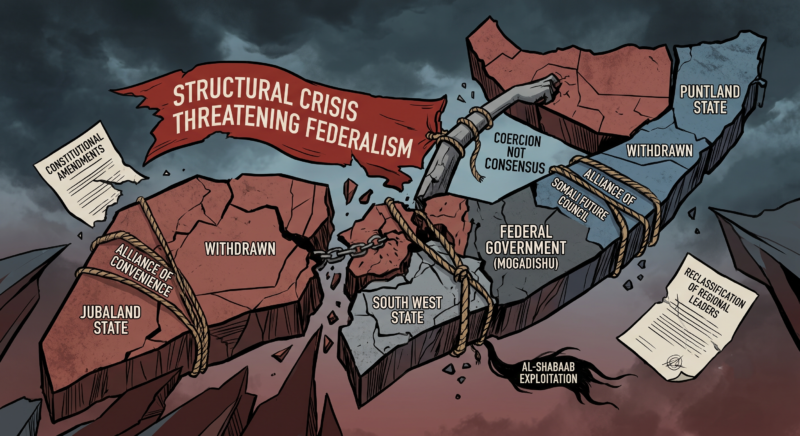
KISMAYO – Jubaland State has issued a formal statement backing Puntland President Said Abdullahi Deni against the Federal Government, as the already fractured relationship between Mogadishu and the country’s federal member states deepens into what analysts now describe as a structural crisis threatening the survival of Somalia’s federal experiment.
The statement, issued by Jubaland’s Information Minister Abdifitah Mohamed Mukhtar, accuses President Hassan Sheikh Mohamud of shifting his political pressure tactics to Puntland after failing in a previous campaign against Jubaland. “The Federal Government of Somalia, after failing in its offensives against Jubaland and after the people of Jubaland defended themselves strongly, has now turned its political ambitions and pressure toward Puntland,” Mukhtar said. He also warned that President Mohamud’s policy, built on coercion rather than consensus, would have political consequences.
An Alliance of Convenience
Jubaland’s support for Puntland is not born of solidarity but of shared grievance. Both states have rejected the federal government’s constitutional amendments, which abolish the title of “president” for regional leaders and reclassify them as “leaders,” a move that regional administrations view as an assault on their autonomy. Jubaland has declared itself an independent government and withdrawn from the country’s federal structure, while Puntland has severed ties with Mogadishu and begun functioning as an autonomous government.
The two states are united in their opposition to the federal government’s push for a one-person, one-vote electoral system, a model they argue requires broader consensus among all federal stakeholders. Both are members of the Somali Future Council, an alliance critical of the federal government’s handling of the electoral process.
A Pattern of Federal Overreach
Jubaland’s accusation that the federal government has shifted its focus to Puntland after failing in Jubaland is consistent with a broader pattern of federal overreach. President Mohamud has warned that the national army can operate anywhere in the country, a statement widely interpreted as a threat of military action against regional states. Defence Minister Ahmed Moallim Fiqi has echoed this threat, stating that “there is no greater crime than a Somali leader announcing they have cut ties with the Somali government.”
The federal government has already demonstrated its willingness to use force against regional states. In March 2026, federal troops entered Baidoa and removed South West State President Abdiasis Laftagareen, who resigned and fled to Nairobi. Puntland President Deni has warned that the South West State operation could be repeated in other regions, urging his forces to remain vigilant.
Jubaland’s statement is a welcome show of solidarity, but it is also a reminder of the limits of regional opposition to the federal government. Jubaland and Puntland have declared themselves independent, but they have not been able to translate their declarations into effective governance. Both states remain heavily dependent on international aid and security assistance, and their ability to resist federal pressure is constrained by their own institutional weaknesses.
The federal government, for its part, has also failed to present a credible alternative. The constitutional amendments have deepened the rift with regional states and have been condemned by the international community, which has called for renewed dialogue. The opposition has argued that the new constitution undermines federalism and concentrates excessive power in the hands of the federal presidency.
A Crisis of Governance
The confrontation between Mogadishu and its regional states is not a dispute over policy; it is a crisis of governance. The 2012 Provisional Constitution established a federal system but left many essential aspects of power-sharing undefined. This vagueness has fueled years of political tension and conflicting interpretations of jurisdiction. The federal government’s push for centralization, combined with regional states’ resistance, has created a governance vacuum that Al-Shabaab has been quick to exploit.
The political instability coincides with mounting criticism against the federal government for neglecting to prepare for elections. Opposition factions and international observers caution that without a consensus on electoral procedures, the nation risks descending into renewed instability. Analysts caution that rifts between Mogadishu, Jubaland, and Puntland might provide opportunities for the militant group to extend its influence, especially in disputed or inadequately administered regions.
Way Forward
Jubaland’s statement in support of Puntland is a symptom of a deeper crisis. The federal government’s refusal to engage in genuine dialogue, combined with regional states’ resistance to centralization, has brought Somalia to the brink of collapse. The international community must pressure both sides to return to negotiations and reach a consensus on the country’s political future. Without such a consensus, Somalia’s federal experiment will continue to unravel, and the gains made in the fight against Al-Shabaab will be lost.
Recommended Reading On ftlsomalia.com
- Federal Government Abolishes ‘President’ Title for FMS Leaders
- Jubbaland Declares Independence From Somalia’s Federal System
- Somali President: National Army Can Operate Anywhere in Country
- Puntland Leader Orders Forces on Alert Over Federal Intervention Fears
- Regional States and Opposition Say New Constitution Undermines Federalism