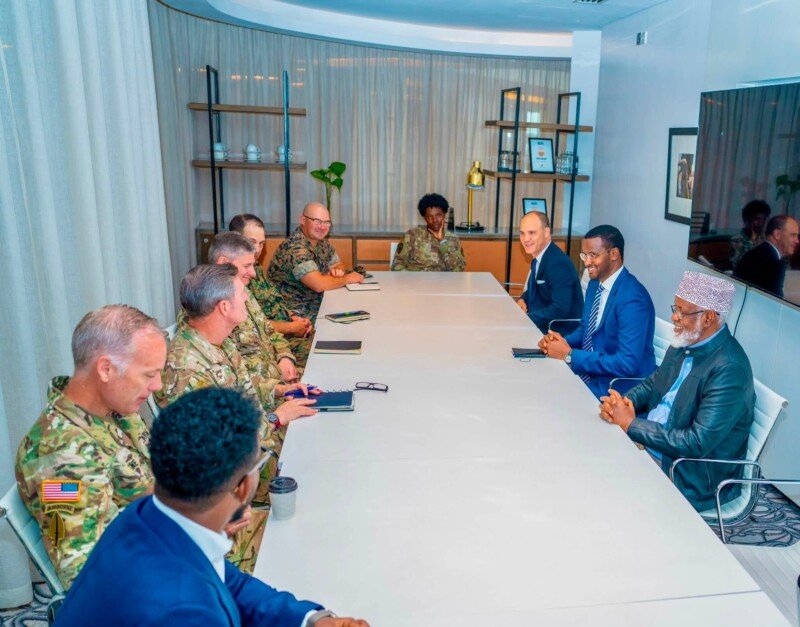
KISMAYO — Jubaland President Ahmed Mohamed Islam (Madobe) has held high-level talks with Maj. Gen. Claude K. Tudor Jr., Commander of Special Operations Command Africa (SOCAFRICA), and his accompanying delegation, in the port city of Kismayo to reinforce strategic military alliances and accelerate joint counter-terrorism operations against Al-Shabaab militants.
The meeting, which took place at the president’s office, focused on strengthening security cooperation, expanding counter-terrorism collaboration, and securing continued international support for operations aimed at stabilising Jubaland. President Madobe stressed the necessity of sustained international backing to maintain the momentum of current offensives and fully secure the region.
Maj. Gen. Tudor commended recent joint military operations carried out by Jubaland State forces and the elite Somali Danab Advanced Infantry Brigade, noting that the coordinated missions had inflicted significant losses on the militants and achieved tangible strategic gains. The discussions also touched on the successful joint defence of the strategic coastal town of Kudhaa, which officials noted has significantly reduced militant presence in critical frontline areas.
President Madobe has previously hosted senior U.S. military commanders, including SOCAFRICA Commander Maj. Gen. Claude K. Tudor Jr., to reinforce strategic military alliances and intensify joint counterterrorism operations. The Jubaland leader has consistently emphasised the importance of international backing to sustain the offensive against Al-Shabaab.
Joint Operations and Tactical Gains
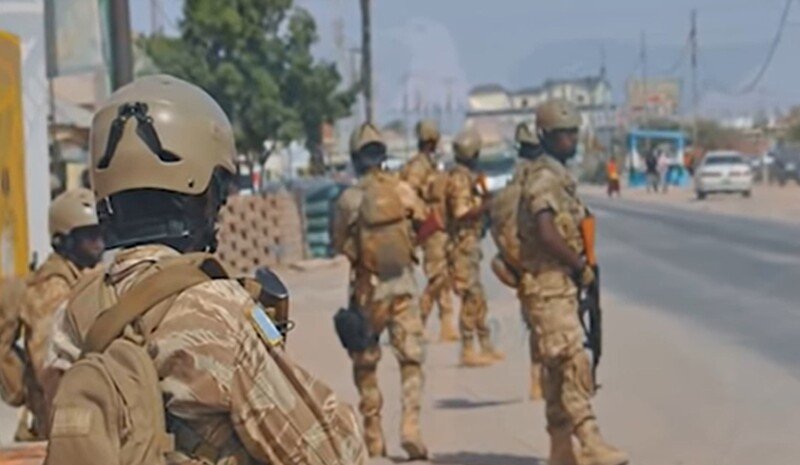
Jubaland’s Darawiish forces and the Danab commandos have been at the forefront of recent military advances in the region. Joint operations have intensified in recent days, with Somali National Army and Jubaland forces carrying out coordinated offensives targeting militant bases and logistical hubs in the Dhasheeg-Waamo area of Lower Juba. Elite U.S.-trained Danab commandos have spearheaded the advance, capturing key positions and securing major access routes.
General Tudor praised the recent joint operations, noting that the collaboration between Jubaland forces and the Danab Brigade has resulted in significant tactical victories and has effectively weakened militant influence in key sectors of the region. The two sides agreed to deepen cooperation between Jubaland authorities and U.S. Africa Command (AFRICOM) to help ensure lasting peace and stability in the territory.
The United States has reaffirmed its support for Somali forces, with U.S. officials recently engaging with regional administrations across Somalia, including Jubaland, Puntland, and Somaliland.
U.S. Engagement and Regional Dynamics
The meeting comes amid a broader pattern of deepening security engagement between Washington and Jubaland. President Madobe has previously held discussions with U.S. Ambassador Richard H. Riley, urging the United States to invest in Somalia’s regional states and reaffirming Jubaland’s pivotal role in national counterterrorism efforts.
Ambassador Riley has also visited Kismayo to discuss bilateral ties, emphasising the importance of national unity in fighting terrorism for the benefit of all Somalis.
The U.S. delegation’s visit also comes as a separate U.S. congressional delegation visited Jubaland in late July 2026, led by Congressman Ronny Jackson, to discuss counterterrorism cooperation and continued American support for regional security operations.
The engagement with Jubaland, however, has not been without controversy. Jubaland has also expressed solidarity with Puntland in its recent confrontation with the Federal Government, highlighting the complex and sometimes fractious dynamics within Somalia’s federal system.
Critical Note
While the meeting between President Madobe and General Tudor underscores the strong security partnership between Jubaland and the United States, the reliance on external military support raises questions about the sustainability of counter-terrorism gains in the absence of robust local governance and institutional capacity. The emphasis on joint operations and tactical victories, while strategically important, must be complemented by efforts to address the underlying drivers of instability, including weak governance, corruption, and clan-based grievances that Al-Shabaab continues to exploit. Furthermore, the U.S. engagement with regional administrations, while pragmatic, risks further fragmenting an already fractured federal system, as seen in the recent tensions between Jubaland and Puntland against the Federal Government. The international community, while supporting counter-terrorism efforts, must also press for inclusive governance and accountability to ensure that military gains translate into lasting peace and stability for the people of Jubaland and Somalia as a whole.
Recommended Reading On ftlsomalia.com
- Jubaland President Meets with U.S. Military Officials to Bolster War on Al-Shabaab
- Joint Operations Intensify Against Al-Shabaab in Jubaland
- Jubaland President Meets U.S. Congressional Delegation in Kismayo
- U.S. Reaffirms Support for Somali Forces as Army Chief and AFRICOM General Hold Talks
- PM Hamza Praises Danab and Jubaland Forces for Kudhaa Defense
- AFRICOM Commander Visits Jubbaland Leader