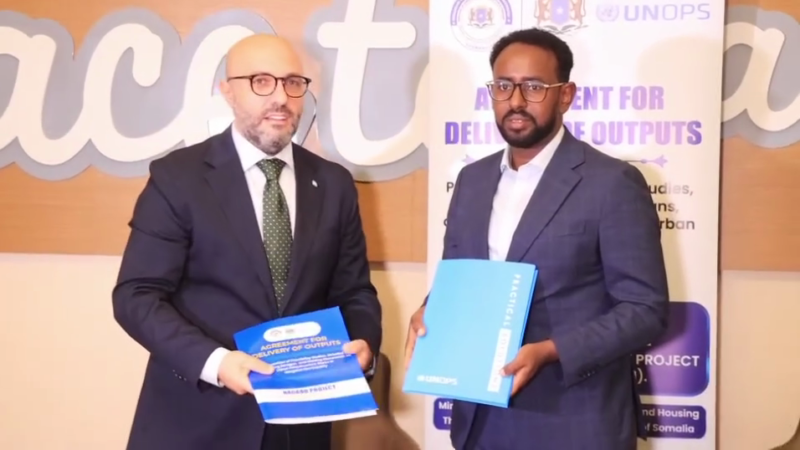
MOGADISHU — The Federal Government of Somalia has signed a major infrastructure project to construct a 45-kilometre road in Hargeisa, the capital of the Woqooyi Galbeed region, as part of a broader $245 million development programme aimed at rebuilding roads, bridges, and drainage systems across the country.
Public Works, Reconstruction and Housing Minister Ayub Ismail announced the project during a press briefing in Mogadishu, after signing the agreement. He described the initiative as a significant step in the government’s efforts to extend reconstruction and development to all regions of Somalia.
“Reconstruction efforts are of great importance, and we will ensure they reach all regions of the country through the construction of modern roads, bridges, and drainage systems,” Minister Ismail said.
The 45-kilometre road in Hargeisa is one of several infrastructure projects being implemented under the federal government’s development agenda. The government has previously announced a sweeping highway plan under the “Nagaad Projects”, which includes roadworks planned for Hargeisa and other regions, reflecting a coordinated effort to standardize transport networks across federal member states.
Scope of the Infrastructure Programme
Minister Ismail confirmed that the total value of the infrastructure projects being implemented across the country stands at $245 million. The programme includes the construction of new roads, rehabilitation of existing transport networks, and the development of bridges and drainage systems to address flooding and improve urban mobility.
The projects are part of the federal government’s broader strategy to improve connectivity, stimulate economic activity, and enhance public services across Somalia. International partners, including European nations, have also approved infrastructure agreements covering road reconstruction and water supply projects in the region.
Taiwan has previously accepted a request from Somaliland for the construction of an airport road in Hargeisa, enhancing accessibility and boosting economic activities around the airport area.
Political Context and Implementation Challenges
The announcement of the Hargeisa road project comes amid ongoing political tensions between the Federal Government and the Somaliland administration, which claims the region as part of its self-declared territory. The federal government’s decision to fund and implement infrastructure projects in Hargeisa is likely to be viewed by Somaliland authorities as an assertion of federal authority over the region.
Despite these political complexities, the federal government has emphasised its commitment to delivering development projects to all regions of Somalia. The Ministry of Public Works has been actively engaged in advancing infrastructure projects across the country, including road rehabilitation in Beledweyne and other strategic locations.
The Ministry has also enhanced cooperation with international partners on reconstruction and resettlement, accelerating infrastructure projects and strengthening the national framework for the resettlement of internally displaced persons.
Critical Note
While the signing of the 45-kilometre road project in Hargeisa represents a significant commitment to infrastructure development, the overtly implementation of such projects in contested territories poses considerable challenges. The political status of Hargeisa, which is administered by the self-declared Republic of Somaliland, means that federal infrastructure projects in the region may face opposition from local authorities and could complicate already tense relations between Mogadishu and Hargeisa. Furthermore, the $245 million infrastructure programme, while ambitious, will require effective coordination between federal and regional authorities, transparent procurement processes, and robust oversight to ensure that funds are used efficiently and that projects are completed on time. Previous infrastructure initiatives in Somalia have been plagued by delays, cost overruns, and allegations of corruption. The government would be well advised to ensure that the implementation of these projects is accompanied by clear accountability mechanisms and that the benefits reach local communities. The international community, which has supported Somalia’s reconstruction efforts, must also press for transparency and good governance in the use of development funds, lest these projects become another example of unrealised potential in a country that has long suffered from infrastructure deficits.
Recommended Reading On ftlsomalia.com
- Somalia Unveils Bold Highway Plan to Unite Regions and Revive Trade
- Public Works Minister Launches Major Commercial and Residential Development in Mogadishu
- Somalia’s Public Works Ministry and IOM Enhance Cooperation on Reconstruction and Resettlement
- Taiwan to Construct an Airport Road in Hargeisa
- Three EU Countries Approve Infrastructural Agreements with Somaliland
- Somalia Pursues Gulf Support for Urban Reconstruction