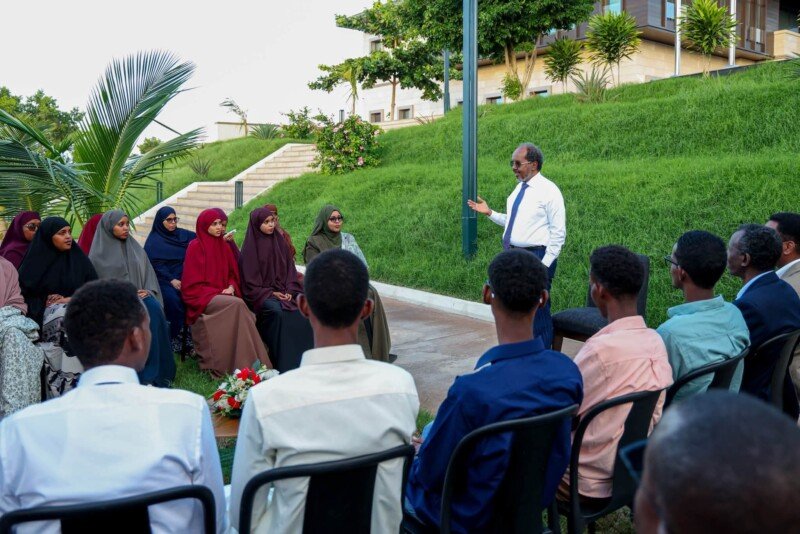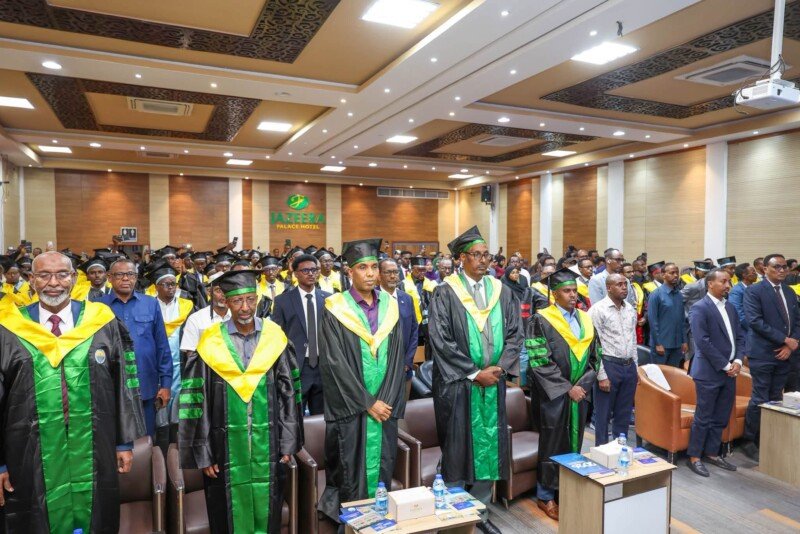
MOGADISHU — Prime Minister Hamza Abdi Barre has addressed a graduation ceremony at Mogadishu University, congratulating students on their achievements while challenging them to ensure their education meets the demands of Somalia’s labour market.
Speaking at the event, the Prime Minister praised the graduates, their teachers, and families, emphasizing that the knowledge they have acquired is essential for the nation’s development. He stressed that the government has invested significantly in improving education at all levels, recognizing it as a cornerstone of national progress.
“It is a question whether what we have studied and our market are aligned and responding to market needs, or whether it is just a tradition,” Prime Minister Hamza said. “A person who has studied is expected to use their knowledge to solve the problems existing in the market.”
The Prime Minister also highlighted the government’s focus on creating employment opportunities for educated youth within the country, reducing reliance on foreign workers in state-building efforts.
Addressing the Skills Mismatch in Somalia
The Prime Minister’s remarks reflect a growing concern about the alignment between higher education and labour market needs. Youth unemployment is a persistent challenge, with Somalia’s rate standing at 34.23% in 2025. The Minister of Labour and Social Affairs has presented a National Youth Employment Strategy at the Global Labor Market Conference in Saudi Arabia, emphasizing the government’s commitment to implementing substantial job creation programs and vocational training initiatives to equip young people with skills for today’s technology-driven economy.
Efforts to improve educational quality and global competitiveness have included the introduction of Oxford International examinations at the Turkish Maarif Foundation School in Mogadishu, a milestone that opens international academic pathways for Somali students. The accreditation allows students to sit for globally standardized tests locally, reducing the cost and difficulty of seeking such certification abroad.
The Education Minister has also launched a Women’s Scholarship and Empowerment Program in Las Anod, aiming to enhance educational opportunities for women and girls, particularly in regions affected by conflict and instability. This initiative aligns with broader educational reforms, including the provision of free education and the training of thousands of teachers.
The government has adopted a “No Child Left Behind” approach in the education sector, with the Ministry of Education emphasizing that despite limited resources, the government is committed to ensuring that no child is left behind. The ministry’s strategies focus on teacher recruitment and training, rebuilding and renovating schools, and engaging local communities to support education initiatives.
The World Bank has projected Somalia’s economic growth to slow to 2.8 percent this year, constrained by continued aid reductions, climate variability, and limited productive capacity. In this context, ensuring that graduates have the skills needed by the economy is critical for job creation and sustainable development.
International Engagement and Economic Outlook
Somalia’s engagement with the international community has included efforts to strengthen its economic and educational ties. The government has been working to create opportunities for students through scholarship programs to promote equal access to education, especially for those from disadvantaged backgrounds.
Collaboration with international partners, NGOs, and private entities to mobilize resources and implement effective education programs has been emphasized as a key priority. The Ministry of Education has also stressed the importance of establishing robust systems to monitor, evaluate, and enhance education quality and outcomes across the country.
Prime Minister Hamza’s own background as an educator, including his role as a senior lecturer at Mogadishu University and co-founder of Kismayo University, lends weight to his call for aligning education with market needs.
Critical Note
The Prime Minister’s call to align education with market needs is a welcome recognition of a critical challenge facing Somalia’s education system. The question of whether graduates possess the skills required by employers is not unique to Somalia, but the country’s limited economic base and high unemployment make it particularly urgent.
However, the government’s ability to address this challenge will depend on its capacity to implement meaningful reforms in the education sector and create an enabling environment for job creation. The emphasis on reducing reliance on foreign workers is understandable, but it must be accompanied by genuine investment in training and infrastructure.
The gap between the rhetoric of reform and the reality of implementation remains a persistent concern. The Prime Minister’s comments are a positive signal, but they must be followed by concrete actions to ensure that Somalia’s education system prepares graduates for the demands of the modern economy.
Recommended Reading On ftlsomalia.com
- Somali Labor Minister Presents National Youth Employment Strategy at Global Labor Conference
- Somali Students Gain Global Access as Turkish-Backed School Launches Oxford Exams
- Somalia’s Education Minister Launches Women’s Scholarship and Empowerment Program
- Somalia Adopts a “No Child Left Behind” Approach in Education Sector