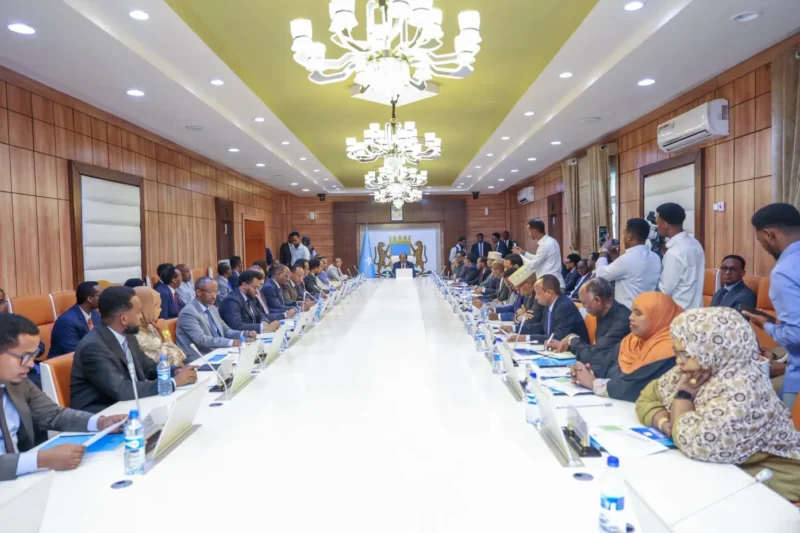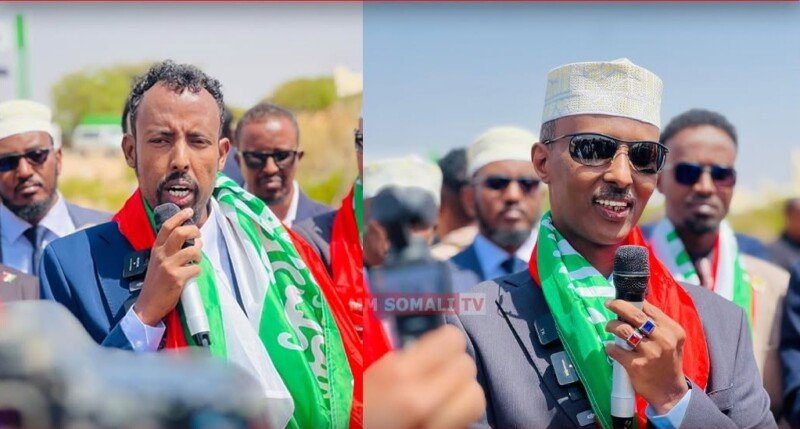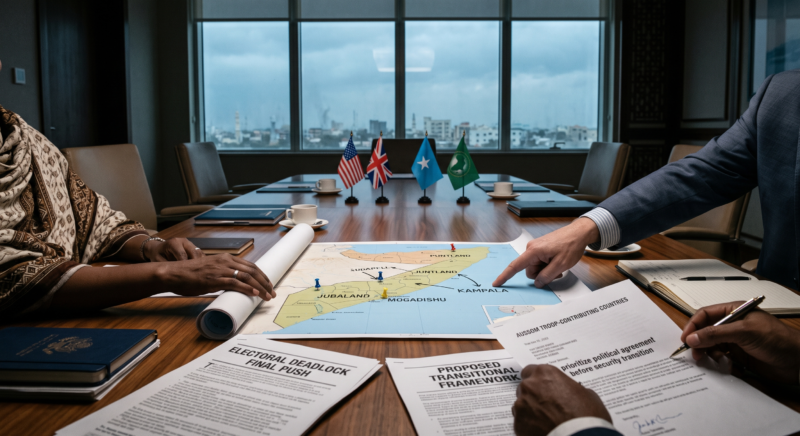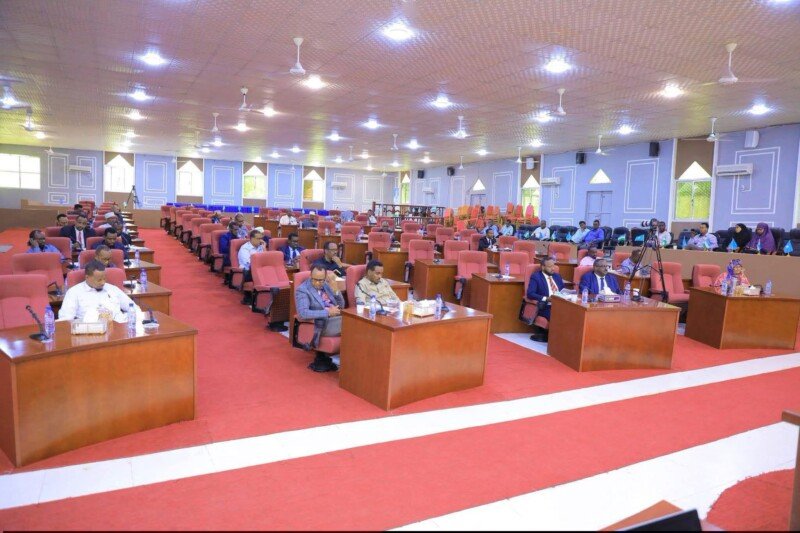
GAROWE – The Puntland parliament has formally opened debate on a package of constitutional amendments that would fundamentally alter the region’s governance structure, including a proposal to abolish direct presidential elections in favor of a parliamentary system. The move, which comes as Puntland has fiercely rejected federal constitutional amendments as an “illegal power grab,” raises uncomfortable questions about the region’s commitment to the very democratic principles it claims to defend.
The amendments under consideration include Articles 37, 41, 44, 47, 74, 81, 90, 113 and 126, covering political, judicial and social affairs. The most significant proposal would shift Puntland from a direct presidential system to a parliamentary model, where the 66-member parliament would elect the president, vice president and parliamentary speaker, rather than citizens voting directly. The government has proposed that local council and parliamentary elections be held through a one-person, one-vote system, but the president would no longer be directly elected by the people.
Article 79: The Term Limit Question
Perhaps the most sensitive provision is Article 79, which limits the president to two consecutive terms and would prevent incumbent President Said Abdullahi Deni from seeking re-election. Debate on this article has been deferred to a later session, but it is already generating intense political speculation. Deni, who has been in power since 2019, has not publicly stated whether he intends to seek a third term, but the provision’s existence suggests a concerted effort to curtail executive power or, conversely, an attempt to preempt a controversial extension.
The timing of the debate is striking. Puntland has repeatedly condemned the federal government’s constitutional amendments, which extended the presidential and parliamentary terms from four to five years, as “illegal” and a “power grab”. Puntland officials have argued that President Hassan Sheikh Mohamud’s term expired on May 15, 2026, and that his continued tenure is unconstitutional. Yet Puntland is now engaged in its own constitutional revision process, raising questions about consistency and the selective application of constitutional principles.
A Pattern of Hypocrisy
The contrast between Puntland’s criticism of federal constitutional amendments and its own revision process is difficult to ignore. Deni has accused President Mohamud of “breaking the country apart” and has refused to recognize his administration. Puntland has also engaged in direct talks with international partners, bypassing Mogadishu. The constitutional debate in Garowe is therefore not occurring in a vacuum; it is part of a broader struggle over the future of Somalia’s federal system.
Puntland has accused the federal government of enacting changes “without broad political consensus” and undermining the federal system. Yet the current amendments are being debated by a parliament whose mandate has itself been a subject of controversy, with some legislators questioning the legitimacy of the process.
The proposal to abolish direct presidential elections is particularly ironic. Puntland has positioned itself as a defender of democratic principles, rejecting federal electoral reforms as “predetermined” and “undemocratic”. Yet the proposed shift to a parliamentary system would remove the most direct expression of popular will from the region’s governance structure. Critics are likely to question whether this is a genuine reform or a strategic move to consolidate power within the political elite.
A Calculated Move
The amendments come at a time of deepening political tensions between Puntland and the federal government. Puntland has flagged Somalia’s constitutional crisis and called for emergency dialogue, warning that the country is experiencing a constitutional vacuum. The federal parliament’s mandate expired on April 14, 2026, and the presidential term concluded on May 15, 2026, according to Puntland’s interpretation.
By moving toward a parliamentary system, Puntland is aligning itself more closely with the federal structure it criticizes. The federal government has also proposed a parliamentary model, albeit with different details. The convergence suggests that both sides may be converging on a similar vision of governance, even as they remain locked in political confrontation. The amendments have already drawn criticism from opposition figures within Puntland, who argue that the process lacks transparency and could undermine democratic gains.
Way Forward
The Puntland constitutional debate is a significant moment for the region, with implications for its political future and its relationship with the federal government. The amendments, if passed, would fundamentally alter the balance of power in Garowe, shifting authority from the electorate to the parliamentary elite. The deferral of Article 79 suggests that the most contentious issues have yet to be resolved, and the political maneuvering is likely to intensify in the coming weeks.
For the people of Puntland, the debate raises fundamental questions about the nature of democracy and representation. The shift from direct to indirect elections would represent a significant retreat from the principle of popular sovereignty, even as the region’s leaders continue to decry federal overreach. As one observer noted, “the amendments risk being seen not as a genuine reform, but as a calculated move to consolidate power within the political elite.” The coming weeks will determine whether Puntland’s constitutional revision strengthens democratic institutions or undermines them.
Recommended Reading On ftlsomalia.com
- Puntland Accuses Federal Government of Creating Constitutional Vacuum
- Puntland Legislators Approve Controversial Amendments to the Region’s Constitution
- Puntland Flags Somalia’s Constitutional Crisis, Calls for Emergency Dialogue
- Puntland Leader Warns Federal Government Will Cease to Exist After May 15
- Deni Accuses Hassan Sheikh of Breaking the Country Apart