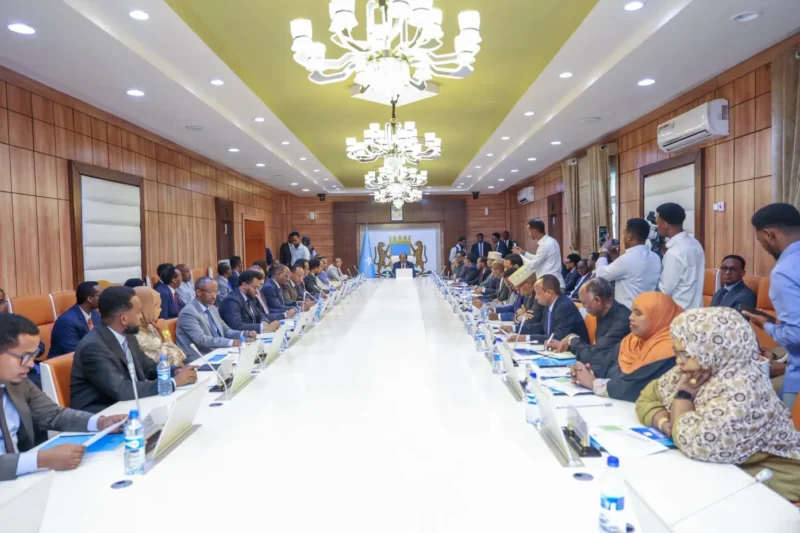
MOGADISHU – President Hassan Sheikh Mohamud has chaired a Cabinet meeting in Mogadishu in the absence of Prime Minister Hamza Abdi Barre and his deputy, Salah Ahmed Jama, in a move that has raised questions about the leadership dynamics within the federal government at a time when the country is navigating multiple political and security transitions.
The meeting, which took place on Thursday (today), covered a range of issues including security, the ongoing one-person, one-vote elections in Galmudug, and democratic governance. The Cabinet was also briefed on the latest military operations against Khawaarij militants, with officials presenting reports on recent gains and the destruction of militant positions.
A Meeting Without the Prime Minister
The absence of Prime Minister Barre and Deputy Prime Minister Jama from the meeting is notable, coming at a time when the government is facing significant challenges on multiple fronts. The Prime Minister has been actively involved in recent diplomatic efforts, including defending the federal government’s right to pay and promote Somali soldiers who had been neglected by previous administrations. He also recently commemorated the second anniversary of his accession to office by highlighting the government’s achievements, including the liberation of 215 towns and villages from Al-Shabaab.
The absence of the Prime Minister and his deputy from a key Cabinet meeting suggests either a deliberate delegation of authority or a potential rift within the executive branch. The President’s decision to chair the meeting himself, rather than appointing an acting chair, underscores his direct involvement in the government’s day-to-day operations, even as the Prime Minister and his deputy are absent from Mogadishu.
Cabinet Approves New Legislation
During the meeting, the Cabinet approved two key pieces of legislation. The first is the Business Registration and Licensing Bill, which aims to formalize the business sector and improve the regulatory environment for private enterprise. The second is a Memorandum of Understanding between the Office of Religious Affairs of the Turkish Presidency and Somalia’s Ministry of Endowments and Islamic Affairs, which seeks to enhance cooperation in the field of religious affairs.
The Cabinet also reaffirmed the government’s commitment to strengthening security, stability, economic growth, and the implementation of development plans. It called on the Somali public to continue cooperating with government institutions to achieve a peaceful, united, and prosperous Somalia.
A Critical Moment for Somalia
The Cabinet meeting comes at a critical moment for Somalia. Galmudug voters have headed to the polls in historic one-person, one-vote elections, marking a significant step toward democratic governance in the region. Deputy Prime Minister Salah Ahmed Jama had earlier visited polling stations in Galkayo to monitor the process, underscoring the government’s commitment to democratic reforms.
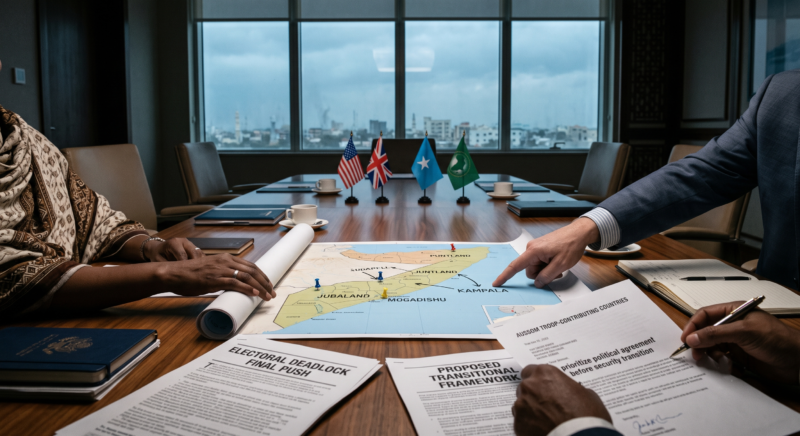
The government is also preparing for the Kampala summit on the future of the African Union Support and Stabilization Mission in Somalia (AUSSOM), where troop-contributing countries, defence ministers and military chiefs will decide the fate of a mission that has become the cornerstone of Somalia’s counter-terrorism efforts. A US delegation has toured Jubaland, Puntland and Somaliland ahead of the summit, signalling Washington’s willingness to engage directly with regional administrations.
Way Forward
The Cabinet meeting chaired by President Mohamud in the absence of the Prime Minister and his deputy reflects the government’s efforts to maintain momentum on its policy agenda despite the political dynamics within the executive branch. The approval of new legislation and the focus on security and democratic reforms are welcome steps, but the government must also address the underlying governance challenges that continue to undermine public confidence. The success of the government’s agenda will ultimately depend on its ability to deliver tangible results for the Somali people, rather than merely managing political appearances.
Recommended Reading On ftlsomalia.com
- Prime Minister Hamza Barre: Somali National Army Has Right to Pay and Promote Its Soldiers
- SNA Liberated 215 Towns and Villages from Al-Shabaab, Says Barre
- Galmudug Elections Underway as 300 Polling Stations Open Across 11 Districts
- Deputy Prime Minister Inspects Polling Stations as Galmudug Holds Historic One-Person, One-Vote Elections
- As AUSSOM Teeters on the Brink, US Delegation Visits Regional Administrations Ahead of Kampala Summit
- Somalia Faces Critical Security Test as AUSSOM Mission Nears Collapse Without UN Support