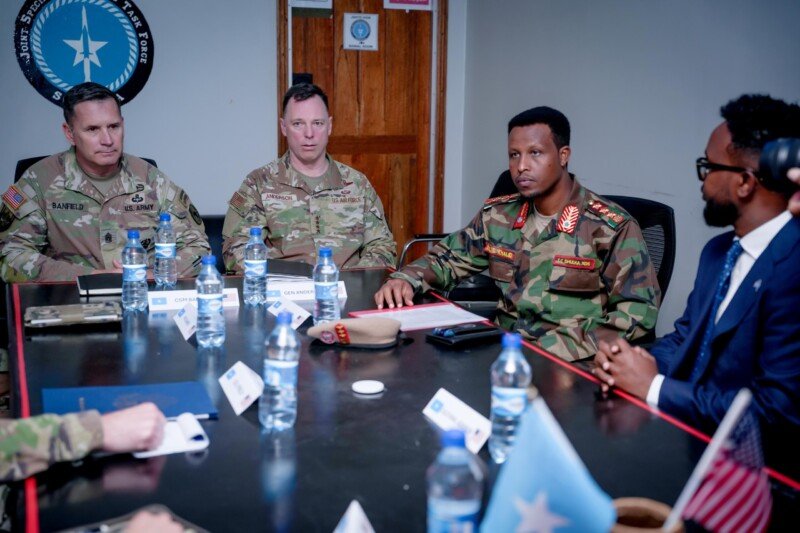
MOGADISHU – The acting Commander of the Somali National Army and Ground Forces Commander, Brigadier General Sahal Abdullahi Omar, has held talks with the Commander of U.S. Africa Command (AFRICOM), General Dagvin R.M. Anderson, in Mogadishu, as the two sides discussed strengthening counter-terrorism cooperation and accelerating coordination between Somali forces and their American counterparts.
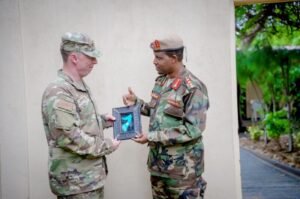
The meeting, which took place at the General Dhagabadan Military Camp, focused on supporting ongoing operations against Khawaarij militants and enhancing joint operational planning. General Anderson reaffirmed the United States’ commitment to continuing its support for the Somali National Army, particularly in the areas of counter-terrorism operations and capacity building.
A Partnership Under Strain
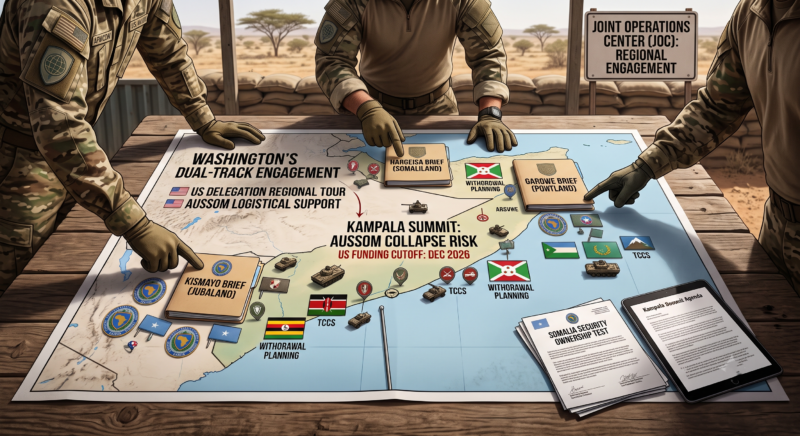
The meeting comes at a critical moment in U.S.-Somalia security relations. The United States has contributed nearly $2 billion to the UN support mission in Somalia but has grown increasingly frustrated with what it views as insufficient progress by Somali leaders in assuming responsibility for their own security. Washington has notified the African Union that it will no longer finance the UN Support Office in Somalia (UNSOS) beyond December 2026, a decision that threatens to pull the logistical rug from under the 12,000-strong African Union Support and Stabilization Mission in Somalia (AUSSOM). Without UNSOS, AUSSOM would lose critical logistical support, including food, water, fuel, transportation, medical services and casualty evacuation.
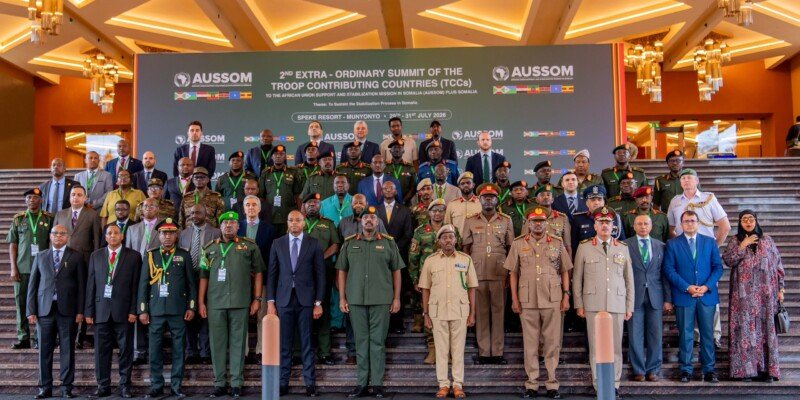
The timing of General Anderson’s visit is significant. It comes just days before the Kampala summit on the future of AUSSOM, where troop-contributing countries, defence ministers and military chiefs will decide the fate of a mission that has become the cornerstone of Somalia’s counter-terrorism efforts. AUSSOM has reaffirmed its dedication to Somalia’s peacebuilding and stabilisation initiatives, but the mission’s ability to deliver on its mandate is increasingly constrained by funding shortfalls. The US delegation’s tour of Jubaland, Puntland and Somaliland ahead of the summit has signalled Washington’s willingness to engage directly with regional administrations, a move that risks further fragmenting an already fractured federal system.
A Pattern of Engagement Without Accountability
The meeting between General Omar and General Anderson underscores the ongoing US commitment to supporting Somali forces, but it also raises questions about the transparency and accountability of that engagement. While US officials have framed their military cooperation as essential to counter-terrorism efforts, the lack of parliamentary oversight and public transparency in Somalia’s international security agreements has been a recurring concern.
The US has previously engaged with Puntland and Somaliland as “administrations within Somalia,” a formulation that allows military-to-military engagement outside formal State Department channels. AFRICOM Commander General Dagvin Anderson completed an unprecedented high-level visit to Somaliland and Puntland, labeling them “administrations within Somalia” and offering them military diplomatic engagement unavailable via formal U.S. State Department routes.
Preparing for a Major Offensive
The discussions also focused on preparations for a major offensive against Khawaarij militants, which the Somali government has been planning for months. The offensive is expected to involve the Somali National Army, regional forces, and allied local fighters, with US support playing a critical role in logistics, intelligence, and air operations.
General Anderson’s visit follows a series of high-level engagements between Somali and US military officials. The Somali Army Chief and U.S. officials have held discussions on security cooperation, underscoring the ongoing bilateral engagement even as Washington signals frustration with Mogadishu’s failure to present a credible plan for the security transition.
Way Forward
The meeting between General Omar and General Anderson reflects the ongoing US commitment to supporting Somali forces, but it also highlights the contradictions in Washington’s approach. While the US continues to provide military support, it is simultaneously withdrawing financial support for the UN mission that sustains Somali forces. The European Union and United States have together funneled more than $7 billion into Somalia’s security sector since 2007, yet nearly two decades later, Somalia remains reliant on international forces, with donor nations increasingly questioning the long-term results of their investment. The Kampala summit will be a test of whether Somalia can persuade its international partners to continue funding a mission that has been underway for nearly two decades.
For the Somali government, the challenge is to present a credible plan for the security transition, address the corruption and governance failures that have undermined donor confidence, and engage with regional administrations in a spirit of genuine partnership rather than confrontation. Without these steps, the meeting between General Omar and General Anderson will be remembered not as a moment of strengthened cooperation, but as another missed opportunity.
Recommended Reading On ftlsomalia.com
- Somali Army Chief, U.S. Official Discuss Security Cooperation
- Ethiopia, Puntland, Somaliland Leaders Discuss Security with AFRICOM Commander
- US Faces Critical Choice on Somalia Security Assistance as AUSSOM Mandate Nears Expiry
- Somalia Faces Critical Security Test as AUSSOM Mission Nears Collapse
- AUSSOM Reaffirms Support for Somalia’s Peace
- Donor Fatigue Grows as $7B Security Investment in Somalia Faces Scrutiny