DOHA — The Federal Government of Somalia and Qatar have discussed cooperation on the establishment of the National Academy of Somalia, a planned centre for developing leadership and improving the quality of civil service, as Prime Minister Hamza Abdi Barre leads an official delegation to Doha.
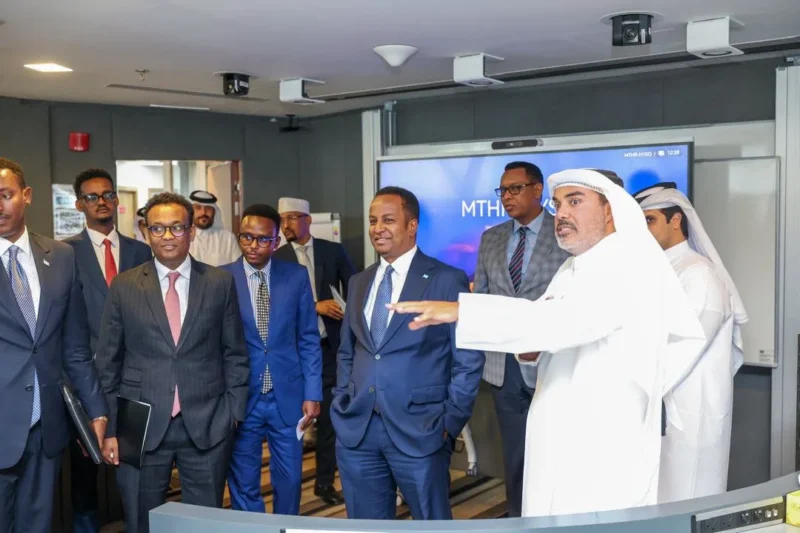
Foreign Minister Abdisalam Abdi Ali (Dhaye) held a meeting at the Qatar Leadership Centre in Doha with officials from the centre, focusing on Qatar’s potential involvement in implementing the academy. The two sides agreed to sign a Memorandum of Understanding in the near future outlining cooperation on the establishment and development of the National Academy of Somalia.
The Foreign Minister was accompanied by the Permanent Secretary of the Prime Minister’s Office, Kamal Dahir Guutaale, and the Senior Advisor to the Prime Minister, Dr. Ahmednur Uleex, who were part of the discussions on the matter. The Qatar Leadership Centre, based in Doha, specialises in leadership development, training officials, and enhancing the capacity of government institutions, offering programmes for senior leaders, civil servants, and emerging leaders.
The cooperation with the centre is expected to contribute to the establishment of the National Academy of Somalia, designed to develop leadership skills, public administration, and the capacity of government employees. The initiative forms part of Somalia’s broader national transformation agenda, with a focus on strengthening public institutions and developing leadership capabilities.
The National Academy discussions are part of Prime Minister Hamza Abdi Barre’s wider working visit to Qatar, which is focused on strengthening bilateral relations and reviewing progress on previously signed agreements between the two countries. The Prime Minister met with the Emir of Qatar to discuss bilateral cooperation and regional issues of mutual concern, with the Qatari Emir reaffirming his country’s commitment to supporting Somalia’s security, stability, and development.
Deepening Somalia-Qatar Relations
The bilateral relationship has deepened significantly in recent years. In January 2026, Somalia and Qatar signed a Defence Cooperation Agreement in Doha, aimed at strengthening military ties and security collaboration between the two countries. The agreement, described as “historic” by Defence Minister Ahmed Moallim Fiqi, focuses on military training, the exchange of expertise, the development of defence capabilities, and enhanced security cooperation. The pact came just days after Somalia terminated all bilateral agreements with the United Arab Emirates, signalling a strategic pivot toward Doha and Ankara.
Prime Minister Hamza Abdi Barre has previously hosted Qatar’s Ambassador to Somalia, Dr. Abdullah bin Salem Al‑Nuaimi, for high-level talks centred on reinforcing bilateral relations and exploring avenues for expanded cooperation across multiple sectors. The Prime Minister briefed the ambassador on the federal government’s ongoing initiatives in security, political development, and national reconstruction, while expressing gratitude to Qatar for its sustained support in infrastructure development, humanitarian assistance, and initiatives aimed at preserving the unity and stability of Somalia.
The two countries have established a joint committee and finalised strategic agreements, with the inaugural session jointly led by Somalia’s Foreign Minister Abdisalam Abdi Ali and Qatar’s Minister of State for Foreign Affairs, Soltan bin Saad Al-Muraikhi. The high-level discussions concluded with the signing of four comprehensive agreements targeting development in cultural, financial, youth, and agricultural sectors. The cultural agreement includes collaboration on library and historical archive management, cultural festivals, and art exhibitions, while the customs cooperation agreement focuses on improving customs law enforcement and addressing smuggling.
Somalia’s Minister of Public Works, Reconstruction and Housing, Ayub Ismail Yusuf, held bilateral talks with his Qatari counterpart on the sidelines of the 13th World Urban Forum in Baku, focusing on cooperation in urban development, housing, and infrastructure projects. The discussions underscore the expanding partnership between the two countries, which has deepened across multiple sectors in recent years.
Qatar has also provided support in the energy sector. Qatar’s Minister of State for Energy Affairs met with Somalia’s Minister of Energy and Water Resources in Doha to discuss enhancing bilateral collaboration in the energy sector.
In February 2026, a Qatari Emiri Air Force C-17A Globemaster III strategic airlift aircraft arrived in Mogadishu, indicating an ongoing expansion of military logistics in the Horn of Africa as regional alliances shift. The arrival coincided with a period of enhanced security collaboration between Mogadishu, Doha, and Ankara, with the flight underscoring a developing three-way security alliance as the Federal Government adjusts its foreign policy approach.
President Hassan Sheikh Mohamud visited Doha in February 2026 for high-level talks focused on strengthening bilateral relations in security, economic development, and political stability. The visit formed part of a wider diplomatic initiative to expand international partnerships following Somalia’s termination of agreements with the UAE.
President Mohamud has also engaged in high-level telephone discussions with Qatar’s Emir, with the Emir reaffirming Qatar’s full support for Somalia’s legitimate institutions and its commitment to enhancing the country’s security and stability. Doha has emerged as one of Mogadishu’s most critical partners since diplomatic relations between Somalia and the UAE deteriorated.
Prime Minister Barre has also hosted the Qatari ambassador in Mogadishu for high-level talks, with the meeting focusing on expanding collaboration across political, economic, and development fronts. Somalia has long considered Qatar one of its closest strategic partners in the Gulf, particularly in infrastructure development, humanitarian support, and institutional capacity-building.
The Clingendael Connection
It is worth noting that Somali civil servants and peace actors have previously received high-quality training from the Clingendael Institute, a world-renowned diplomatic academy based in the Netherlands that has trained diplomats and civil servants from over 140 countries, including Turkey and Qatar. In October 2025, Clingendael delivered its first humanitarian negotiation training in Mogadishu, working with 21 humanitarian professionals delivering assistance across Somalia. The training included practical simulations based on real negotiation challenges, including negotiating with armed groups about a peace proposal and working within a consortium of NGOs.
In July 2025, UNDP Somalia, Somalia Stability Fund, partnered with the Clingendael Institute to deliver advanced training on mediation and negotiation for 24 members of the Somali Women Peace Networks, equipping them with hands-on tools to strengthen their role in peacebuilding and community dispute resolution across Somalia.
Given that Somalia has had direct access to one of the world’s premier diplomatic training institutes, the same institute that trains officials from Turkey and Qatar, the decision to pursue civil service training through Qatar rather than directly through Clingendael raises questions about strategic priorities. While Clingendael’s programmes have provided Somali officials with direct, world-class training on negotiation, mediation, and public administration skills, the shift toward Qatar appears to be driven primarily by financial considerations. Somalia has struggled to secure sustained funding from international partners to continue accessing Clingendael’s expertise directly, and Qatar has stepped in to fill this gap.
Critical Note
The agreement to establish the National Academy of Somalia with Qatar’s support represents a pragmatic approach to capacity building, given the financial constraints that have limited Somalia’s ability to continue accessing Clingendael’s world-class training directly. However, the decision raises questions about strategic priorities and the risk of duplicating efforts that were already being delivered effectively.
Somalia has had direct access to one of the world’s premier diplomatic training institutes, the same institute that trains officials from Turkey and Qatar. The fact that Somalia is now seeking to build this capacity through Qatar rather than directly through Clingendael suggests a failure to secure sustained funding from international partners to maintain this relationship. This represents a missed opportunity to build on an established partnership and to continue developing Somali officials’ skills through a globally recognised institution.
Furthermore, the effectiveness of the new academy will depend on how it is implemented. Somalia has signed numerous agreements with international partners, but the translation of these commitments into tangible improvements in governance and service delivery has often been slow. The government must ensure that the National Academy is established with clear objectives, adequate resources, and strong institutional backing to avoid becoming another symbolic project that fails to deliver meaningful change.
Prime Minister Barre’s engagement with Qatar on this and other issues reflects the government’s broader strategy of diversifying its international partnerships, but this must be balanced with a commitment to building on existing successes rather than starting anew. The partnership with the Qatar Leadership Centre could provide valuable expertise in building a national institution for civil service training, but its effectiveness will ultimately depend on implementation and sustained commitment from both sides.