MOGADISHU — Somalia’s real GDP growth slowed to an estimated 3.1 percent in 2025, down from 4.0 percent in 2024, according to the Central Bank of Somalia’s Annual Report for 2025. The moderation reflects the impact of reduced international aid, drought conditions, and rising living costs weighing on domestic demand.
Nominal GDP rose to $13.234 billion in 2025, up from $12.348 billion in the previous year, while per capita GDP increased to $793 from $761 in 2024. Despite the moderation, the Somali economy demonstrated resilience, supported by continued private sector activity, remittance inflows, and growth in trade, telecommunications, financial services, and other service-related sectors.
Lower external assistance affected public expenditure, humanitarian operations, and development programs, while persistent infrastructure gaps and climate vulnerabilities continued to weigh on productive capacity. The slowdown in growth reflects a combination of domestic and external factors, including climate-related shocks, global economic uncertainty, and structural constraints in key productive sectors.
Inflationary pressures accelerated during the year, with consumer price inflation reaching 3.7 percent in 2025 compared to 3.3 percent in 2024, driven mainly by food, utilities, and transport costs. Annual average inflation rose from 4.0 percent in January to 5.3 percent in December 2025, indicating increased price pressures during the second half of the year.
Sectoral Performance and Trade Imbalance
Household final consumption remained the largest component of GDP, growing 3.3 percent in real terms in 2025, down from 3.9 percent in the previous year as demand for imported non-food goods cooled and lower aid flows trimmed household budgets. Government final consumption grew 9.2 percent, supported by stronger revenue collection, while gross fixed capital formation increased by 5.8 percent, driven by rising imports of machinery and equipment.
The livestock sector, which accounts for approximately 73 percent of total goods exports, experienced a decline in export earnings, falling 3 percent from $950.9 million in 2024 to $922.9 million in 2025. The decline reflected short-term market and supply constraints, though the sector continued to generate export earnings equivalent to approximately 7 percent of GDP.
Imports of goods and services accounted for 80 percent of GDP in 2025, while exports accounted for only 21 percent, resulting in a large trade imbalance of about $7.4 billion.
Drivers of Resilience
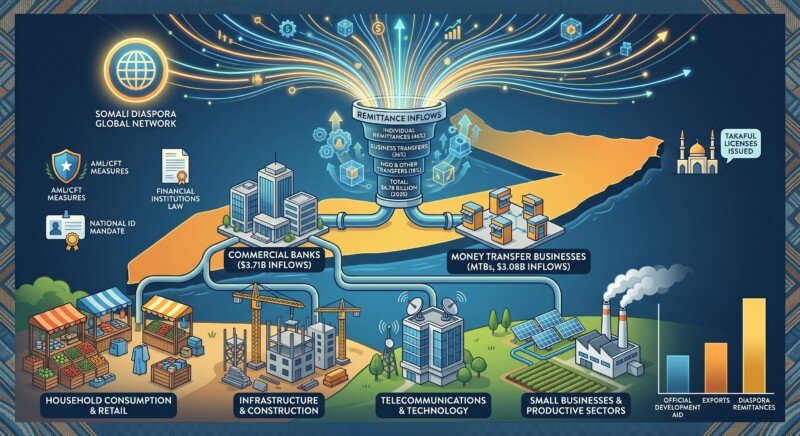
Remittance inflows remained a central pillar of Somalia’s economic stability in 2025, reaching a record $6.78 billion, a 5 percent increase from $6.43 billion in 2024. Individual remittances totaled $3.13 billion, up 15 percent from the previous year, reaffirming their role as the largest and most stable source of inflows.
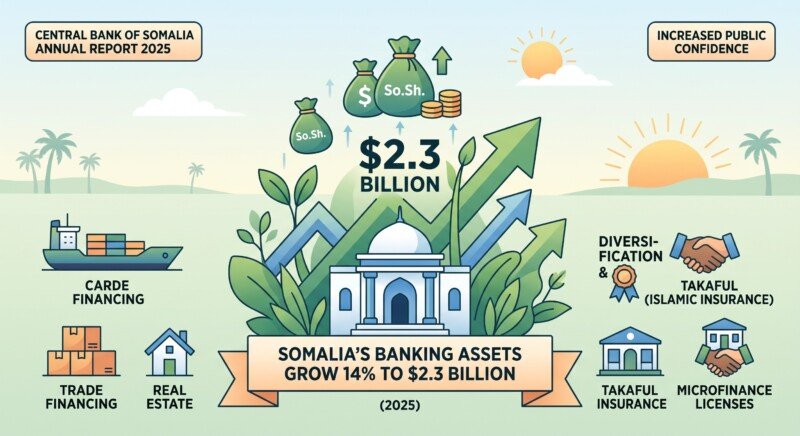
The banking sector also demonstrated strong growth, with total banking assets increasing by 14 percent to $2.3 billion, equivalent to 20 percent of GDP. The sector remained financially sound, with capital adequacy and core capital ratios continuing to exceed regulatory requirements. Financing assets rose by 14 percent to $540 million, reflecting continued private-sector credit demand.
The Third Somali Banking and Finance Conference convened in Mogadishu in October 2025, bringing together senior government officials, central bank representatives, and financial sector leaders to deliberate on advancing Somalia’s economic resilience through modern banking reforms and innovative financing strategies.
Somalia has also stepped up its push to rejoin the global financial system, hosting a high-level roundtable in Washington, D.C., alongside the World Bank Group to tackle the country’s widening correspondent banking gap. The meeting drew representatives from major international banks, development partners and Somali financial institutions, all focused on restoring safe and reliable cross-border payment channels.
Following the attainment of the Completion Point under the Enhanced Heavily Indebted Poor Countries (HIPC) Initiative in December 2023, Somalia’s external debt position underwent a fundamental transformation. Total external debt declined from $5.23 billion in 2018 to $1.48 billion in 2025, while the external debt-to-GDP ratio fell from 61 percent to 11 percent.
Central Bank of Somalia Governor Abdirahman M. Abdullahi has highlighted that approximately $210 million is lost annually as funds pass through numerous intermediaries in East African financial centers before reaching Somalia, with each transaction adding unnecessary expenses, delays, and reducing transparency.
A newly approved remittance tax in the United States has raised alarm among Somali families and policymakers, who warn it could severely disrupt a critical economic lifeline for millions. Under the “One Big Beautiful Bill,” the U.S. will begin imposing a 1 percent tax on all outgoing remittances starting January 2026. For Somalia, where remittances account for up to 30 percent of GDP, the impact could be devastating.
Critical Note
The slowdown in Somalia’s economic growth to 3.1 percent reflects the structural vulnerabilities that continue to constrain the country’s development. The decline in foreign aid, which has been a critical source of fiscal and humanitarian support, has exposed the fragility of Somalia’s public finances and its dependence on external resources. The government’s push for greater domestic revenue mobilization and economic self-reliance is a welcome step, but it faces significant challenges given the country’s narrow tax base and limited administrative capacity.
While remittances and private sector activity have provided a buffer against external shocks, they cannot substitute for sustainable economic development and job creation. The large trade imbalance—with imports accounting for 80 percent of GDP and exports just 21 percent—highlights the economy’s structural weakness and its reliance on foreign supply to meet domestic consumption and investment needs.
The banking sector’s expansion and the reduction in external debt are positive developments, but the effectiveness of these gains will depend on the government’s ability to translate them into tangible improvements in living standards and economic opportunity for ordinary Somalis. Without sustained investment in productive sectors, infrastructure, and human capital, the risk is that Somalia’s economic growth will remain constrained by the same structural factors that have limited its potential for decades.
Recommended Reading On ftlsomalia.com
- Somali Remittances Hit All-Time High of $6.78 Billion
- Somalia’s Banking Sector Expands to $2.3 Billion
- Somali Banking Leaders Chart Course for Economic Transformation
- Somalia Pushes for Financial Reconnection at Washington Roundtable
- Billions Flow In, Little Change Out: Somalia’s Aid Crisis Deepens
- U.S. Remittance Tax Threatens Lifeline for Millions in Somalia