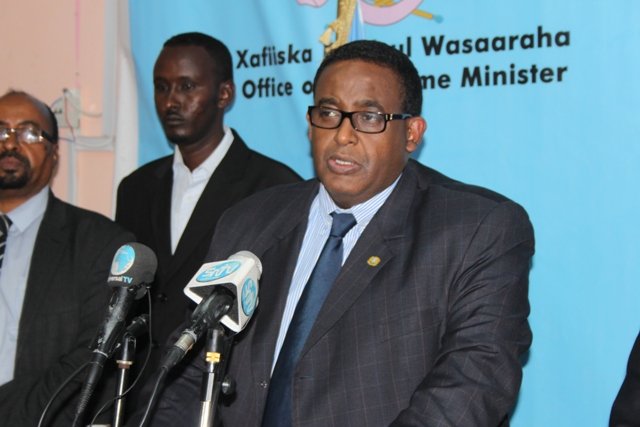
MOGADISHU — Former Prime Minister Omar Abdirashid Ali Sharmarke has warned that Somalia has entered a “difficult phase of a constitutional vacuum,” highlighting growing political uncertainty after the federal parliament’s mandate expired and with the president’s term set to end in the coming weeks — all without an election in sight.
The situation, he suggested, carries both urgency and risk, as institutions operate beyond their formal mandates.
“The Federal Government of Somalia is now operating on borrowed time and has very few viable options left to implement the agendas they invested so heavily in,” Abdirashid stated on social media.
His remarks draw attention to a narrowing window for political compromise, as tensions mount over the direction of governance and the legitimacy of ongoing decisions.
“There is still one month left for the President to convene all stakeholders and reach a settlement acceptable to everyone. This time emphasis should also be placed on ways to address what is becoming a vicious cycle of personalizing power by the end of a term,” he said.
Government Briefs International Partners
The warning came a day after Somali government officials briefed ambassadors of international partners in Mogadishu, stating that the mandates of both parliament and the president had been extended by one year. Officials said the extension followed the implementation of a new constitution in March.
In early March 2026, Somalia’s bicameral parliament approved the country’s new constitution following a protracted process that spanned more than 13 years. Sheikh Aden Mohamed Nur, Speaker of the House of the People, announced that 186 members of the lower house and 37 senators from the Upper House voted in favor of the new constitution during a joint session.
“The new constitution will be formally signed into law by President Hassan Sheikh Mohamud. It replaces the provisional constitution adopted in 2012, when more than 800 delegates adopted it at a conference in Mogadishu while the country was under a transitional government,” according to parliamentary records.
The new constitution extends the presidential term from four years to five years. It also stipulates that the president will be elected by parliament, while members of parliament will be chosen directly by citizens. The constitution defines the roles of the executive, legislature, and judiciary, and establishes oversight mechanisms designed to prevent abuse of office, ensure transparency, and uphold the rule of law.
Constitutional Amendments Rejected by Opposition
The move, however, remains contested. Opposition figures argue the constitution was adopted without sufficient political consensus among key stakeholders, raising fresh questions about legitimacy at a time when the country’s political future is already uncertain.
Former President Mohamed Abdullahi Farmaajo has declared that the constitutional mandate of the Federal Parliament officially expired on April 14, 2026, warning that Somalia has entered a period of “rising political uncertainty.” Farmaajo argued that legislative activities can only resume after new elections are held, challenging the one-year term extension announced by the leadership of the House of the People.
In a direct address to his successor, Farmaajo noted that President Mohamud has only one month left in office under his mandate, set to expire on May 15. He urged the administration to present an urgent and clear election plan to avoid a total constitutional vacuum.
“A month before the end of his term, outgoing President Hassan Sheikh Mohamud must urgently present a credible plan for the upcoming elections. Failing to do so will destabilize the country in ways that will have lasting political, social, security, and economic implications,” Farmaajo said.
Parliament Enters Caretaker Phase
Abdulatif Muse Sanyare, a member of the House of the People, has stated that parliament will now operate in a caretaker capacity.
“From today, parliament enters a caretaker phase. It can handle essential and routine matters but cannot pass new laws or approve major agreements until a new parliament with full legitimacy is formed,” Sanyare said.
He added that the legislature’s ability to hold the executive accountable, including summoning or dismissing ministers, is effectively suspended during this period.
Sanyare also noted that if the Speaker of the House resigns, the First Deputy Speaker would assume the role in an acting capacity, as no formal internal elections can be conducted without a fully mandated parliament. His remarks come amid reports that the current Speaker, Sheikh Adan Mohamed Nur (Madoobe), is considering a bid for the presidency of South West State.
Opposition Warns of Parallel Administration
The Somali Future Council — a powerful political alliance comprising Jubbaland, Puntland, and opposition figures — has warned that if both parliamentary and presidential terms lapse without elections or a political agreement, they would move ahead with organizing their own polls and establish a parallel federal administration.
The Somali Future Council has issued a formal public statement directly endorsing South West State’s decision to conduct independent regional elections, demonstrating a united front against Mogadishu’s proposed electoral framework.
The core dispute centers on federal constitutional amendments passed without regional consensus and the central government’s push for a “one-person, one-vote” system — a model that regional states deem currently impractical and a unilateral mechanism for consolidating federal power.
Abdirashid Warns of Political Instability
Abdirashid has previously issued stark warnings regarding the intersection of oil exploration and political disputes. In April 2026, he cautioned that the government’s offshore oil exploration with Turkey, combined with unresolved constitutional disputes, risks igniting political instability unless national consensus is reached.
In a statement released on April 10, Abdirashid called on President Mohamud to focus on resolving internal disputes before the president’s term and parliament’s mandate expire, noting that tensions remain high.
He specifically warned that exploiting oil and mineral resources might turn into a source of political conflict unless all key stakeholders agree on a formal and binding framework. He also expressed strong concern that delays in reaching crucial national pacts could endanger Somalia’s governance process.
Abdirashid’s intervention reflects growing anxiety among Somalia’s political elite that pursuing resource extraction while constitutional and electoral disputes remain unresolved could deepen regional and factional divides.
Oil Drilling Adds to Political Tensions
The warning came as the Turkish drilling vessel Çağrı Bey was received at Mogadishu port in a ceremony attended by officials from both countries. Somalia’s petroleum minister, Dahir Shire Mohamed, confirmed that the first well, named ‘Curad-1’, will be drilled offshore Galmudug state — about 275 kilometers from the coastline, between the towns of Mareeg and Harardeere.
Abdirashid stressed the need for a lasting solution to contradictory policies arising from constitutional amendments and the electoral roadmap. He argued that these internal disagreements, along with oil drilling, require full consensus because they form the foundation of statehood.
The exploration campaign is part of a broader energy cooperation agreement between Somalia and Turkey, aimed at helping Mogadishu benefit from its natural resources. However, the former prime minister’s message serves as a reminder that without political unity, even promising oil finds may fuel further instability.
International Community Urged to Monitor Crisis
With parliament’s mandate now expired and the presidency due to reach its term limit in one month, Somalia is facing widening political uncertainty and an increasingly unclear path toward elections. Despite repeated warnings from opposition figures and regional authorities, officials in Mogadishu have yet to present a broadly accepted framework to resolve the deepening constitutional and political impasse.
The dispute comes at a time of increased political tension following changes to the constitution that were passed by the federal parliament shortly before its term ended. The political standoff has revived memories of the 2021 political crisis, when prolonged disputes over delayed elections escalated into armed clashes on the streets of Mogadishu between the administration of then-President Farmaajo and opposition forces.
The international community, including the United States, European Union, and United Nations, continues to monitor the situation closely. The federal government has yet to issue a formal response to Abdirashid’s latest warning.