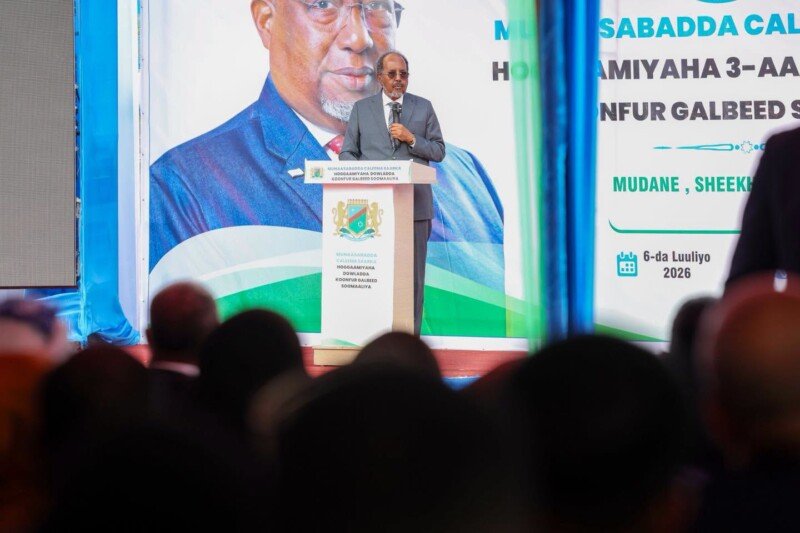
BAIDOA – President Hassan Sheikh Mohamud has declared that Somalia has moved beyond the era of personality-driven politics and is transitioning toward a formal party-based system with direct, one-person, one-vote elections, in an address delivered at the inauguration ceremony of South West State President Sheikh Aden Mohamed Nur (Aden Madobe).
Speaking at the event in Baidoa, President Mohamud said the Federal Government and several Federal Member States have agreed on a political reorganisation that aligns with internationally recognised democratic practices. “The Federal Government and many regional states have agreed to formally reorganise the country politically and to operate in the way the world knows,” he said. “Personality politics are a thing of the past in Somalia and will not continue. The country has now adopted a system with a known framework that belongs to the people.”
President Madobe was elected on June 10, 2026, securing a landslide victory in the regional leadership election held in Baidoa. The handover ceremony took place at the presidential palace in Baidoa, where Madobe formally assumed office from interim leader Jibril Abdirashid Haji Abdi.
A Historic Democratic Transition
The President described the recent historic elections in South West State as a significant step toward democratic consolidation and stability. He noted that the people of Somalia had sent a clear message in favour of one-person, one-vote elections, and that the rest of the country would be transitioned to the direct electoral system currently being implemented.
“The Somali people have sent a message in favour of one-person, one-vote elections,” President Mohamud said. “The rest of the country will be reached and it will be implemented.”
The President has consistently advocated for universal suffrage, describing direct elections as a vital step toward breaking the cycle of clan-based power-sharing and building a fully accountable democratic state.
Transition from Clan-Based to Party Politics
The President’s remarks align with the federal government’s broader push to transition Somalia away from the indirect, clan-based electoral system that has dominated since 2000. The government has previously called for reconciliation and political stability, urging citizens to embrace dialogue and warning against polarising politics.
Opposition leaders have drawn sharp battle lines against what they describe as “illegitimate term extensions” and “disputed elections”, warning the government not to push the country into another cycle of political turmoil.
Challenges to the Democratic Transition
While the President’s vision for a party-based political system represents a significant departure from Somalia’s traditional political model, opposition groups have argued that the country lacks the political consensus, constitutional framework, and security conditions necessary for such a transition. The opposition Somali Future Council has called for a return to the indirect electoral system, citing concerns over the feasibility and security of nationwide universal suffrage.
The Future Council has formally proposed a return to indirect voting, insisting that any electoral framework must be negotiated among all stakeholders and cannot be imposed unilaterally by the federal government.
Way Forward
As Somalia continues to navigate its political transition, the President’s address underscores the government’s determination to implement a universal suffrage model and move beyond clan-based politics. However, the path forward remains contested, with opposition groups and several Federal Member States insisting on a consensus-based approach. The outcome of ongoing negotiations will determine whether Somalia can achieve a unified electoral framework that commands broad political acceptance.
Recommended Reading On ftlsomalia.com:
- Madobe Elected South West State President as Sharif Hassan Withdraws Citing Irregularities
- President Stands Firm on One-Person, One-Vote Elections
- Somali President Issues New Year’s Message to FGS
- Opposition Warns Against ‘Red Lines’ on Term Extension and Disputed Elections
- Opposition Seeks Indirect Voting System as Future Council Sets Conditions for May 10 Dialogue