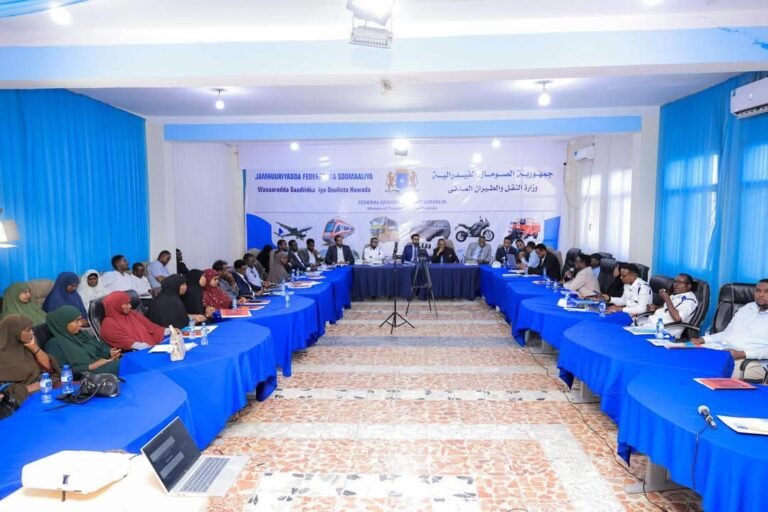
MOGADISHU: Somalia’s Federal Ministry of Transport and Civil Aviation has convened a consultative meeting focused on road safety and traffic congestion management at its headquarters in the Shingaani District. The gathering concentrated on advancing the transportation network, improving road safety measures, and tackling traffic congestion issues in the capital and beyond.
The Director General of the Ministry, Omar Ali Afrax, officially launched the session, which was joined by department directors and advisors, representatives from the Ministries of Health, Public Works, Internal Security, and Interior, along with officials from the Traffic Police and Hornvista, a transport and road safety company. Discussions centered on proposed revisions to the Traffic Law, designed to create a contemporary system aligned with current requirements.
The Ministry outlined a strategic vision built on three fundamental priorities: formulating clear laws and regulations for rapid implementation, enhancing coordination between institutions tasked with public safety, and boosting public education to encourage shared responsibility in road usage. Participants underscored the direct connection between road safety and the nation’s comprehensive development, emphasizing that reducing traffic accidents and enhancing transportation systems contribute substantially to economic advancement and public protection.
Attendees acknowledged the necessity of updating traffic laws to match current circumstances, with recommendations emphasizing clearer regulations, stricter enforcement, and better coordination among entities. Authorities also outlined intentions to broaden public awareness initiatives to encourage safer road practices and shared accountability among motorists and pedestrians. The ministry emphasized that improving road safety and reducing congestion are essential for supporting economic activity and public welfare, noting that inadequate transport systems and traffic accidents continue to impact productivity.
Background: Road Safety Challenges in Somalia
The consultative meeting reflects growing government attention to road safety, a sector that has seen limited regulation in recent decades. The Federal Government previously established a National Road Safety Council to coordinate efforts across ministries and reduce the rising toll of traffic accidents. According to World Health Organization data, road traffic injuries are a leading cause of death in Somalia, particularly among young adults, with poorly maintained roads, lack of signage, and weak enforcement of traffic rules contributing to high fatality rates.
Mogadishu has experienced a rapid increase in vehicle numbers in recent years, outpacing infrastructure development and leading to chronic congestion. The Shingaani District, where the meeting was held, is one of the oldest and most densely populated areas of the capital, suffering from narrow streets and limited parking. The proposed Traffic Law revisions aim to introduce modern traffic management systems, including designated lanes, traffic signals, and pedestrian crossings.
Private sector participation, represented by Hornvista, signals a collaborative approach. Hornvista has previously partnered with local authorities on smart transport solutions, including GPS tracking for public buses and digital fare collection systems. The company’s involvement in the consultative meeting suggests that technology-driven solutions may feature in the revised regulatory framework.
The gathering forms part of wider governmental efforts to modernize infrastructure and establish a more efficient and secure transportation network. This collaborative meeting represents a significant advancement toward creating a complete road safety framework and alleviating congestion, offering advantages nationwide as Somalia continues its post-conflict reconstruction and urban development trajectory.