HARGEISA — Somaliland security forces have seized weapons and military vehicles from groups involved in recent clan fighting in the Awdal and Salal regions, as authorities move to prevent armed militias from re-emerging and reigniting conflict.
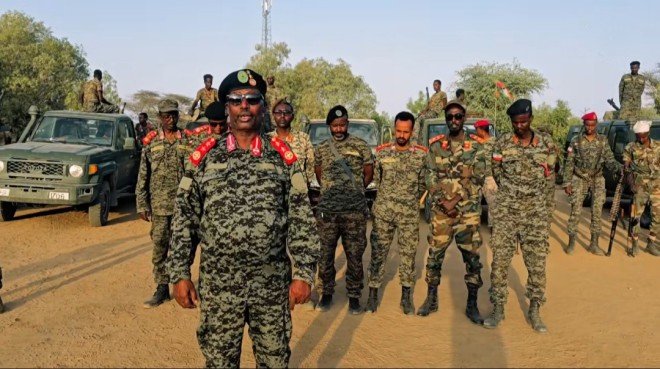
The military displayed some of the vehicles and weapons recovered during the operations, warning that civilians and clan groups will not be permitted to maintain illegal stockpiles of weapons or operate military vehicles outside the authority of the state. Somaliland Military Command further highlighted that they have ordered the security forces to take firm actions against anyone who brandishes weapons or attempts to reignite the inter-clan conflict in the western regions.
Military commanders said they had been instructed to take firm action against anyone who openly carries weapons or attempts to revive the recent clan conflict in western Somaliland. The operations follow the breakdown of a recently negotiated peace agreement between the communities involved in the fighting, which called for a ceasefire, the withdrawal of armed groups and an end to actions that could trigger a renewed confrontation.
The inter-clan skirmishes in western Somaliland are rooted in long-standing tensions between the Issa and Gadabuursi (Samaroon) communities, with disputes over cultural rights, symbolic recognition, and local sovereignty over the coastal town of Saylac. The conflict escalated in December 2025 after the government rescinded a prohibition on a publication detailing the cultural heritage of the Issa clan, which was interpreted by the Gadabuursi as evidence of governmental favoritism. At least 19 civilians were killed and 214 others injured during those protests.
A Different Approach to Clan Conflict
The crackdown highlights a fundamental difference between Somaliland’s approach to armed clan disputes and the situation in much of Somalia, where weapons are widely available and clan-based armed groups can operate with considerable freedom. In Mogadishu, firearms are widely visible and weapons are reportedly traded openly in parts of the capital’s markets. Across Somalia, political and clan disputes frequently become intertwined with armed mobilization, making it difficult for the state to establish a monopoly over the use of force.
Somaliland’s authorities, by contrast, have sought to maintain a policy that tribal militias cannot simply roam the country carrying heavy weapons or operate independently of the state. That policy has been a major element of Somaliland’s relative security and stability over the years. The government has previously integrated clan-based militia units into its national armed forces, with Vice President Mohamed Ali Aw Abdi presiding over the formal incorporation of local tribal militia units in Erigavo.
Somaliland has also implemented prohibitions on carrying weapons in key cities, with only the police force authorized to carry firearms within Erigavo. Military personnel are required to leave their weapons in their barracks, and civilians found carrying weapons will have them confiscated by the police.
The security situation in the western regions has been further complicated by rising tensions with Djibouti, following Somaliland’s controversial maritime agreement with Ethiopia and recent diplomatic engagements with Israel. Authorities have blocked Djibouti’s flag carrier from landing in the territory, sharply escalating a diplomatic dispute that intensified after Israel recognised Somaliland. Fears are growing that the diplomatic standoff could worsen already fragile clan relations across Awdal.
Critical Note
The latest security operations in Awdal and Salal reflect Somaliland’s longstanding approach of maintaining a state monopoly on force, treating clan militias as a direct threat to state authority. This contrasts sharply with the situation in Somalia proper, where armed clan groups operate with considerable freedom and are frequently mobilized along political lines. While Somaliland’s policy has contributed to its relative stability, the effectiveness of this crackdown will ultimately be measured not by the number of weapons seized, but by whether lasting peace can be achieved and whether the underlying grievances that produced the conflict are addressed.
The challenge is not simply to confiscate weapons. Lasting peace will depend on whether the authorities can combine disarmament with credible political dialogue, impartial law enforcement and mechanisms for resolving the underlying grievances that produced the conflict in the first place. Somaliland’s government has repeatedly warned that it will not tolerate attempts to restart clan warfare or the illegal possession of weapons and military vehicles. For communities that have already experienced violence, the message is straightforward: peace agreements cannot survive if armed factions remain free to rearm.
The success of the latest campaign will ultimately be measured not by the number of weapons displayed at military headquarters, but by whether those weapons remain out of the hands of clan militias—and whether Awdal and Salal can finally move beyond the cycle of confrontation that has threatened their communities.
Recommended Reading On ftlsomalia.com
- Somaliland Forces Eliminate Militants from Djibouti Border
- Protest Against Somaliland’s May 18 Celebrations Erupts in Borama
- Somaliland to Recruit New Soldiers from Clan Militias
- Somaliland Bars Djibouti Airline as Diplomatic Rift Worsens
- Somaliland Bans Carrying of Unauthorized Weapons in Erigavo
- President Irro Appeals for Calm After Borama Violence