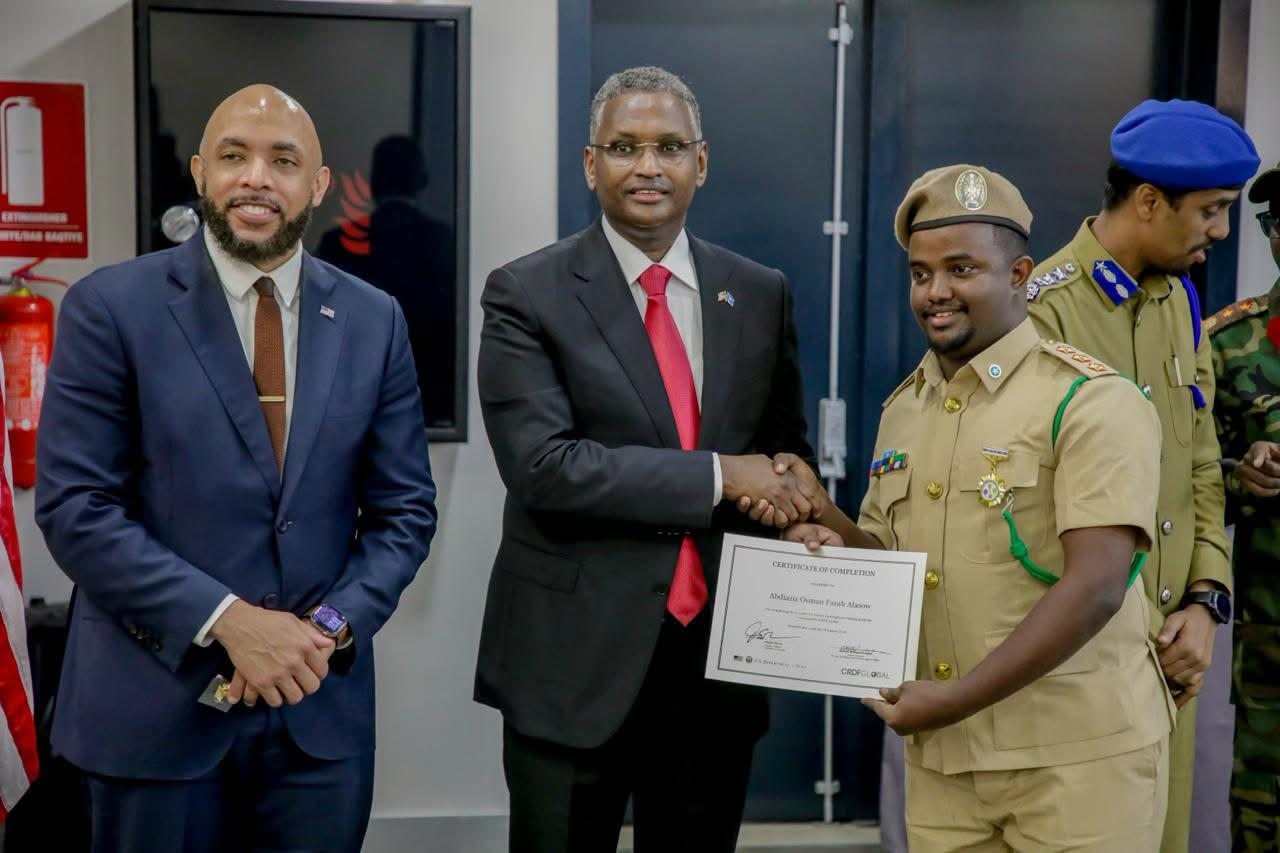
MOGADISHU — Nearly 80 officers from the Somali Police Force and the National Intelligence and Security Agency (NISA) have completed a year-long training program on modern crime scene investigation, supported by the United States government.
The training covered modern crime scene investigation techniques, evidence collection and preservation, and methods for verifying critical information for investigations. Justin Davis, the U.S. embassy’s chargé d’affaires in Somalia, said the programme was designed to bring the two security institutions together to develop common investigative skills and improve cooperation.
“Two years ago, the United States and Somalia set out to do something that had never been done before: bring NISA and the Somali Police Force together, side by side, into a single training environment,” Davis said at the graduation ceremony in Mogadishu.
Somali officials said the training would help strengthen professional investigative practices and improve cooperation between security and judicial institutions. Asad Osman Abdullahi, commander of the Somali Police Force, said the programme had helped improve investigators’ knowledge and skills. Hassan Ali Noor Shute, chairman of the first-instance military court, said the training had helped move investigations towards more systematic methods based on verifiable evidence that can be presented in court. Mahad Mohamed Salah, director general of NISA, urged the graduates to use their newly acquired skills in combating militant groups and organised crime.
This training follows a broader pattern of Somalia’s engagement with international partners to rebuild its security and justice institutions. In September 2025, Somalia partnered with Türkiye to launch a tripartite initiative aimed at enhancing forensic investigation capabilities. The collaboration focuses on training law enforcement personnel, establishing modern laboratories, and sharing best practices in handling evidence.
The United States has been a central partner in supporting Somali security forces. Discussions have centered on enhancing joint operations and continued collaboration in the fight against Al-Shabaab and ISIS. U.S. military support, particularly in training, intelligence sharing, and targeted operations, remains a central pillar in the fight against Al-Shabaab. This partnership has been instrumental in strengthening Somalia’s security institutions.
Other international partners are also contributing to the development of Somalia’s police force. In May 2026, a 10-day training program for Somali Police Force instructors, funded by the Government of Japan, was launched in Mogadishu. The program focuses on strengthening police capacity and improving security services. In February 2026, the Somali Police Force initiated an advanced training curriculum for specialized police units backed by the European Union.
Critical Note
The completion of this year-long training program represents a significant investment in Somalia’s forensic capabilities and a welcome step toward professionalizing crime scene investigation in the country. The partnership with the United States underscores the international community’s commitment to supporting Somalia’s security sector reform.
However, the sustainability of these gains depends on the government’s ability to retain trained personnel and provide them with the equipment and resources needed to apply their skills. Forensic capacity building is often undermined by low pay, lack of equipment, and institutional fragmentation. Without sustained investment in forensic laboratories, equipment, and career development pathways for trained officers, the skills acquired during this training may be difficult to maintain and apply effectively.
The government must prioritize the allocation of resources to support forensic services and ensure that trained personnel are deployed effectively within the criminal justice system. The integration of forensic evidence into judicial proceedings will require not only technical capacity but also a commitment from prosecutors and judges to rely on scientific evidence. The international community should continue to support these efforts while advocating for accountability and transparency in the use of these capabilities.
Recommended Reading On ftlsomalia.com
- Gambia, Somalia Partner with Türkiye to Boost Forensic Investigation Capacity
- Japan-Funded Police Instructor Training Program Launched in Mogadishu
- Somalia and U.S. Deepen Military Cooperation to Combat Al-Shabaab and ISIS
- AU, US Officials Discuss Boosting Security Cooperation in Somalia
- Somalia Commences Elite Police Training Backed by EU