MOGADISHU – Unconfirmed reports from sources at Mogadishu’s Aden Adde International Airport suggest that the Head of Turkey’s National Intelligence Organization (MIT) arrived in the Somali capital on the morning of Thursday, June 4. The reports, which remain unverified by official sources on either side, have fueled speculation about Ankara’s eagerness to broker a ceasefire between the federal government and opposition forces following days of intense armed clashes.
If confirmed, the arrival of the MIT chief would represent a significant escalation in Turkey’s diplomatic engagement, moving beyond back-channel communications to direct, on-the-ground mediation. According to airport sources who spoke on condition of anonymity, the official was received by senior Somali security personnel before departing the airport under heavy escort. Neither Villa Somalia nor the Turkish Embassy has issued a statement regarding the reported visit.
The reported arrival comes as a new report published by the Ankara-based Center for Middle Eastern Studies (ORSAM) paints a sobering picture of the Horn of Africa’s trajectory, concluding that the region has entered a period of “strategic transformation” defined by militarized diplomacy, external dependency, and a steady erosion of regional cooperation frameworks.
Ankara-Based Institute Warns of Regional Fragmentation
The report, titled “The Horn of Africa in 2025: Geopolitical Competition, Maritime Security and Energy,” was co-authored by ORSAM’s North and East Africa Studies Coordinator Kaan Devecioğlu and researcher Hasna Jebel Abagero. Released in May 2026, the study argues that the boundaries between domestic instability and regional rivalry along the western flank of the Red Sea basin have become increasingly blurred throughout the past year.
ORSAM, a Turkey-based research institute, has long been recognized for its analysis of Middle Eastern and African affairs. The institute’s location in Ankara is significant, given Turkey’s expanding military and economic footprint across the Horn of Africa, particularly in Somalia. The report’s critical assessment of regional fragmentation, however, does not shy away from examining the consequences of external involvement, including that of Turkey itself.
The report identifies “militarized governance” as a defining regional pattern. Across the Horn, political leaders have increasingly relied on security institutions to preserve authority, while the distinction between political administration and warfare has largely disappeared. “As state capacity contracted, coercive power expanded, resulting in the entrenchment of a reactive rather than preventive model of governance,” the authors write.
The Federal Government of Somalia has previously accused regional leaders of orchestrating attacks through loyal militias, a pattern that ORSAM’s report suggests is becoming increasingly common across the Horn of Africa.
Turkey’s Expanding Military Footprint in Somalia
Turkey’s military presence in Somalia has expanded dramatically in recent months. Turkish F-16 fighter jets and attack helicopters roared over Mogadishu in April, celebrating the 66th anniversary of Somalia’s army formation with an impressive aerial demonstration. The exhibition highlighted Turkey’s ongoing commitment to arming and training Somali security personnel as the nation strives to rebuild following over three decades of internal conflict.
Turkish F-16 fighter jets were observed performing low-altitude test flights over Mogadishu in February, signaling a significant upgrade in Ankara’s military engagement in the Horn of Africa. According to knowledgeable sources, Turkey deployed at least three fighter jets to Somalia as part of an enhanced defence support package.
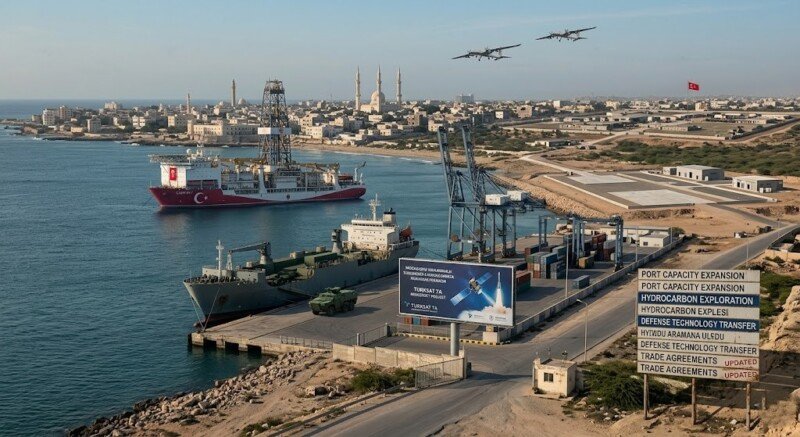
A Turkish military transport recently docked at Mogadishu Port, offloading a shipment of M48 and M60 Patton battle tanks in a move signaling a significant escalation of Ankara’s military footprint in the Horn of Africa. According to informed security sources, the tanks will be positioned to defend Turkish installations in the Warshiikh district, approximately 60 kilometers north of Mogadishu, where facilities are reportedly being prepared for missile and satellite launch operations.
Drone Cooperation and Defense Technology Transfer
Somalia’s President Hassan Sheikh Mohamud paid a high-level visit to Baykar’s Özdemir Bayraktar National Technology Center in Istanbul in July 2025, as part of growing Somalia-Türkiye defense cooperation. The visit highlighted Somalia’s interest in enhancing its national security through advanced drone technology, particularly the Akinci and Bayraktar TB2 unmanned aerial vehicles (UAVs).
“Strengthening our defense capacity is key to ensuring the safety of our people and defeating terrorism. This partnership with Türkiye is built on trust, and this visit represents a major step toward building a modern, self-reliant Somali defense force,” President Mohamud stated during the visit.
Turkey has completed the design phase of its next-generation Turksat 7A communications satellite, and a Turkish media report has suggested that Somalia could serve as the launch site for the project, a move that, if confirmed, would mark a major technological milestone for Somalia. Turkey has already begun construction of a spaceport in Somalia, with the facility intended to provide Ankara with fully independent access to orbit. Analysts note that Somalia’s geographic location near the equator offers a technical advantage for satellite launches, as the Earth’s rotational speed is highest at the equator, providing additional thrust and allowing rockets to carry larger payloads with less fuel.
Maritime and Port Infrastructure Development
Somalia and Turkey reached a comprehensive agreement in January to develop new infrastructure projects at the Mogadishu Port. The deal aims to enhance trade, increase government revenue, and improve the efficiency of the nation’s primary maritime gateway. The agreement followed the arrival of a senior Turkish delegation led by Deputy Minister of Transport and Infrastructure, H.E. Durmuş Ünüvar.
Somalia’s Minister for Ports and Marine Transport held a high-level meeting with Türkiye’s Minister of Transport and Infrastructure during the 2025 Global Connectivity Forum in Istanbul, signaling a renewed commitment to deeper bilateral cooperation in ports and maritime infrastructure.
“This engagement reflects our determination to transform Somalia into a competitive logistics hub in the Horn of Africa. We view Türkiye as a valuable and trusted partner in realizing this vision,” the Somali minister stated.
Oil and Gas Exploration: The Petreulüm Projects
A cornerstone of the Somali-Turkish economic partnership is the hydrocarbon exploration agreement signed between the two nations. Somalia and Turkey have discussed strengthening bilateral cooperation in the energy sector, with Turkish Energy and Natural Resources Minister Alparslan Bayraktar and Somali Minister of Petroleum and Mineral Resources Dahir Shire Mohamed reviewing the current status of hydrocarbon exploration activities being conducted by both countries onshore and offshore in Somalia.
Somalia announced it is ready to begin its first offshore oil drilling operations, with a Turkish government-owned drilling ship arriving off its coast in April 2026. In a post on social media, Somalia’s Petroleum Minister Dahir Shire described the move as a “historic milestone in our offshore energy journey… A new chapter begins.”
The Turkish Petroleum Corporation’s drilling ship, Çağrı Bey, is on its first international mission, heading into Somalia’s territorial waters in the Arabian Sea. It will carry out deep water drilling at sites identified by recent surveys that mapped the country’s hydrocarbon potential. Researchers estimate the country holds billions of barrels of oil reserves, but exploration has been hampered by decades of conflict and political instability.
Trade and Commercial Agreements
The commercial relationship between Somalia and Turkey is underpinned by a series of formal agreements. These include a Commercial and Economic Cooperation Agreement signed in January 2018, an Agreement on Mutual Promotion and Protection of Investments signed in June 2016, and a Double Taxation Prevention Agreement also signed in June 2016.
The Minister of Commerce and Industry of Somalia represented the nation at the 14th World Trade Organization (WTO) Ministerial Conference in Yaoundé, Cameroon, in March 2026. On the sidelines of the conference, Minister Gamal held high-level discussions with the Turkish delegation regarding expanded commercial cooperation.
“On the sidelines of the WTO Ministerial Conference MC14 in Yaoundé, I held productive talks with my Turkish counterpart, H.E. Ömer Bolat. We discussed strengthening Somalia–Türkiye trade, boosting volumes, and expanding cooperation while building on our longstanding brotherhood,” Minister Gamal stated.
Somalia: Diplomatic Gains Amid Structural Fragility
Somalia is portrayed in the ORSAM report as a nation caught between tactical consolidation and structural fragility. The report notes that President Hassan Sheikh Mohamud’s administration sought to strengthen political legitimacy through counterterrorism efforts, expanding international partnerships, and managing internal divisions involving Puntland and Somaliland.
ORSAM highlights Somalia’s strategic proposal to the United States in March 2025, which envisaged granting Washington exclusive access to key coastal facilities, as a clear manifestation of Mogadishu’s balancing strategy. While the initiative expanded U.S. influence in the region, it also intensified broader debates surrounding sovereignty.
The severe political crisis that escalated after heavy fighting around the residences of former prime minister Hassan Ali Khaire and former president Sharif Sheikh Ahmed underscores the fragility that ORSAM identifies as a persistent feature of Somalia’s political landscape.
Neutral, But Critical: Turkey’s Balancing Act
Despite Ankara’s mediation efforts, Turkey’s deep military and economic ties to President Hassan Sheikh Mohamud’s administration have raised questions about its neutrality. Turkey has invested heavily in Somalia’s security infrastructure, operating the Camp TURKSOM military training base in Mogadishu and providing the Somali National Army with advanced Bayraktar Akinci drones.
Opposition leaders have accused Ankara of aligning itself with Mohamud during the constitutional standoff. Their concerns intensified after Turkish Ambassador Alper Aktas recently met Mohamud at Villa Somalia and publicly reaffirmed Turkey’s support for his administration.
Somali opposition politician Abdirahman Abdishakur warned that Turkey risked being perceived as taking sides in a contested political transition. “The Turkish government’s decision to publicly reaffirm support for Hassan Sheikh Mohamud immediately after the expiration of his constitutional mandate sends a deeply troubling political signal,” Abdishakur said.
As fighting escalated this week, images circulated online appearing to show a Turkish-supplied armoured vehicle destroyed near the residence of Sharif Sheikh Ahmed. Critics argued that military equipment provided by Ankara to strengthen Somalia’s fight against Al-Shabaab was now being deployed in a domestic political conflict.
ORSAM’s Critical Outlook for 2026
The report concludes that the Horn of Africa has entered 2026 not in a state of open war, but under conditions of “prewar positioning.” ORSAM describes this as a tense equilibrium in which the boundaries between deterrence, provocation, and survival have become dangerously blurred.
ORSAM argues that the region’s security order is becoming increasingly dependent on the presence and mediation of external actors, while internal governance reforms lag behind the pace of geopolitical transformation. The central question, according to the authors, is whether regional states can transform the divisions arising from their roles within the Red Sea and Indian Ocean systems, as well as from their alliances with external powers, into mechanisms of cooperation before those fractures reach an irreversible depth.
The report’s critical assessment of external involvement, including that of Turkey, is notable given ORSAM’s Ankara base. While acknowledging Turkey’s constructive role in mediating between Ethiopia and Somalia through the Ankara Declaration, the report warns that external military footprints, including those of Gulf states, the U.S., China, Russia, and Turkey, have transformed the Horn of Africa into a “living laboratory of multipolar competition.”
ORSAM’s final warning is stark: “Peace and prosperity cannot be sustained through tactical alignments or temporary cooperation initiatives alone. What is required are institutionalized mechanisms capable of linking security with development, energy with diplomacy, and sovereignty with shared governance.”
As of Friday afternoon, there was no official confirmation from the Turkish government regarding the reported MIT visit. However, the rumors alone have shifted the diplomatic calculus in Mogadishu, signaling that external actors are preparing to play a more assertive role in resolving a crisis that has brought the capital to the brink of all-out conflict. The former president’s move away from Mirinaayo, following former prime minister Khaire’s withdrawal from Sayidka, suggests a temporary de-escalation, but the underlying political disputes remain unresolved. The opposition’s core demands include immediate agreement on an electoral framework, a peaceful transition plan, and a viable route to free, fair, and inclusive elections.
Recommended Reading On ftlsomalia.com:
- Federal Government Blames Jubbaland Leader for Beled-Hawo Clashes
- Turkey Joins Mediation Efforts as Former President’s Move Away from Marinayo Signals Potential De-escalation
- Somali Minister Accuses Former Leaders of Coup Attempt After Mogadishu Clashes
- From Badbaado Qaran to Marinayo 2.0: Somalia’s Never-Ending Cycle of Term Disputes and Electoral Violence Returns to Mogadishu
- International Community Urges Renewed Dialogue Between Somali Government and Opposition Groups
- Somalia to Host First Turkish Satellite Launch in Africa
- Somalia and Turkey Agree to Expand Mogadishu Port Capacity
- Somali President Eyes Advanced Drone Cooperation with Türkiye