WASHINGTON – A new report presented to the U.S. Congress has reaffirmed Washington’s official recognition of Somalia’s sovereignty and territorial integrity while simultaneously outlining multiple avenues for enhanced security, diplomatic, and commercial cooperation with Somaliland, exposing the delicate balancing act at the heart of American policy in the Horn of Africa.
The document, developed under Section 7019(e) of the 2026 National Security, Department of State, and Related Programs Appropriations Act, confirms that the United States continues to acknowledge Somalia’s sovereignty and territorial integrity. It also emphasizes Washington’s constructive relationship with Somaliland and the exploration of increased engagement within this policy framework.
“This report examines potential areas for improved United States engagement with Somaliland. The United States recognizes the sovereignty and territorial integrity of the Federal Republic of Somalia, which includes the region of Somaliland. Within that framework, the United States maintains a positive, constructive relationship with Somaliland and continues to explore additional opportunities for engagement with Somaliland authorities,” the State Department declared in the report.
Strategic Interests Driving Engagement
The report underscores Somaliland’s strategic positioning near the Bab al-Mandab Strait and the Red Sea, characterizing it as a potentially valuable partner in addressing common security challenges. According to the findings, Somaliland’s geographic location could assist in monitoring and countering extremist threats, including possible connections between the Houthis and Al-Shabaab.
“The Horn of Africa’s security environment remains complex, with ongoing violent extremist threats and regional disputes. Somaliland’s strategic location near Yemen and the Bab al-Mandab Strait positions it as a potential partner on shared security interests, including freedom of commercial and military navigation from the Red Sea to the Indian Ocean. It is also geographically positioned to potentially assist with efforts to monitor and counter violent extremist organizations, particularly connections between Houthi terrorists and al-Shabaab, al-Qa’ida’s largest and wealthiest affiliate,” the report detailed.
The document further indicates that officials from the U.S. Africa Command maintain regular contact with Somaliland authorities and are assessing potential areas for future collaboration. The U.S. Embassy in Mogadishu conducts regular visits to Somaliland to discuss mutual interests, including security matters, humanitarian aid, and economic development.
However, travel to Somaliland remains subject to the same security protocols applied throughout Somalia, necessitating substantial logistical and security preparations. Embassy officials coordinate closely with AFRICOM during such visits.
“Embassy Mogadishu conducts regular, periodic visits to Somaliland to engage on matters of mutual interest, including security cooperation, humanitarian assistance, and economic issues. U.S. government travel to Somaliland is subject to the same security requirements as the rest of Somalia, necessitating the use of non-commercial aircraft and other resource intensive security measures. Embassy Mogadishu coordinates closely with AFRICOM to take advantage of U.S. military resources where available,” the report reads.
Economic Potential and Persistent Challenges
The report highlights Somaliland’s economic potential and efforts to attract foreign investment, particularly in natural resources, infrastructure, transportation, and trade sectors. Special attention is directed toward the development of the Port of Berbera and Berbera Airport, which are increasingly recognized as strategic transportation hubs for Somaliland and neighboring Ethiopia.
“Somaliland authorities have encouraged U.S. investment in minerals and outlined priorities in infrastructure, trade, and economic growth. Somaliland’s ports represent potential alternatives to other congested regional facilities. The ongoing development of the Berbera airport and seaports into a trade and transportation hub for Somaliland and landlocked Ethiopia could create increased opportunities for U.S. investment infrastructure, exports, and other commercial opportunities,” the report states.
The Berbera corridor has emerged as a strategic trade and transportation hub for Somaliland and neighboring Ethiopia, offering an alternative logistics gateway to the congested ports in Djibouti and facilitating increased regional commerce.
However, the document also acknowledges persistent challenges, including regional security concerns and the unresolved political status of Somaliland, which continue to impact investment, banking, and broader economic activities. The State Department warned that “regional security concerns and the dispute over Somaliland’s status, including its refusal to cooperate with national authorities, present challenges for investment, banking, and trade.”
The congressional report is notable as it publicly acknowledges Somaliland’s growing strategic importance to U.S. interests while reaffirming Washington’s long-standing policy of recognizing Somalia’s territorial integrity. Though the report does not indicate any change in U.S. recognition policy, it suggests that Somaliland is increasingly being assessed in Washington through a pragmatic perspective focused on security, trade, and regional stability.
The focus on Berbera, maritime security, and AFRICOM cooperation reflects growing American interest in the Red Sea corridor, especially as geopolitical competition escalates and concerns mount over Houthi attacks on international shipping.
Somalia has been actively engaging in international forums to boost global trade and economic partnerships, reflecting the federal government’s broader strategy of attracting foreign investment and integrating into global markets.
Former Ambassador Criticizes President Mohamud
The report’s release coincides with sharp criticism of President Hassan Sheikh Mohamud from a former U.S. ambassador to Somalia. Larry Andre, an experienced American diplomat, accused Mohamud of deliberately breaking down the nation’s federal system, a move he argued has unexpectedly supported Somaliland’s quest for independence.
“President HSM has become a significant backer of Somaliland independence through his actions that dismantle Somalia’s federal structure,” Andre stated. “Additionally, Somaliland’s performance regarding civil liberties, particularly freedom of expression, and handling of minority communities is concerning.”
The candid evaluation reflects a growing chorus of local critics who have long argued that Mohamud, whose presidential term expired on May 15 despite his claim of an additional year under constitutional amendments, focuses primarily on Mogadishu while neglecting the rest of the nation.
The Federal Government of Somalia extended its mandate for one year under the newly adopted constitution, a move that opposition figures and several federal member states have rejected as lacking national consensus.
Opposition leaders have drawn sharp battle lines against what they describe as “illegitimate term extensions” and “disputed elections”, warning the government not to push the country into another cycle of political turmoil.
In Puntland, President Said Abdullahi Deni has consistently accused Mohamud of orchestrating the nation’s division. Deni and other regional leaders claim the federal president is disregarding agreed constitutional and electoral processes, instead implementing one-sided changes designed to strengthen his political position while sidelining rivals.
Puntland leader Said Abdullahi Deni has accused Mohamud of breaking the country apart, stating that the federal government’s actions under Mohamud have systematically dismantled the federal system and undermined the power-sharing arrangements that form the basis of Somalia’s post-conflict governance structure.
Federal Interventions and Regional Backlash
The consequences of Mogadishu’s approach have been severe. In Southwest State, federal authorities in March removed the regional president, setting up an election that opposition groups denounced as illegitimate. Critics say the procedure was arranged to hand the presidency to Adan Madobe, the federal parliament speaker, whose authority had already expired when he participated in the contest.
The Federal Government has previously accused regional leaders of orchestrating attacks through loyal militias, describing such actions as “premeditated acts of aggression aimed at undermining national authority and destabilizing the region.”
Former regional paramilitary units, whose allegiances were broken by Mogadishu’s interference, have formed a new armed rebellion. This week, these combatants briefly captured Baidoa, Southwest State’s administrative center, in intense exchanges with federal security personnel.
In Galmudug, Mohamud is pursuing a comparable political maneuver, attempting to replace the current regional president. This approach has caused an extraordinary internal split: Mahad Salad, head of the National Intelligence and Security Agency, a cornerstone of the federal security apparatus, has publicly opposed Mohamud on this matter, insisting that either the president support his own candidacy for regional leadership, ensure a fair election, or cease efforts to remove the current administration. All three demands have been rejected.
International partners including the UN, African Union, EU, IGAD, the United States, and the United Kingdom have urged renewed dialogue between the Somali government and opposition groups following the collapse of US and UK mediated talks earlier this month.
Somaliland’s International Position
Andre’s comments come at a politically sensitive time for Somaliland, the self-proclaimed republic that has administered itself separately from Mogadishu since 1991 without gaining widespread international acceptance as a sovereign state. Recently, Israel emerged as the latest nation to officially acknowledge Somaliland, with both parties rapidly advancing plans to establish embassies.
Israel formally recognized Somaliland in late 2025, with both parties announcing plans to establish embassies. Somaliland declared it will open its diplomatic mission in Jerusalem, a choice that provoked criticism from Mogadishu and eighteen other countries with Muslim majorities.
The Somali federal government has concentrated much of its diplomatic pressure on the United Arab Emirates, which Mogadishu accuses of financing global advocacy campaigns for Somaliland. Last week, Prime Minister Hamza Abdi Barre claimed that Abu Dhabi was investing millions of dollars to promote Somaliland’s recognition process, an assertion that Emirati representatives have not publicly responded to.
The Somali federal government has accused the United Arab Emirates of financing global advocacy campaigns for Somaliland’s recognition, with Prime Minister Hamza Abdi Barre claiming that Abu Dhabi was investing millions of dollars to promote the separatist region’s international standing.
However, for a substantial portion of Somalia’s political establishment and expert circles, the more influential factor in Somaliland’s improving international position is neither Tel Aviv nor Abu Dhabi, but Mohamud himself, a perspective now supported by Andre’s public statement.
Mogadishu’s Tense Relationship with Washington
The strained relationship between Mogadishu and Washington was further exposed when Somalia’s State Minister of Foreign Affairs Ali Bal’ad, one of President Mohamud’s closest confidants, issued and then swiftly deleted a strikingly combative statement directed at the United States.
The original post came in response to reports that American officials had begun bypassing the federal government to engage directly with Somalia’s regional states on matters of security cooperation and economic development, a development the federal government views with undisguised alarm.
“Somalia welcomes constructive partnerships with the United States and all international partners on maritime security, counterterrorism, and Red Sea stability. But true partnership must respect Somalia’s sovereignty, constitutional order, and territorial integrity,” Bal’ad wrote.
“The narrative that Somalia can only contribute to regional security through fragmentation is historically false and strategically shortsighted. A stable, united Somalia is the strongest guarantor of long-term security across the Gulf of Aden and the Bab el-Mandeb corridor,” he added.
The post was quietly removed and replaced with a softened iteration. Somali MP Mursal Khalif moved quickly to document what had occurred, framing the deletion not as a diplomatic correction but as a revealing act of political candor undone by institutional self-interest.
“State minister deleted the original post which was directed at the US government in a manner demanding acceptance of President Hassan Sheikh Mohamud’s stay in power without constitutional mandate. Amplifying a revised post will not change the facts,” Khalif said.
U.S. Shifts to Direct Regional Engagement
The United States has moved toward direct bilateral engagement with Somalia’s regional states, departing from its traditional approach of conducting diplomacy through Mogadishu. The revised diplomatic approach aligns with the foreign policy framework of U.S. President Donald Trump, which emphasizes commercial partnerships and private sector exploration over centralized foreign aid, along with localized security cooperation.
The United States has shifted toward direct bilateral engagement with Somalia’s regional states, departing from its traditional approach of conducting diplomacy through Mogadishu. “Glad the US is bilaterally engaging with Somalia’s federal member states like Puntland rather than routing through Mogadishu. Trying to create a strong central government in Somalia is a failed experiment,” said Joshua Meservey, a senior fellow at the Hudson Institute.
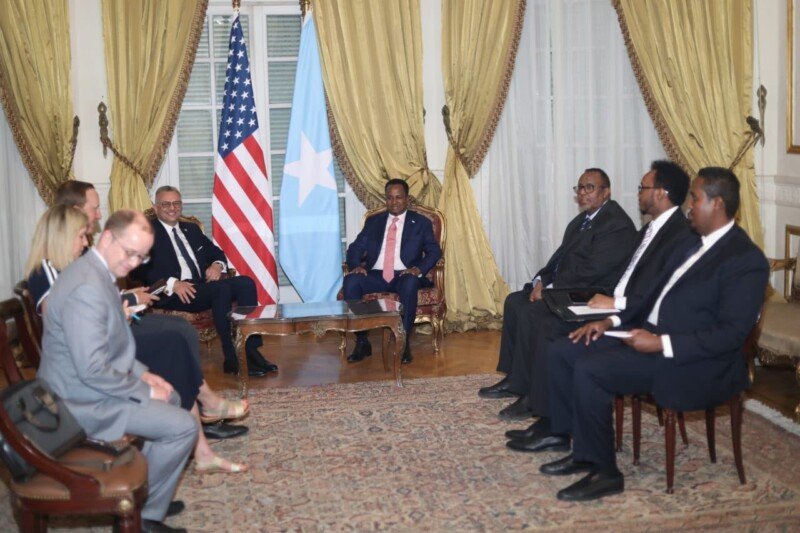
Washington’s new strategy took shape in Garowe, where Puntland President Said Abdullahi Deni hosted a senior U.S. delegation led by Acting U.S. Ambassador Justin Davis and including senior officers from AFRICOM. Instead of traditional humanitarian or institutional capacity-building aid, the talks focused primarily on unlocking investment opportunities in minerals, fisheries, and oil exploration.
The high-level engagement in Garowe followed the failure of recent US-mediated negotiations in Mogadishu between the federal government and opposition figures. Those talks collapsed without achieving consensus on key national issues, including the country’s ongoing political transition and electoral framework.
Concerns Over Security Framework
Experts caution that the divisive forces unleashed by Mohamud, a disintegrating federal agreement, rebellious regional troops, an intelligence director in overt defiance, and a fresh rebellion originating in Somalia’s agricultural heartland, threaten to dismantle the security framework that billions of dollars from American and European taxpayers have worked to build over nearly twenty years.
Al-Shabaab maintains a strong presence near Mogadishu, remaining patient and adaptable as the African Union peacekeeping operation, the foundation of current military stability, prepares for withdrawal. Whether current American diplomats agree with Andre’s assessment of the threat, or possess the influence to change its course, remains an unresolved issue.
The congressional report demonstrates that Somaliland is becoming an increasingly influential element in U.S. strategic planning for the Horn of Africa, particularly concerning maritime security, counterterrorism, and regional trade. However, political barriers persist. Washington continues to support Somalia’s sovereignty while pursuing practical cooperation with Somaliland, reflecting a policy of increased engagement without formal recognition.
Recommended Reading On ftlsomalia.com:
- Israel Recognizes Somaliland, Both Sides to Open Embassies in Jerusalem and Hargeisa
- Berbera Corridor Emerges as Strategic Trade Hub for Ethiopia and Somaliland
- Somalia Accuses UAE of Financing Somaliland Recognition Campaign
- International Community Urges Renewed Dialogue Between Somali Government and Opposition Groups
- Somalia Government Extends Mandate for One Year Under New Constitution
- Opposition Warns Against ‘Red Lines’ on Term Extension and Disputed Elections
- Deni Accuses Hassan Sheikh of ‘Breaking the Country Apart’ as Puntland Leader Departs Mogadishu
- Federal Government Blames Jubbaland Leader for Beled-Hawo Clashes
- Somalia Engages in WTO Conference to Boost Global Trade