MOGADISHU: The United States has delivered one of its most explicit public statements against the use of force on political protesters in Somalia, after a weekend that saw Mogadishu placed under a heavy military lockdown and at least one fatality reported. In an exclusive interview with Dawan Africa, the U.S. Chargé d’Affaires to Somalia, Justin Davis, said that violence against peaceful demonstrators was “never acceptable” and called on Somali political leaders to engage in dialogue and compromise amid widening disagreements over the country’s electoral direction.
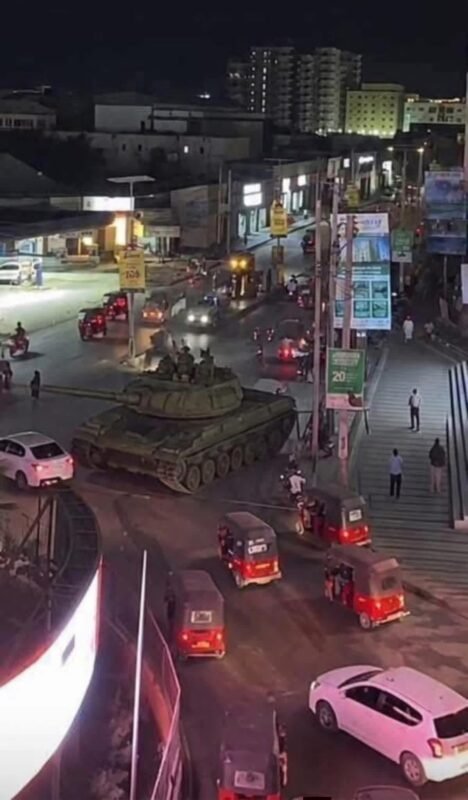
Davis, who has served as Chargé d’Affaires at the U.S. Embassy in Mogadishu since early 2026 after a distinguished career in crisis management and political affairs, stressed that Somalia’s future ultimately “is in the hands of the Somali people and its leaders.” The remarks came after Somali security forces deployed hundreds of troops, tanks, and armored vehicles across the capital, sealing off major roads and effectively preventing an opposition organized rally that had been scheduled for Sunday, May 10. In the days leading up to the planned protest, security forces were also deployed around the home of former Prime Minister Hassan Ali Khaire, and federal authorities carried out a major security reshuffle in northern districts, replacing commanders at key checkpoints and redeploying troops outside the capital.
Witnesses described a tense atmosphere, with heavily armed personnel stationed at strategic intersections and routes to the homes of opposition leaders blocked by armored vehicles and stone barriers. Opposition leaders had confirmed they would proceed with the demonstration despite federal objections, linking the protest to forced evictions, land disputes, and what they called growing authoritarian practices. Forced evictions have recently sparked armed clashes between rival security factions in the Warlaliska neighborhood of Daynile district, resulting in multiple casualties and intensifying public anger.
The protest failed to materialize, but opposition figures and witnesses reported that security forces opened fire to disperse small gatherings, leaving at least one person dead. The government has not publicly commented on the casualty reports. Officials had designated Engineer Yarisow Koonis Stadium as an approved venue for any public gathering, but opposition organizers announced plans to hold protests across 22 locations in the capital, which authorities said would have endangered public order.
The interview provided insight into Washington’s evolving approach to Africa, which Davis described as based on “mutually beneficial partnerships” while reaffirming continued American priorities including counter terrorism, governance improvement, economic collaboration, and regional stability. Davis also warned that persistent political instability could harm both Somalia and its international partnerships, stressing that compromise among Somali political players was urgently required.
His comments followed media reports that Washington had been encouraging both the federal government and opposition figures to participate in negotiations, with some outlets claiming that the first round of U.S. mediated talks was scheduled for May 13 at the Halane compound. However, Somalia’s State Minister for Foreign Affairs, Ali Balcad, has rejected those claims, insisting that Washington was not planning to intervene or facilitate discussions. “The U.S. Embassy is not prepared to directly involve itself in the political tensions currently unfolding in Somalia,” Balcad said. “There is no meeting planned, and there is no intervention being conducted by the embassy in Mogadishu.”
The political standoff centers on the future of Somalia’s electoral system. President Hassan Sheikh Mohamud has championed a transition to a “one person, one vote” model as a historic break from decades of clan based indirect voting. The president has praised the peaceful conduct of direct elections in South West State, describing them as “a new chapter in Somalia’s history.” Opposition leaders have declared that President Mohamud will lose his legal authority after May 15, 2026, unless national elections are conducted or a constitutional alternative is agreed upon. The Somali Future Council has warned that after that date it will take measures to prevent a power vacuum or unconstitutional rule.
With the president’s term set to expire on May 15, the opposition has called for another demonstration on May 16, the first full day after Mohamud’s mandate is scheduled to end. Senior government officials have previously suggested that the administration could remain in power for up to two additional years, a position opposition leaders have rejected. Mogadishu remains under a heavy security presence, and international observers have urged restraint on all sides. Whether Washington’s unusually public criticism will influence behavior on the ground or whether the capital will see a repeat of the 2021 confrontation, when rival military factions clashed, is likely to become clearer in the coming days.
Recommended Reading on ftlsomalia.com:
- Opposition: President’s Mandate Expires May 15 Without Elections
- Somali Government Rejects Claims of Planned U.S.-Mediated Election Talks
- Evictions in Mogadishu Ignite Fierce Political Showdown
- Somali Opposition Plans to Proceed with Anti Government Protest
- Security Forces Deployed at Ex PM’s Residence Ahead of Mogadishu Rally
- Federal Government Deploys New Commanders in Northern Mogadishu
- Federal Government Says Measures Safeguarded Order as Opposition Protest Fails
- President Hassan Sheikh Commends Peaceful Southwest Elections