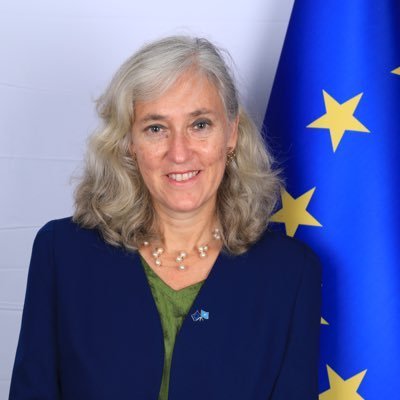
MOGADISHU: President Hassan Sheikh Mohamud received European Union Ambassador Francesca Di Mauro at Villa Somalia on Sunday for talks that both sides described as focused on the strategic partnership between Somalia and the EU. However, a comparison of the official statements issued after the meeting reveals a significant divergence in emphasis, particularly on the country’s unresolved political transition and electoral roadmap.
The readout from Villa Somalia was brief and general. It stated that the meeting concentrated on “enhancing the longstanding strategic partnership between Somalia and the European Union” and “advancing shared priorities linked to state-building and development.” Both parties highlighted “the importance of continued collaboration and constructive engagement on matters of mutual interest.”
Notably absent from the Somali government’s account was any reference to the ongoing political crisis, the expiry of the president’s term on May 15, the collapse of US‑mediated talks at the Halane compound, or the need for an electoral consensus with the opposition.
In contrast, the EU ambassador’s own statement, shared on her official X (formerly Twitter) account, painted a more pointed picture. Ambassador Di Mauro said she and the president had discussed “the way forward” as Somalia enters a new political phase. She added that the talks aimed to reach an agreement on the direction of the elections: a genuinely inclusive process. The EU readout explicitly linked the meeting to the need for resolving the electoral deadlock and ensuring a peaceful political transition, language entirely missing from Villa Somalia’s press release.
What Was Not Stated by Villa Somalia
The omission by the Somali presidency is striking. Villa Somalia made no mention of:
- The expiration of the president’s four‑year term on May 15 under the 2012 Provisional Constitution.
- The opposition’s declaration that President Mohamud is now a “former president” and that his orders should not be obeyed.
- The collapse of US‑ and UK‑mediated talks at the Halane compound just days earlier.
- Any commitment to an inclusive electoral process or a roadmap for a peaceful transition.
The EU ambassador’s emphasis on a “inclusive elections,” suggests that Brussels is pressing the Somali leadership to address the constitutional vacuum and political standoff head‑on. The contrast highlights a growing gap between Mogadishu’s guarded public statements and the more urgent language of international partners who fear prolonged instability could undermine security gains and distract from the fight against Al‑Shabaab.
Context of the Divergence
The disparity comes just days after high‑level talks mediated by the United States and Britain ended without a breakthrough. The Somali Future Council has declared that President Mohamud’s term expired on May 15 and that it no longer recognises his authority. Meanwhile, the president has insisted that his term extends until May 2027 under constitutional amendments passed in March 2026, a position the opposition rejects. The United Nations and the African Union have both called for continued dialogue and urged all parties to avoid unilateral actions that could worsen the crisis.
Ambassador Di Mauro has also been engaging with Puntland President Said Abdullahi Deni, a key opposition figure, and has stated that “both sides remain open to dialogue.” The EU has consistently backed inclusive political processes and warned against any attempt to sideline opposition voices. The latest meeting at Villa Somalia appears to have produced no joint communiqué or concrete agreement, despite the EU envoy’s expressed hope for one.
Other Social Media users have noticed that the EU envoy did not use the title president in her latest tweet, possibly indicating that the EU has taken the position that the term of current FGS has come to an end on May 15th.
The shift, even if subtle, has been interpreted by observers as a deliberate diplomatic signal. At a moment when President Mohamud’s term has expired under the 2012 Provisional Constitution and the opposition refuses to recognize his authority, the EU’s choice of language appears to reflect a new political reality, without formally endorsing either side’s position. Whether the omission was intentional or not, it marks a significant departure from standard diplomatic protocol toward a head of state whose mandate is in dispute
For Somalia’s international partners, the priority remains preventing a further escalation of political tensions while maintaining counter‑terrorism cooperation. Whether the government in Mogadishu will publicly embrace the language of “transition” and “inclusive elections”, as the EU clearly desires, remains uncertain. What is clear is that the divergence between Villa Somalia’s official statements and the EU’s more direct messaging reflects a deepening rift over how to resolve the country’s most serious political crisis in years.
Recommended Reading on ftlsomalia.com: