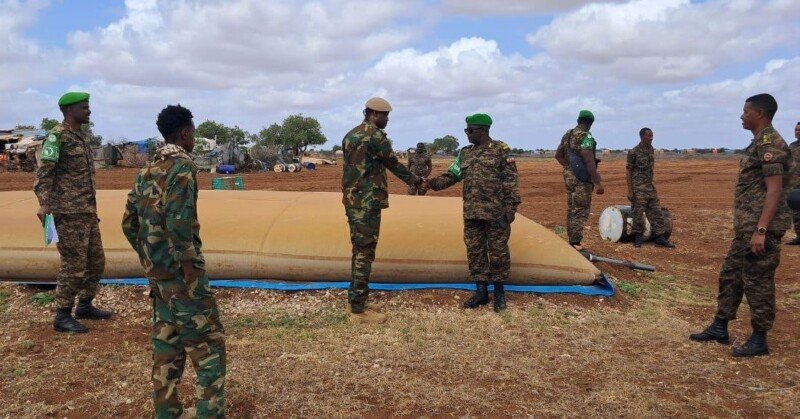
MOGADISHU — The African Union Support and Stabilization Mission in Somalia (AUSSOM) has formally transferred the technical management of the Buurhakaba Forward Operating Base (FOB) to the Somali National Army’s 60th Division in the Bay region, marking another significant step in the progressive transfer of security responsibilities to Somali forces. The handover, which took place on August 8, 2026, with support from the United Nations Support Office in Somalia (UNSOS), comes at a critical juncture as both the AU mission and the UN political presence in Somalia face imminent closure.
The Buurhakaba FOB had been manned since 2014 by the Ethiopian National Defence Force contingent as part of AUSSOM Sector Three operations. The transfer aligns with the Somalia Transition Plan, which envisions the gradual handover of security responsibilities to Somali security forces. The 60th Division has been actively involved in operations against Al-Shabaab in the Bay and Bakool regions.
The handover comes as the United Nations Transitional Assistance Mission in Somalia (UNTMIS) is set to conclude its operations by October 31, 2026, following a formal request from the Federal Government of Somalia. The Somali government, through former Foreign Minister Ahmed Fiqi, wrote to the UN in May 2024 asking not to renew Resolution 2705 (2023), which had established the UN Assistance Mission in Somalia (UNSOM). This request marked a significant shift toward Somali-led governance and the end of decades of direct UN political involvement in the country.
UNTMIS succeeded UNSOM on November 1, 2024, in line with UN Security Council Resolution 2753, with a two-year transition period scheduled to conclude by October 31, 2026. The “sunset clause” sets a definitive timeline for transferring technical and political advisory functions to Somali national institutions and the UN Country Team. The dissolution of UNSOM has been described as a major diplomatic win for President Hassan Sheikh Mohamud, who had long viewed the UN’s role in constitutional development and donor coordination as an infringement on Somalia’s domestic affairs.
AUSSOM’s Mandate and the Transition
AUSSOM, established in January 2025 to replace ATMIS, is mandated to support Somali Security Forces in implementing the Somalia Transition Plan. The UN Security Council adopted Resolution 2809 (2025) in December 2025, extending AUSSOM’s authorization until December 31, 2026, while setting the sunset clause for UNTMIS.
The Security Transition Plan is a comprehensive guide developed by the federal government and partners for the transfer of security responsibility to Somali National Security Forces. Defence Minister Ahmed Moallim Fiqi has held talks with AU Special Representative Ambassador El Hadji Ibrahima Diene to reinforce security cooperation and counter-terrorism efforts as Somalia continues its transition toward full security responsibility.
State Minister for Foreign Affairs Ali Mohamed Omar has met with UNTMIS Officer-in-Charge Raisedon Zenenga to discuss the transition process, with both sides emphasising the importance of continued cooperation in advancing Somalia’s national priorities. UNTMIS is mandated to work closely with the Somali government on security, development and humanitarian assistance during the two-year transitional period.
Funding Crisis and Security Concerns
The transition comes amid significant funding uncertainty. The United States formally notified the African Union on July 1, 2026, that it would end support for UNSOS when the mission’s mandate expires, raising concerns about the sustainability of AUSSOM operations. AFRICOM Commander General Dagvin R.M. Anderson has reaffirmed US support for Somali forces, but Washington has grown increasingly frustrated with what it views as insufficient progress by Somali leaders in assuming responsibility for their own security. The US has contributed nearly $2 billion to the UN support mission but has notified the AU that it will no longer finance UNSOS beyond December 2026.
UNSOS has issued a public tender to liquidate a vast inventory of equipment, including vehicles, generators, medical and laboratory equipment, and heavy construction machinery, signaling a potential wind-down of operations. The request for expressions of interest, published August 6 on the UN Global Marketplace, seeks qualified auctioneers to manage the commercial sale of assets.
Phased Transition and Political Stabilisation
The transition is structured in two main phases. Phase One (November 2024 – October 2025) prioritised support and capacity building in state-building, human rights, rule of law, security sector support, coordination of international aid, and counter-violent extremism. Phase Two (November 2025 – October 2026) involves the progressive transfer of all remaining functions to the Federal Government, the UN Country Team and other partners.
A workshop with 47 delegates from the UN and the Federal Government focused on strengthening the rule of law, policing, corrections, and maritime security systems as part of the UNTMIS roadmap development process. Nasrin Khan, Head of UNTMIS’s Rule of Law and Security Institutions Group, emphasized that the goal remains building a justice and security framework that is resilient, inclusive and responsive to the needs of Somali citizens.
The UK has reaffirmed its defence ties with Somalia, with British Ambassador Charles Nicholas King meeting Defence Minister Fiqi to discuss strengthening bilateral security cooperation, enhancing Somali defence capabilities, and supporting efforts to combat terrorism as Somalia prepares for a post-AUSSOM security architecture.
Critical Note
While the Buurhakaba handover and the transition of UNTMIS functions represent significant steps toward Somali-led governance and security, the timing of these transitions raises serious concerns. The US decision to end funding for UNSOS threatens to undermine the military progress made over nearly two decades of AU-led peacekeeping operations. The government must urgently address internal political divisions and implement meaningful security sector reforms to ensure a smooth transition.
The Kampala summit’s call for an 18-to-24-month extension of UN logistical support reflects a recognition that Somali forces are not yet fully prepared, but this request comes at a time when international support is shrinking. Without a credible, time-bound plan for Somali self-reliance and sustained international engagement, the gains of the past two decades could be reversed, creating a security vacuum that Al-Shabaab is poised to exploit.
Recommended Reading On ftlsomalia.com
- UN to Close Somalia Political Office, Extend AU Mission Until 2026
- Somalia Urges the UN Not to Renew Resolution 2705 (2023)
- Foreign Affairs Minister Meets UNTMIS Delegation
- Defence Minister and AU Envoy Strengthen Ties as AUSSOM Faces Funding Uncertainty
- UN Security Council Extends AU Mission in Somalia
- US Reaffirms Support for Somali Forces