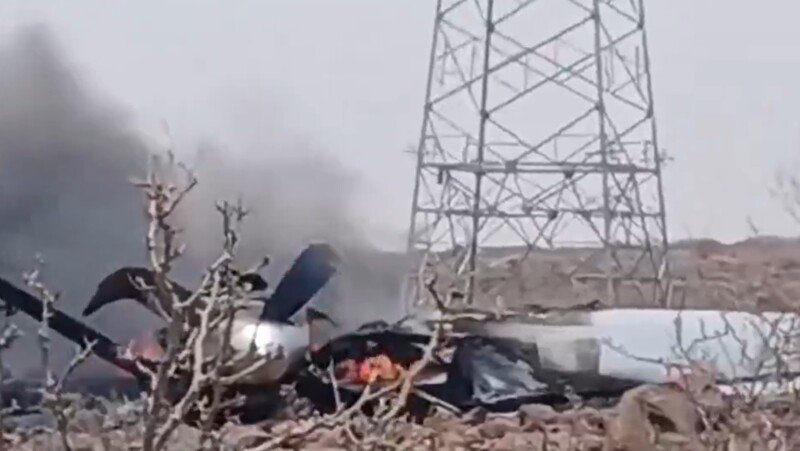
DJIBOUTI CITY — A United States MQ-9 Reaper drone crashed near the Chabelley Airbase in Djibouti on Sunday, August 9, 2026, prompting a security alert from the U.S. Embassy and raising concerns about potential Houthi involvement in the incident.
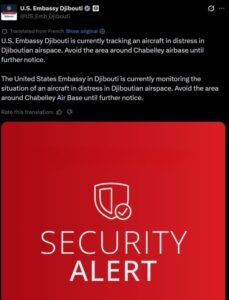
The U.S. Embassy in Djibouti issued a statement confirming it was “tracking an aircraft in distress in Djiboutian airspace” and urged the public to avoid the area around Chabelley Airbase until further notice. The embassy’s alert, posted on social media, did not specify the type of aircraft or the cause of the emergency.
However, multiple reports from media outlets and open-source intelligence sources indicate that the aircraft was a U.S. Air Force MQ-9A Reaper drone that crashed shortly after taking off from Chabelley Airfield. The exact cause of the crash has not yet been determined.
Chabelley Airbase, located southwest of Djibouti City, is a key hub for U.S. military operations in the Horn of Africa and hosts American MQ-9 Reaper drones used for regional surveillance missions. The crash comes amid heightened regional tensions and follows a series of incidents involving U.S. drones in the area.
Potential Houthi Involvement
While no group has claimed responsibility for the drone crash, the incident has fueled speculation about potential Houthi involvement. The Houthi movement in Yemen has a documented history of targeting U.S. MQ-9 Reaper drones. Reports indicate that Houthi forces have shot down numerous American drones over Yemen, with some estimates suggesting as many as 28 MQ-9 Reapers have been lost since 2017.
The Houthis have also escalated their campaign of drone and missile attacks on maritime targets in the Red Sea and the Bab al-Mandeb strait, a vital shipping chokepoint. In July 2026, a drone strike, which some reports attributed to the Houthis, damaged a liquefied natural gas terminal at the Egyptian port of Damietta.
Some initial reports suggested that the MQ-9 drone that crashed in Djibouti might have been returning from a patrol in the Gulf of Oman and lost signal in the vicinity of the Bab al-Mandeb strait, potentially linking its fate to hostile action in the region. The Houthis have cultivated relationships with armed groups in the Horn of Africa, creating an environment where regional conflicts increasingly overlap.
Reports have emerged of an Israeli intelligence presence in Somaliland, with discussions reportedly including the possibility of a military foothold near the Bab al-Mandeb Strait. Yemen’s Houthi movement has already closed the Red Sea to Israeli ships and has threatened to close the strait entirely amid regional tensions.
The United Nations Security Council has extended monthly reporting on Houthi attacks in the Red Sea, with Somalia’s representative emphasising that instability in the Red Sea extends beyond regional boundaries and is closely connected to global peace and prosperity.
The Houthis have previously targeted a UN-flagged aid vessel carrying humanitarian supplies from Somalia, killing four crew members and detaining ten others in an attack that Human Rights Watch labelled a possible war crime.
In a separate incident, the wreckage of a cruise missile was found in Somalia’s Sool region, with authorities believing it was launched by Houthis in Yemen, underscoring the direct security risks facing Somalia from the ongoing conflict.
Regional Context and U.S. Military Presence
The incident occurs as the region remains volatile. A fourteen-nation naval coalition, led by Saudi Arabia, was officially launched on July 31, 2026, to secure the Bab al-Mandeb strait. The formation of this coalition was a direct response to escalating threats, including a reported 40 percent drop in oil tanker transits in just one week.
The U.S. has a significant military presence in Djibouti, with Chabelley Airbase serving as a critical hub for drone operations. Djibouti’s strategic location has made it a key partner in regional security, although the country also faces complex challenges, including a fragile environment and the risk of instability in neighboring Somalia and Yemen.
Global shipping giant Maersk recently suspended new cargo bookings to Berbera, citing “scheduling changes” at a time when the port has been positioning itself as a rising hub for regional commerce. The suspension added pressure to supply chains in the Horn of Africa, particularly for landlocked Ethiopia.
Critical Note
The crash of a U.S. MQ-9 Reaper drone in Djibouti underscores the fragility of security in the Horn of Africa and the interconnected nature of conflicts in the region. While the cause of the crash remains unclear, the incident highlights the risks posed by the Houthi movement’s growing military capabilities and its willingness to target both maritime and aerial assets. The incident also raises questions about the effectiveness of the newly formed naval coalition and the broader international effort to secure the Bab al-Mandeb strait. As the line between regional conflicts blurs, the potential for direct confrontation between international forces and regional actors increases, threatening to further destabilize a region already grappling with conflict, climate change, and humanitarian crises. The international community must work to de-escalate tensions and address the root causes of instability, while also ensuring that military operations are conducted with transparency and accountability.