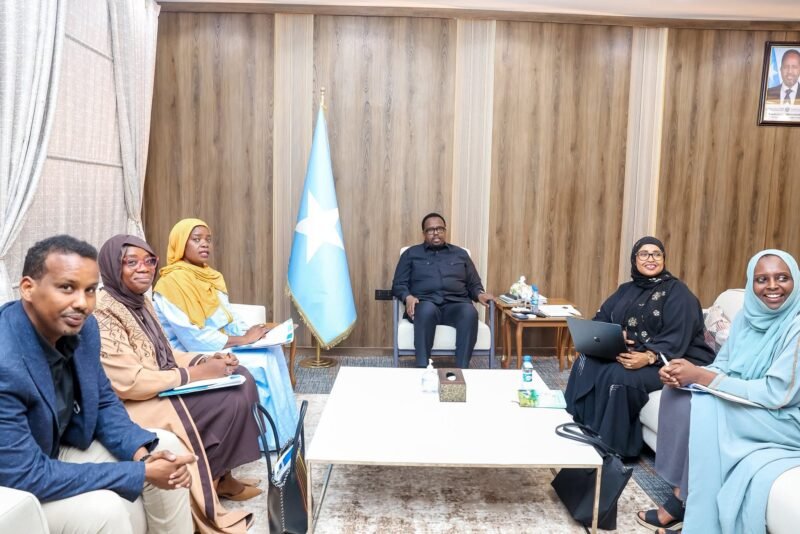
MOGADISHU — The Deputy Prime Minister of Somalia, Salah Ahmed Jama, has received a UN Women delegation headed by Anna Mutavati, Regional Director for East and Southern Africa, to enhance collaboration between Somalia’s government and the UN agency.
The discussion centered on promoting women’s leadership, increasing political involvement, and broadening initiatives that safeguard and empower Somali women and girls.
Deputy Prime Minister Commends UN Women’s Support
The Deputy Prime Minister acknowledged UN Women’s ongoing support for Somali women, highlighting the need to intensify efforts to enable women to take more active roles in state-building, governance, and peace initiatives.
Deputy Prime Minister Jama has previously announced government plans to incorporate more women into the country’s maritime sector, stating that the country must empower more women to improve the whole value chain in the maritime sector. “Women have a critical role to play in this value chain,” he said while launching the national action plan for the Women in Maritime Sector (WiMS).
UN Women Reaffirms Commitment
In response, Anna Mutavati commended the Somali government’s advancements in addressing women’s concerns and reaffirmed UN Women’s dedication to deepening cooperation and continuing assistance to Somalia.
The Minister of Family and Human Rights Development, Khadija Mohamed Al-Makhzoumi, recently unveiled the second phase of the Women’s Peace and Protection Joint Programme (WPP-II), a two-year initiative supported by the United Nations, implemented by UN Women and UNDP with technical assistance from UNTMIS. The initiative aims to reach up to 42,000 people across the nation, focusing on at-risk populations such as internally displaced persons, minority communities, and women with disabilities.
Legislative Milestones for Women’s Empowerment
The meeting comes amid significant legislative progress for women’s rights in Somalia. A mandatory 30 percent women’s quota has been integrated into both the Electoral Law and the Political Parties Law — a historic structural move toward ensuring inclusive, nationwide political engagement. New legislation addressing gender-based violence, the federal ban on female genital mutilation (FGM), and the comprehensive Family Law have substantially enhanced legal protections for women.
Family Ministry Engages UN Women on Gender Equality
The Deputy Prime Minister’s meeting follows similar high-level engagements between Somali institutions and UN Women. In December 2025, the Ministry of Family and Human Rights Development convened a senior-level meeting with UN Women officials, renewing their joint dedication to promoting women’s empowerment and gender equality throughout Somalia. The talks focused on intensifying collaboration to expand gender initiatives, such as those enhancing women’s involvement, safeguards, and economic empowerment.
Women’s Role in Peacebuilding and Humanitarian Response
Women’s Leadership Across Sectors
The meeting reflects the government’s broader commitment to advancing women’s leadership across all sectors of Somali society. The WPP-II initiative is expected to contribute significantly to enhancing women’s participation in leadership, peacebuilding, and decision-making processes nationwide, while supporting the implementation of laws and policies that ensure meaningful inclusion and protection.
Women’s Affairs Coordinator Participates
The Women’s Affairs Coordinator at the Prime Minister’s Office, Aminakeyf Ahmed, also participated in the meeting, underscoring the government’s institutional commitment to mainstreaming gender equality across all ministries and agencies.
The meeting between Deputy Prime Minister Jama and the UN Women delegation marks another step in Somalia’s ongoing efforts to advance women’s empowerment, gender equality, and inclusive governance as the country continues its transition toward democratic stability and long-term development.