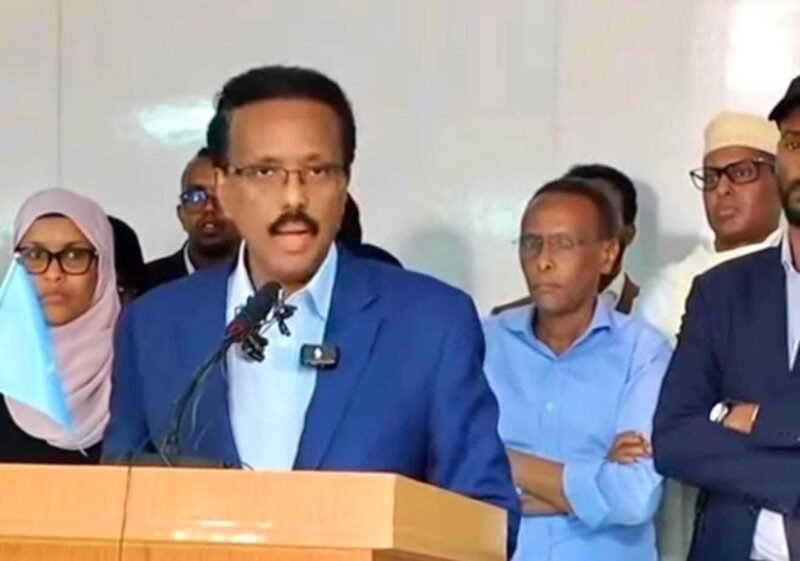
MOGADISHU — Former President Mohamed Abdullahi Farmaajo has declared that the constitutional mandate of the Federal Parliament officially expired on April 14, 2026, warning that Somalia has entered a period of “rising political uncertainty.”
Farmaajo argued that legislative activities can only resume after new elections are held, challenging a recent one-year term extension announced by the leadership of the House of the People. The former president’s statement adds significant weight to the growing opposition against the federal government’s current trajectory.
Urgent Call for Election Plan
In a direct address to his successor, Farmaajo noted that President Hassan Sheikh Mohamud has only one month left in office under his mandate, set to expire on May 15. He urged the administration to present an urgent and clear election plan to avoid a total constitutional vacuum.
“A month before the end of his term, outgoing President Hassan Sheikh Mohamud must urgently present a credible plan for the upcoming elections. Failing to do so will destabilize the country in ways that will have lasting political, social, security, and economic implications,” Farmaajo said.
Any further delays could worsen Somalia’s humanitarian, economic, and security challenges, Farmaajo cautioned, echoing concerns from regional states and international observers.
Farmaajo Eyes Political Comeback
Farmaajo’s intervention comes as he prepares to re-enter the political arena. Mogadishu is bracing for the return of the former president, who is expected to gear up for the 2026 elections. Farmaajo, who served as the nation’s ninth president from 2017 to 2022, is widely remembered for his nationalist rhetoric and efforts to centralize government authority amid Somalia’s complex federal system.
Political observers say his return signals a renewed push for influence in a landscape increasingly defined by youth activism, clan dynamics, and a more assertive civil society. Farmaajo’s campaign is expected to focus on national unity, economic recovery, and security, aiming to reconnect with voters who supported his earlier vision for Somalia’s future.
Previous Warnings on Constitutional Path
Farmaajo has previously expressed deep concern over Somalia’s political trajectory. In December 2025, he issued a detailed political statement warning that Somalia’s governance process has diverged from the agreed constitutional path, emphasizing that key decisions require broader national consensus. He cautioned that unilateral political moves could deepen divisions and undermine state-building efforts.
“The people rejected Farmaajo when he tried it, and they will reject Hassan Sheikh if he follows the same path. Leadership is not ownership. When your time ends, you must step aside and let the nation decide,” a prominent local elder previously warned, as reported by FTL Somalia in October 2025. The elder’s remarks came amid growing speculation about potential term extension attempts.
Parliament Enters Caretaker Phase
The former president’s remarks come at a volatile moment for the Horn of Africa nation. Several lawmakers resigned earlier Tuesday, refusing to recognize the parliamentary extension. While the federal government insists the extension is necessary to implement a “one-person, one-vote” system by 2027, critics view it as an illegal power grab.
Abdulatif Muse Sanyare, a member of the House of the People, has stated that parliament will now operate in a caretaker capacity.
“From today, parliament enters a caretaker phase. It can handle essential and routine matters but cannot pass new laws or approve major agreements until a new parliament with full legitimacy is formed,” Sanyare said.
He added that the legislature’s ability to hold the executive accountable, including summoning or dismissing ministers, is effectively suspended during this period.
Constitutional Amendments Rejected by Regional States
The political standoff has intensified the rift between the central government and regional administrations, further complicating the country’s efforts to stabilize amid ongoing security threats.
The situation is further complicated by recent constitutional amendments approved by the federal parliament before the end of its term. The changes include extending the mandates of federal institutions, including the presidency, from four to five years. The federal government has defended the move as necessary for transitioning to a one-person, one-vote electoral system.
However, the amendments have been strongly rejected by Puntland and Jubbaland state administrations, as well as opposition groups, who argue that the Provisional Constitution clearly sets a four-year term and that the changes lack broad national consensus.
Elder Warnings and Public Sentiment
Elder Hussein Hadole previously declared that President Mohamud has “six months left” in his tenure, stressing that the Somali public will not tolerate any attempt to prolong his stay, just as they opposed former President Farmaajo when he faced accusations of seeking an extension.
“If leaders start deciding their own timeframes, then there is no difference between a president and a dictator,” Hadole said.
The president’s allies have previously argued that ongoing security operations and state-building initiatives require continuity, but critics say such reasoning should not override constitutional order. Analysts warn that even the perception of an attempted extension could reignite protests or factional conflict at a time when unity is crucial.
Political Uncertainty Deepens
With parliament’s mandate now expired and the presidency due to reach its term limit in one month, Somalia is facing widening political uncertainty and an increasingly unclear path toward elections. Despite repeated warnings from opposition figures and regional authorities, officials in Mogadishu have yet to present a broadly accepted framework to resolve the deepening constitutional and political impasse.
The dispute comes at a time of increased political tension following changes to the constitution that were passed by the federal parliament shortly before its term ended. The political standoff has revived memories of the 2021 political crisis, when prolonged disputes over delayed elections escalated into armed clashes on the streets of Mogadishu between the administration of then-President Farmaajo and opposition forces.
Sources indicate that opposition leaders are planning political meetings in Galkayo to coordinate their next steps, although internal disagreements have reportedly slowed efforts to unify their position. Tensions are also rising in Mogadishu, with stakeholders closely watching developments amid concerns over potential instability.
Somalia now faces a challenging political transition, as international partners and citizens alike await a negotiated solution that could pave the way for stability and consensus.