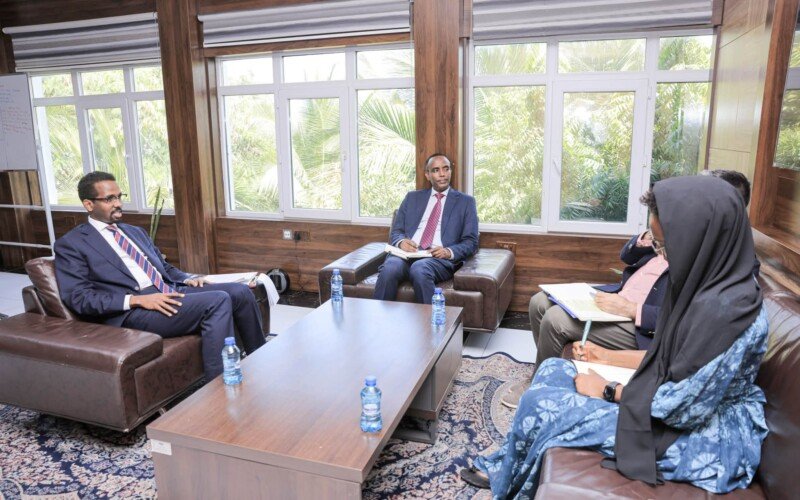
MOGADISHU — The Director General of Somalia’s Ministry of Planning, Investment and Economic Development, Abdifatah Abdulqadir Farah (Abdifatah Hared), has held a productive meeting with the Chief of Mission of the International Organization for Migration (IOM) in Somalia, Manuel Marques Pereira, to discuss aligning the agency’s programmes and strategies with the government’s flagship National Transformation Plan (NTP) 2025-2029.
The talks, which took place in Mogadishu on Thursday, August 6, 2026, focused on ensuring that IOM’s interventions are fully harmonized with Somalia’s national development priorities, strengthening the government’s coordination role in development cooperation, and reinforcing the alignment of international support with domestic goals. Both sides also discussed enhancing joint planning, improving coordination of development efforts, strengthening migration and displacement data systems, and reviewing IOM’s country strategy to ensure it reflects Somalia’s evolving needs and priorities.
IOM has been a key partner in supporting reconstruction and resettlement efforts, with the agency’s Chief of Mission previously reaffirming full commitment to supporting government initiatives in urban development and social welfare. The meeting builds on a series of engagements between Somali ministries and IOM, including the agency’s reaffirmation of its commitment to Somalia’s stability and migration agenda in July 2025.
Aligning IOM’s Strategy with National Priorities
A central focus of the discussions was the need to ensure that IOM’s programmes and strategies are fully aligned with the National Transformation Plan, the government’s medium-term development framework that runs from 2025 to 2029. The NTP was officially launched in March 2025 and serves as a blueprint for Somalia’s transformation, addressing critical challenges in governance, economic growth, infrastructure, and social development.
Deputy Prime Minister Salah Ahmed Jama has highlighted the NTP as the government’s primary development framework, and the Ministry of Planning has been actively coordinating with international partners to ensure their programmes complement national priorities. The Ministry has held similar talks with CARE International to strengthen collaboration on NTP implementation, focusing on monitoring and evaluation systems and institutional capacity-building.
Director General Farah welcomed IOM’s commitment to strengthening cooperation with the federal government. Both sides agreed to accelerate consultations, enhance collaboration, and take effective steps to advance the implementation of the country’s development plans.
IOM’s Role in Somalia’s Development and Migration Landscape
IOM has been operational in Somalia since 2006, implementing a wide range of programmes in displacement tracking, community stabilization, health, livelihoods, and migration management. The agency has been actively involved in supporting Somalia’s efforts to manage migration, address displacement, and build resilience among vulnerable communities. IOM’s programmes, including Daris-Wacan, Saameynta, and Resilience, have been pivotal to the state’s broader reconstruction objectives.
Somalia recently adopted its first National Labour Migration Policy, developed in close collaboration with IOM and other partners, establishing a legal and institutional framework to promote safe, orderly, and regular migration. The policy reflects the government’s commitment to strengthening migration governance and protecting the rights of migrant workers.
The meeting also comes as Somalia continues to face significant displacement challenges, with IOM providing counselling and reintegration assistance to stranded migrants, including over 1,400 Somali migrants who remained stranded in Libya as of April 2025. The agency’s Displacement Tracking Matrix has been a critical tool for monitoring population movements and informing humanitarian responses.
Strengthening Government Coordination and Data Systems
The discussions also addressed the importance of strengthening migration and displacement data systems, improving coordination between government institutions and international partners, and enhancing the government’s role in leading and coordinating development cooperation. The Ministry of Planning has been working to strengthen national monitoring and evaluation systems to ensure that development programmes are effectively tracked and that resources are directed to priority areas.
The NTP includes ambitious targets, such as expanding electricity coverage to 80 percent and cutting electricity costs by half nationwide, reflecting the government’s commitment to transformative change. Aligning international partners’ programmes with these national targets is essential to ensuring that development assistance contributes to sustainable progress.
Critical Note
While the meeting between the Ministry of Planning and IOM reflects a welcome commitment to aligning international support with national priorities, the gap between policy alignment and on-the-ground implementation remains a persistent challenge in Somalia’s development landscape. The NTP, while ambitious, faces significant obstacles including funding shortfalls, institutional capacity constraints, and the ongoing security crisis. The government’s ability to effectively coordinate the diverse array of international partners and ensure that their programmes contribute to national goals will be a critical test of its development governance capacity. Furthermore, while IOM’s programmes in displacement tracking, community stabilization, and migration management are valuable, they must be complemented by broader efforts to address the root causes of displacement, including conflict, climate change, and economic marginalization. The government would be well advised to ensure that the alignment of international programmes with the NTP is accompanied by strengthened monitoring and evaluation systems, transparent reporting, and accountability mechanisms to ensure that development assistance translates into tangible improvements in the lives of ordinary Somalis. Without such measures, the risk remains that well-intentioned partnerships will produce limited results, and that Somalia’s development aspirations will remain unrealized.
Recommended Reading On ftlsomalia.com
- Somalia Officially Launches the 2025-2029 NTP
- Deputy Prime Minister Opens Third Somalia Development Forum
- Ministry of Planning and CARE International Discuss NTP Implementation
- Somalia’s Public Works Ministry and IOM Enhance Cooperation on Reconstruction
- IOM Reaffirms Commitment to Somalia’s Stability and Migration Agenda
- Somalia Adopts First National Labour Migration Policy