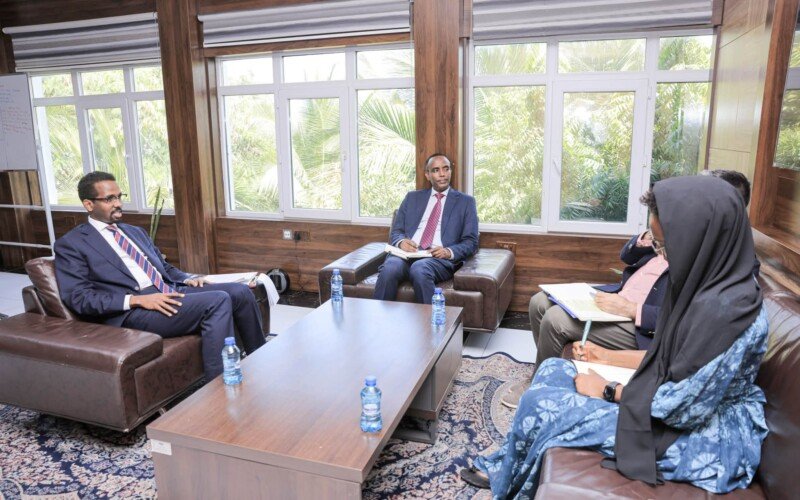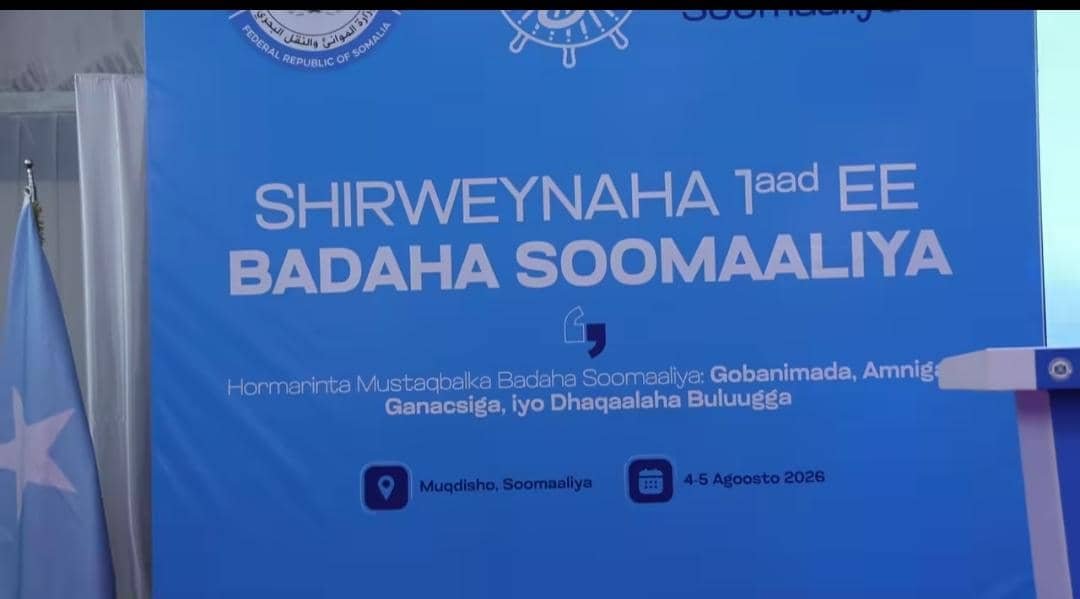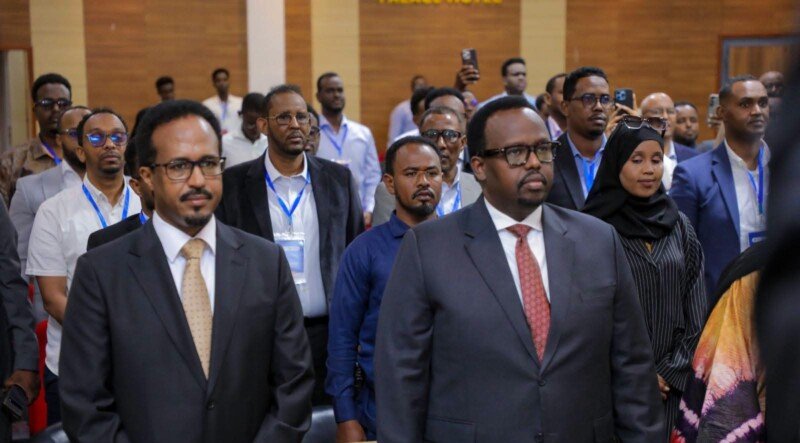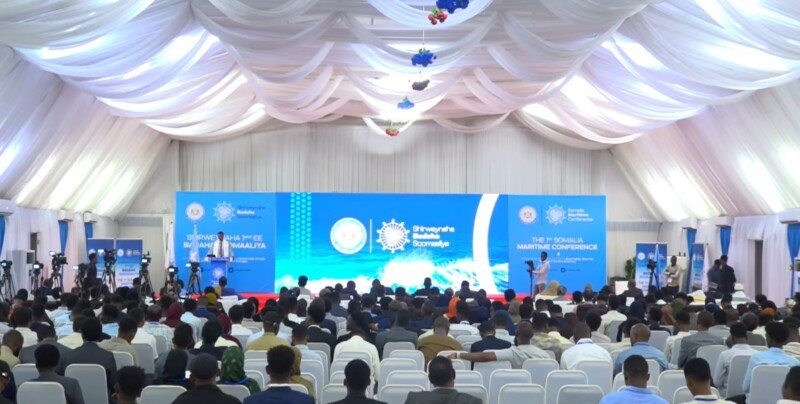
MOGADISHU — Somalia’s first-ever national maritime conference concluded on August 5, 2026, with a comprehensive communiqué outlining sweeping reforms to strengthen maritime governance, security, and economic development, following two days of deliberations that brought together government institutions, academia, international partners, and the private sector.
The inaugural Somalia Maritime Conference, organized by the Ministry of Ports and Marine Transport under Minister Abdulqadir Mohamed Nur (Jaamac), was officially opened by President Hassan Sheikh Mohamud. The conference sought to establish a national platform for annual discussions on maritime affairs, including ports, blue economy, shipping, maritime security, and the sustainable use of ocean resources.
President Mohamud opened the conference by highlighting Somalia’s vast potential for investment in the maritime and blue economy sectors, describing the country’s maritime domain as a strategic national asset with the potential to drive economic growth, create jobs, and strengthen regional connectivity.
National Maritime Strategy and Institutional Reforms
A central recommendation of the conference was the development and adoption of a comprehensive National Maritime Strategy that defines Somalia’s objectives in maritime defence, security, the blue economy, ports, shipping, environmental protection, and maritime diplomacy. The conference called for the establishment of a National Maritime Council comprising relevant ministries and agencies, supported by a technical committee of experts.
Participants also urged the government to prioritize maritime affairs in national planning and annual budgets, and to accelerate the drafting and review of maritime legislation to align with the constitution, international law, and national security interests. In a significant move, the conference endorsed the creation of a Somali Ports Authority or Agency and the completion of enabling legislation.
Maritime Security and Defence Capabilities
On maritime security and defence, the conference called for strengthening the Somali Navy and the Somali Police Force’s coast guard unit, ensuring they receive adequate resources, training, and equipment to fulfil their national duties. It also emphasized the importance of promoting research on maritime security, with the Somali Institute for Security Studies playing a regular role.
Somalia has recently tightened its grip on piracy with new maritime legislation, safeguarding its waters and protecting international shipping routes. The EU has also conducted joint drills with the Somali Coast Guard to boost maritime security, deter piracy, and ensure the safe passage of vessels in one of the world’s busiest maritime corridors.
Blue Economy, Environment, and Fisheries
The conference placed significant emphasis on combating illegal, unreported, and unregulated (IUU) fishing and other forms of maritime crime to protect Somalia’s marine environment and biodiversity. It called for the implementation of large-scale national projects to enhance the utilisation of diverse maritime resources and strengthen preparedness for climate change impacts.
Somalia’s blue economy holds billion-dollar promise, with Director General Dirshe underscoring the untapped potential of the country’s maritime resources. “Somalia’s blue economy can transform livelihoods and strengthen our economy, but only if we protect it. Illegal fishing is not just a theft of resources—it’s a theft of opportunity from our people,” Dirshe said.
Prime Minister Hamza Abdi Barre has launched a new Fisheries Ministry headquarters to boost Somalia’s blue economy, describing it as “the country’s future.”Somalia has also established the SOMTÜRK fisheries partnership with Turkey to enhance blue economy development, increase fish production, create local processing facilities, and address IUU fishing.
Federal and Regional Coordination
Recognising the need for coordination between the federal government and federal member states, the conference recommended holding regular operational meetings between ministries and agencies at both levels to structure cooperation on maritime affairs. It also proposed the creation of a joint working group of federal and regional representatives to coordinate maritime issues on an ongoing basis.
Maritime Diplomacy and International Engagement
The conference stressed the importance of unified diplomatic efforts on maritime issues, led by the Ministry of Foreign Affairs and International Cooperation to ensure coherence across government. It called for the establishment of a dedicated diplomatic repository for maritime affairs and for strengthening Somalia’s permanent mission to the International Maritime Organization (IMO) with adequate technical and financial resources.
Participants urged prioritisation of engagement with international and regional forums on maritime issues and the ratification of international maritime conventions that serve Somalia’s national interests. They also recommended the creation of a Somali experts’ platform on international law of the sea and the establishment of a dedicated forum for Somali scholars and professionals specialising in maritime science and related disciplines.
Ports, Shipping, and Infrastructure
On ports and shipping, the conference called for the modernisation of Somali ports, including dedicated fishing ports, and the development of a domestic shipping service connecting regional ports for passenger transport and cargo. It also urged support for Somali-owned shipping businesses through addressing obstacles and facilitating investment, as well as the renegotiation of port concession agreements with local and international companies.
Somalia and Egypt have agreed to enhance cooperation in fisheries, blue economy, and petroleum and mineral resources, following separate meetings held in Mogadishu between senior Somali ministers and an Egyptian delegation.
Education and Maritime Sciences
The conference underscored the need to strengthen maritime education and research. It called for the activation of the Somali Maritime Institute with a dedicated annual budget, the establishment of a National Defence University, and the creation of an independent faculty of maritime studies at the Somali National University with adequate funding. It also recommended the development and publication of a Somali-language dictionary of maritime sciences.
Annual Conference and Implementation
Finally, the conference endorsed President Mohamud’s decision to make the Somalia Maritime Conference an annual event, with a dedicated budget to sustain it, and to ensure that the communiqué’s recommendations are translated into cabinet decisions and integrated into national policies, laws, and plans.
Critical Note
While the inaugural Somalia Maritime Conference produced an ambitious and comprehensive communiqué, the gap between policy aspirations and implementation remains a familiar challenge in Somalia’s state-building journey. The conference’s recommendations, while well-intentioned, rely heavily on institutional capacity, funding, and political will that have historically proven elusive. The creation of a National Maritime Council, a Somali Ports Authority, and a National Defence University will require sustained legislative and budgetary commitment from a government already stretched thin by security and humanitarian crises. Furthermore, the federal government’s ability to coordinate effectively with federal member states on maritime issues, particularly given recent tensions with Puntland over Turkish fisheries and oil exploration, remains untested. The conference’s emphasis on combating illegal fishing and strengthening maritime security is welcome, but Somalia’s track record of enforcing its maritime laws and protecting its vast coastline from foreign exploitation is weak. Without concrete action plans, dedicated funding, and transparent monitoring mechanisms, the communiqué risks becoming another well-intentioned but largely unimplemented policy document. The international community, which has significant stakes in maritime security in the Horn of Africa, would be well advised to support Somalia in translating these recommendations into tangible outcomes, while holding the government accountable for progress.
Recommended Reading On ftlsomalia.com
- President Mohamud to Open Inaugural Somalia Maritime Conference as Blue Economy Takes Center Stage
- Somalia’s Blue Economy Holds Billion-Dollar Promise, Says DG Dirshe
- PM Barre Launches New Fisheries Ministry HQ to Boost Somalia’s Blue Economy
- Somalia Tightens Grip on Piracy with New Maritime Law
- EU Conducts Joint Drill with Somali Coast Guard to Boost Maritime Security