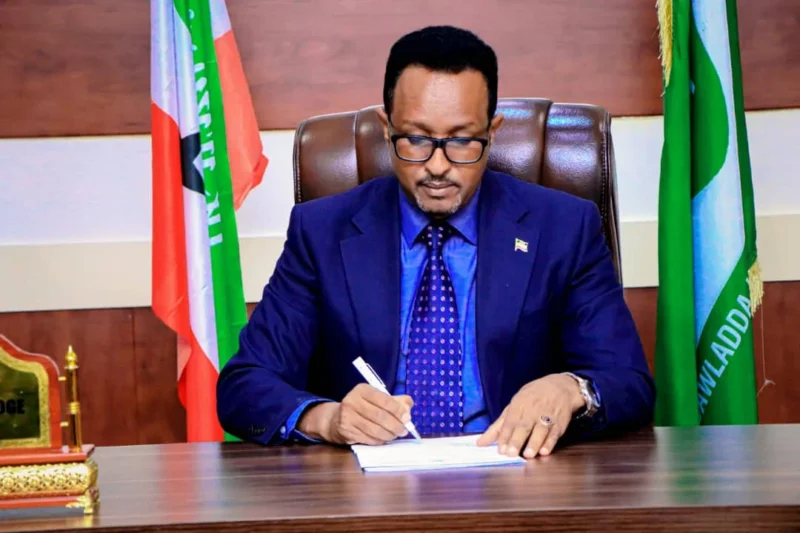
HARGEISA – The Hargeisa City Council has dismissed Mayor Abdikarim Ahmed Mooge and his deputy, Khadar Ahmed Omar, following an emergency session on Tuesday, marking the first time a sitting mayor of the Somaliland capital has been removed by the local council since the territory adopted its multi‑party democratic system. Hours after the vote, the council elected engineer Abdirisaq Mohamed Farah, widely known as “Wiiwaa,” as the new mayor and engineer Aadan Jama Hadi, known as “Mideeye,” as deputy mayor. The two will jointly lead the administration of Somaliland’s political and economic capital for the remaining two years of the council’s extended mandate.
The removal session was chaired by the governor of the Maroodi Jeh region and attended by members of the regional council as well as the secretary of Hargeisa municipality. Council members approved the removal after a motion was filed accusing both officials of failing to carry out their duties, poor management practices, and other administrative concerns. The formal motion to remove Mooge and his deputy was submitted a day before Tuesday’s vote. Political analysts described the development as unprecedented in Somaliland’s modern democratic history, marking the first time an incumbent mayor of Hargeisa has been formally removed by the local council since the adoption of the territory’s multi‑party political system.
Political Background and Term Extension Controversy
Mooge and his deputy assumed office on June 17, 2021, after departing from the opposition parties Waddani and UCID, which had previously formed a political alliance. Mooge had long indicated his intention to resign from his post, saying his tenure was originally due to expire at the end of May 2026. However, Somaliland’s House of Elders approved a 27‑month extension in April for the mandates of local councils and the House of Representatives, effectively extending the political calendar and intensifying political tensions within the council. The extension drew criticism from opposition figures and civil society groups, who warned it could deepen political uncertainty and institutional tensions. Analysts said the extension became a catalyst for escalating rivalries inside the Hargeisa council, where competing alliances increasingly clashed over the future direction of the capital’s administration.
New Leadership and Cross‑Party Alliance
Wiiwaa, who was elected to the Hargeisa Local Council in 2021 under the opposition Waddani party, pledged after the vote to prioritize cooperation and urban development in the rapidly expanding capital. “Thank God, the extraordinary session ended peacefully and respectfully for us,” Wiiwaa said after his election. “I promise to work for you and take the task further, God willing.” He called on city council members to cooperate with the new leadership, share ideas, and work together on Hargeisa’s development. Deputy Mayor Mideeye was elected from the ruling Kulmiye party, creating a cross‑party municipal leadership arrangement that analysts say could either stabilize the council or generate new political bargaining inside City Hall. A rival bloc backing candidate Khadar Noor boycotted Tuesday’s session, underscoring divisions inside the council chamber during the highly scrutinized proceedings.
Protests, Gunfire, and Police Response
The leadership change has sharply divided public opinion in Hargeisa. Some residents and politicians support the removal of Mooge, while others reject the council’s decision. The tensions led to gunfire in the capital on Monday night, ahead of Tuesday’s extraordinary session. Somaliland police said Tuesday they arrested several people accused of firing gunshots in Hargeisa during protests linked to the city council’s election of a new mayor and deputy mayor. Police spokesman Abdiaziz Sheikh Ismail said officers had identified people suspected of firing weapons in the capital Monday night, with some detained and others still being pursued. “Last night, shots were fired in the capital by suspects who have been identified by the police. Some have been arrested and some are being pursued,” Abdiaziz said. “The people of Somaliland have given us good support in this matter.” The police spokesman warned people using social media to spread what he described as statements that could damage security and stability, adding that police were monitoring anyone involved in illegal acts.
Legal Framework and Dismissal Process
The motion to dismiss Deputy Mayor Khadar Ahmed Omar had been initiated by eight local councilors who cited Article 51 of the Governance Law and Somaliland Districts (Lr. 23/2019), which grants the council the power to dismiss the Deputy Mayor. The councilors argued that the Deputy Mayor had failed to address ongoing conflicts within the Hargeisa local council and had been blamed for political and community divisions in the capital. On Monday, the Ministry of Local Government and Urban Development officially announced that the Hargeisa Local Council would hold an extraordinary meeting to discuss a motion to dismiss the Deputy Mayor. The letter, dated May 11, 2026, from the office of the Minister of Local Government, Mr. Hassan Du’ale Ma’alin, stated that the ministry had accepted a request from eight local councilors from Hargeisa Municipality. The motion to dismiss Mooge and his deputy was then expanded to include both officials.
Analysis and Outlook
The removal of Abdikarim Mooge represents a notable political shift in Somaliland, particularly considering his popularity among certain segments of the public and his reputation for implementing visible urban reforms and civic engagement in Hargeisa. The council’s decision appears to reflect increasing political and administrative tensions within the city leadership, as well as evolving alliances inside the municipal council. Although the official accusations centered on governance and management issues, the action is also likely connected to broader political considerations as Somaliland’s political landscape continues to develop. The rapid appointment of new leadership indicates that council members aimed to ensure continuity in city administration and prevent an extended power vacuum in the capital. The departure of Mooge could provoke varied reactions among residents, with supporters potentially viewing the dismissal as politically motivated, while critics may argue that administrative changes were necessary. The performance of the newly elected mayor and deputy mayor will likely face careful examination as they take control of Somaliland’s most significant city.