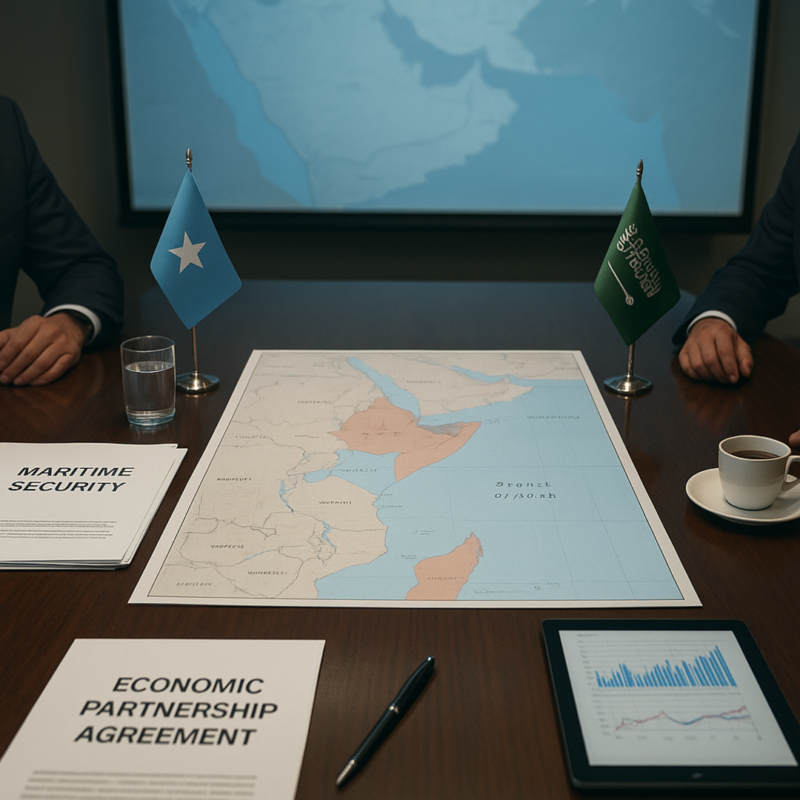
KAMPALA: President Hassan Sheikh Mohamud held talks with Saudi Vice Foreign Minister Waleed bin Abdulkarim Al‑Khereiji on the sidelines of Ugandan President Yoweri Museveni’s inauguration ceremony in Kampala, with discussions focusing on regional security, maritime stability and expanding economic collaboration between the two nations.
The meeting underscored the growing strategic partnership between Mogadishu and Riyadh, as Somalia continues to strengthen its ties with Gulf states amid heightened geopolitical tensions in the region. The two countries have previously coordinated diplomatic positions at high-level summits, including an emergency OIC meeting in Jeddah where Saudi Arabia reaffirmed its backing for Somalia’s sovereignty and territorial integrity.
Maritime Security and Economic Stability
According to officials familiar with the discussions, the talks covered regional developments, maritime security in the Red Sea and Gulf region, and the economic risks associated with disruptions in the Strait of Hormuz, a vital global shipping channel essential for energy supplies and international trade. The Strait of Hormuz crisis has already impacted Somalia’s economy, with imports declining by 40 percent and food prices rising by 10 percent, according to the National Bureau of Statistics.
Both parties also explored enhanced cooperation in counter‑terrorism, trade, and broader economic partnership. Somalia and Saudi Arabia formalised a significant military cooperation agreement in Riyadh earlier this year, covering joint initiatives to safeguard Red Sea maritime passages against piracy and geopolitical threats. A landmark maritime cooperation agreement focused on port development and transport has also been signed, aiming to modernise Somalia’s port facilities and draw foreign investment.
Saudi Arabia as a Key Partner
Saudi Arabia remains one of Somalia’s most important partners in the Gulf, with cooperation encompassing humanitarian aid, investment, security coordination, and livestock trade — a major revenue source for the Somali economy. The bilateral relationship has evolved into a strategic partnership founded on mutual respect and common interests. The maritime agreement perfectly aligns with Somalia’s comprehensive blue economy strategy, aiming to bolster regional connectivity and facilitate seamless trade across East Africa and the Gulf.
Wider Diplomatic Engagement
The meeting coincided with Somalia’s intensified regional and international diplomacy as the nation advances economic reforms, expands trade relationships, and seeks additional foreign investment following debt relief achievements and renewed engagement with Gulf and East African states. President Mohamud had travelled to Kampala to attend Museveni’s inauguration, where he also held bilateral talks with the Ugandan leader on security, counter‑terrorism and economic development.
Somalia has recently placed greater emphasis on maritime security due to concerns about piracy, illegal fishing, and threats to commercial shipping lanes in the Red Sea, Gulf of Aden and Indian Ocean. The Federal Government has acknowledged ongoing discussions regarding a proposed tripartite security arrangement with Saudi Arabia and Egypt, focused on enhancing collaboration on Red Sea security and broadening military partnerships. Somalia has welcomed the recent US-Iran ceasefire agreement and praised Saudi Arabia’s mediation efforts, underscoring Mogadishu’s growing role in regional diplomacy as a current member of the UN Security Council.
Recommended Reading on ftlsomalia.com:
- Somali Cabinet Approves Private Security Regulations as Strait of Hormuz Crisis Drives 40% Import Drop
- Somalia Signs Military Pact with Saudi Arabia in Riyadh; Moves to Counter Regional Rivals
- Somalia, Saudi Arabia Sign Maritime Cooperation Agreement
- Somalia Confirms Red Sea Security Pact Discussions with Saudi Arabia, Egypt
- Somalia Backs US-Iran Ceasefire Deal
- Somalia Extends Congratulations to Saudi Arabia on Founding Day
- Somali President Attends Museveni’s Inauguration in Uganda