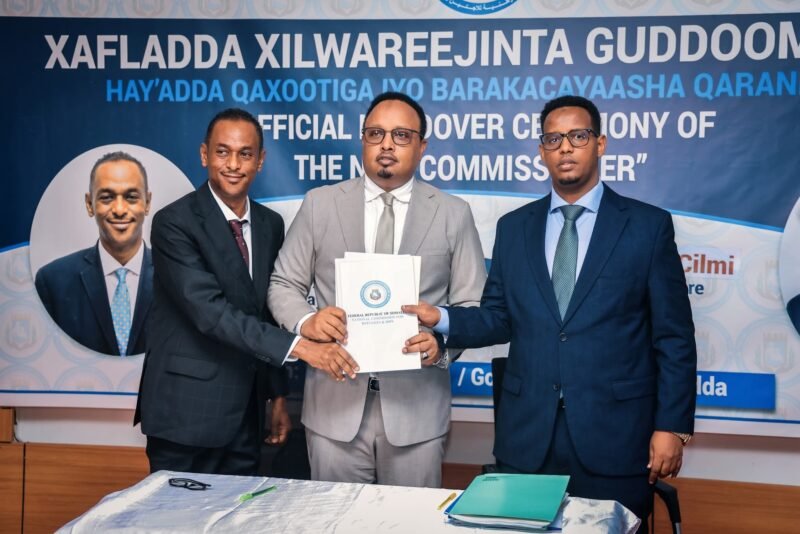
MOGADISHU – The Federal Government of Somalia has formally transferred executive leadership of the National Commission for Refugees and Internally Displaced Persons (NCRI) in a handover ceremony held in Mogadishu. Liban Abdi Igal officially assumed the role of Commissioner, succeeding Ahmed Hussein Elmi.
The transition was overseen by the Deputy Minister of Interior, Federal Affairs and Reconciliation, Abdihakim Ashkir. The Deputy Minister outlined the significant national responsibilities entrusted to the NCRI and directed the new administration to maintain operational continuity while enhancing inter-agency coordination. The NCRI has previously been a key stakeholder in national forums addressing civilian protection and stabilization efforts, underscoring the importance of coordinated government action in assisting vulnerable communities.
The Deputy Minister emphasized that providing sustainable solutions for displacement remains a fundamental security and development priority for the federal government. Ashkir stressed that the commission must operate with complete transparency and strict accountability to fulfill these objectives. He recognized the progress achieved under the outgoing commissioner Ahmed Hussen Elmi, whose appointment in January 2025 was tasked with strengthening the commission’s efforts in addressing the needs of refugees and internally displaced persons.
Ashkir directed the new Commissioner, Igal, to expedite the commission’s field activities. The leadership change aims to extend essential services to underserved populations and strengthen national resettlement and urban integration initiatives.
Background: NCRI’s Role and Displacement Crisis in Somalia
The NCRI is the primary government body mandated to coordinate, manage, and implement policies and programs related to refugees and internally displaced persons. The Commission has been proactive in developing strategies to support displaced populations, including a 5-Year Strategic Plan launched in October 2024 aimed at providing protection, support, and sustainable solutions for IDPs in Somalia. This most recent leadership transition comes at a time when Somalia continues to confront one of the world’s most severe internal displacement crises.
The scale of displacement remains immense. A UN report from January 2026 indicated that around 680,000 individuals were compelled to abandon their residences throughout 2025, elevating the total number of internally displaced persons to 3.3 million. Displaced families face desperate conditions, often lacking adequate shelter and sanitation, as seen in camps across regional states like HirShabelle.
Government Efforts and International Collaboration
In response, the government has pursued a multi-pronged approach to address the displacement crisis. In a landmark move in November 2025, the Upper House of Parliament passed the Bill on Internally Displaced Persons, which defines the government’s responsibilities in prevention, protection, and durable solutions for IDPs, including voluntary return and resettlement. Complementing these legal protections, economic initiatives are also being implemented. The IBS Bank signed a Memorandum of Understanding with the NCRI in November 2024 to enhance financial inclusion and social welfare support for IDPs and refugees, aiming to provide accessible financial services and promote economic stability among vulnerable communities.
International collaboration remains crucial. The NCRI has worked extensively with international partners like UNHCR and IOM to repatriate Somali citizens stranded abroad and to coordinate aid for those returning home. Furthermore, the government has committed to working closely with the UNHCR to address the concerns of IDPs, a commitment reinforced by the Deputy Minister Ashkir in previous high-level meetings.
In this challenging context, the new Commissioner, Liban Abdi Igal, assumes his responsibilities. His immediate tasks will include advancing durable solutions for displaced families, ensuring the delivery of essential services, and strengthening national resettlement and urban integration initiatives, aligning with the government’s broader security and development objectives.