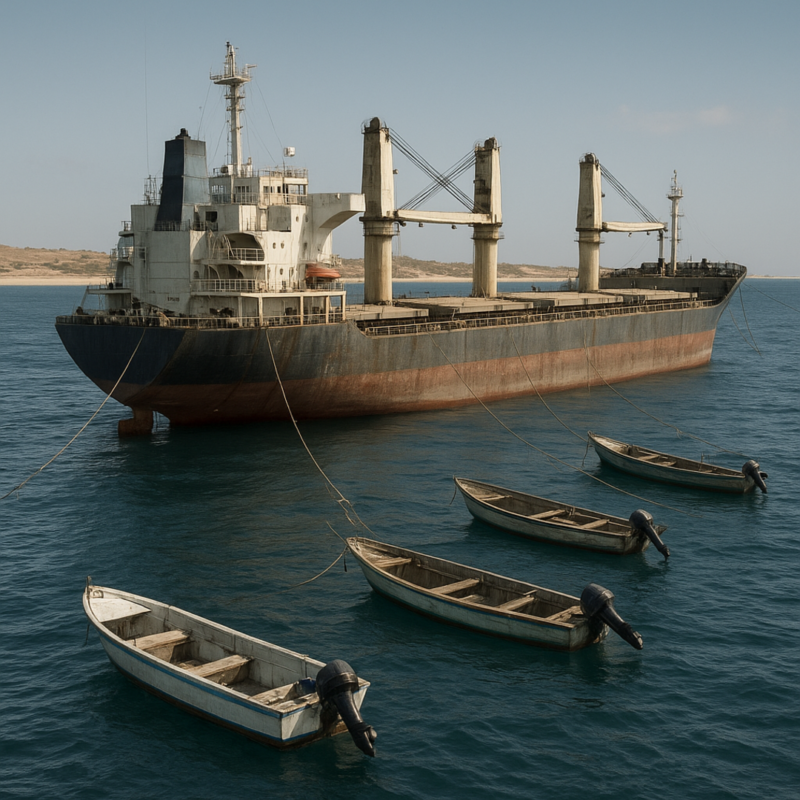
MOGADISHU — Three vessels have been hijacked off Somalia’s coast within a week, intensifying concerns about a potential piracy revival in the Horn of Africa and adding fresh challenges for the global shipping industry already grappling with disruptions in key maritime chokepoints.
The most recent incident involved the commercial vessel Sward, a cement carrier, which was seized on April 26, according to the Maritime Security Centre Indian Ocean (MSCIO), the European Union’s naval monitoring body. The hijacking came just days after the oil tanker Honour 25 was captured on April 21 while transporting approximately 18,000 barrels of oil destined for Mogadishu.
“All incidents remain unresolved,” the centre stated in its announcement. “Ships operating in the region are urged to exercise extreme caution, especially within 150 nautical miles between Mogadishu and Xaafuun.” The United Kingdom Maritime Trade Operations (UKMTO) has since raised the piracy threat level to “substantial.” Maritime authorities have issued urgent warnings about an escalating piracy threat along Somalia’s coastline, marking a troubling resurgence of maritime crime in the Indian Ocean.
Somali piracy experienced a significant increase in the late 2000s and reached its peak in 2011 with 212 documented attacks, according to EU naval statistics. During that period, pirate groups grew increasingly audacious, conducting operations as far as 2,270 nautical miles from Somalia’s coastline into the Indian Ocean. A coordinated international naval coalition subsequently brought the attacks under control, limiting incidents to just a few cases per year from 2014 onward. Nevertheless, attacks have begun increasing again since 2023.
The global shipping industry has already been facing challenges due to instability in the Strait of Hormuz and attacks by Iran-backed Houthi rebels in Yemen near the Bab el-Mandeb strait. Vessels must traverse these waters to exit the Red Sea, one of the world’s most heavily trafficked trade routes, with many choosing alternative routes around the Horn of Africa. Experts attribute the uptick in piracy to several factors, including a period of heightened regional tension that has diverted international naval assets to the Red Sea to counter threats posed by Houthi rebels in Yemen, leaving parts of the Indian Ocean more vulnerable. Additionally, economic hardship in coastal areas and weak maritime enforcement have created conditions conducive to pirate activity.
The Sward, a cement carrier flying the flag of St. Kitts and Nevis, had departed from Egypt’s Suez port on April 13 and was en route to Mombasa, Kenya, when pirates seized it approximately six nautical miles from the port town of Garacad, according to Puntland security officials. The vessel’s crew consisted of 17 members: 15 Syrians and two Indians. An operations officer from the Puntland Maritime Police Force, speaking on condition of anonymity, reported that nine pirates boarded and assumed command of the vessel. “The ship is currently under the control of armed men, and we are monitoring the situation,” the officer stated.
Following the hijacking, which occurred shortly after 8 p.m. on Sunday, the pirates navigated the vessel toward the Somali coast and anchored it offshore near Garacad. Authorities reported that six armed individuals and an unarmed interpreter fluent in English and Arabic were the first to board the vessel. “The interpreter is communicating with the crew and maintaining contact with the vessel’s owner,” one security official stated. By Tuesday morning, four additional armed men had joined, increasing the number of pirates on board to 20, authorities confirmed.
The oil tanker Honour 25, which was captured on April 22 approximately 30 nautical miles off the Somali coast, was carrying 18,500 barrels of oil and had departed from Berbera port in Somaliland on February 20. Security officials reported that six gunmen took control of the vessel, and under pirate control, the Honour 25 has anchored near the Somali coastline between the fishing towns of Xaafun and Bander Beyla. The crew consists of 17 members: 10 Pakistanis, four Indonesians, one Indian, one Sri Lankan, and one from Myanmar. Sources indicate that five additional armed individuals have since boarded the tanker.
Jethro Norman, a senior researcher at the Danish Institute for International Studies, explained that pirates are exploiting the situation where international naval forces have concentrated much of their resources on the Red Sea to counter Houthi attacks, while Puntland security forces face numerous challenges both on land and at sea. “Pirate networks are reassessing their capabilities, and they are better armed than their predecessors,” Norman stated. “GPS technology, satellite communications, and hijacked vessels serving as mother ships enable them to operate hundreds of miles offshore.”
Broader Resurgence of Piracy
These hijackings represent the most recent incidents in what maritime security analysts describe as a concerning resurgence of piracy off the Horn of Africa. In late March 2026, international naval forces were closely monitoring an Iranian-flagged dhow, Al Waseemi 786, which was hijacked approximately 400 nautical miles east of Mogadishu, with security officials warning that the captured dhow was highly likely being converted into a “mothership” — a mobile forward operating base used by pirates to launch further deep-water attacks. The Maritime Security Centre – Horn of Africa (MSCHOA) and the European Union Naval Force (EUNAVFOR) have formally classified the situation as a “probable piracy event.”
In November 2025, a Spanish frigate from Operation Atalanta successfully rescued the crew of a Malta-flagged oil tanker, Hellas Aphrodite, after Somali pirates attempted to hijack the vessel roughly 1,000 kilometers off Somalia’s coast. The crew of 24 took refuge in the ship’s fortified citadel while distress signals were sent out, and responding swiftly, the Spanish frigate ESPS Victoria secured the vessel and confirmed that all crew members were unharmed.
The Liberian-flagged merchant vessel “Basilisk” and its 17 crew members that had been captured by Somali pirates was rescued by the European Union’s anti-piracy force, underscoring the effectiveness of international maritime security operations in the Indian Ocean and Red Sea. Since 2008, EU Naval Forces have played a critical role in countering piracy off the coast of Somalia, working closely with global partners to deter and respond to threats.
Puntland’s Maritime Security Role
The Puntland Maritime Police Force (PMPF) serves as the primary maritime security agency in the region, though it faces significant capacity constraints in patrolling the vast coastline. Since the PMPF’s establishment in 2010, the United Arab Emirates has provided approximately $50 million annually for training, equipment, and salaries. The Puntland Maritime Police Force will continue to receive the annual support, which is critical for maintaining its counter-piracy and maritime security operations off the coast of Somalia.
The European Union Naval Force has previously emphasized the critical role of collaboration with regional partners, such as the Puntland Maritime Police Force, in addressing piracy threats. Following the release of the Yemeni-flagged fishing vessel Saytuun-2, which had been seized by suspected Somali pirates, EUNAVFOR highlighted that such partnerships are essential for enhancing maritime security, conducting effective patrols, and ensuring the safety of vessels and their crews in high-risk areas.
On Thursday morning, Puntland security forces clashed with suspected pirates in the Garacad area of the Mudug region, with several people feared dead and others wounded following the confrontation. The incident came amid heightened tensions in Garacad, where Puntland authorities are said to be preparing operations against pirate groups currently holding multiple commercial vessels. An armed confrontation early Thursday in Garacad district left one Puntland security officer dead and several others injured, including a senior police commander, according to local sources. The fighting reportedly broke out between Puntland security forces and armed militia believed to have been attempting to free detainees accused of piracy-related crimes.
International Response and US Policy Shift
The resurgence of piracy has prompted a major policy shift from the United States. In January 2026, President Donald Trump declared that Somali pirates attempting to hijack vessels will now face the “ultimate penalty,” announcing that Defense Secretary Pete Hegseth has received “full authorization” to deploy U.S. military forces against pirate groups, including the use of drone strike tactics previously reserved for high-value terror targets. Trump’s declaration came amid a resurgent piracy threat off the Horn of Africa and coincided with an active hostage situation involving a China-flagged fishing vessel, which pirates seized on December 31 near Bander Beyla.
In response to the escalating threat, the European Union Naval Force Operation Atalanta has increased aerial and surface surveillance in the area. In September 2025, EU NAVFOR conducted joint maritime exercises with the Somali Police Coast Guard focused on Visit, Board, Search, and Seizure (VBSS) operations, designed to strengthen Somalia’s capacity to combat illegal activities at sea. Based in Nairobi, Kenya, and operating under the EU’s Common Security and Defence Policy (CSDP), Operation Atalanta remains the EU’s flagship maritime security mission in the region, tasked with deterring piracy and ensuring the safe passage of vessels in one of the world’s busiest maritime corridors.
Somalia-Yemen Maritime Security Cooperation
The Federal Government has been actively strengthening regional maritime security partnerships. In October 2025, Somalia’s Ambassador to Yemen met with Yemen’s Defense Minister in Aden to renew security collaboration, focusing on combating illegal migration routes and coordinated efforts against terrorism. Ambassador Mohamed expressed Somalia’s readiness to deepen intelligence sharing and operational coordination with Yemeni authorities. In December 2025, Somalia’s Defense Minister Ahmed Moallim Fiqi convened a strategic meeting in Cairo with his Yemeni counterpart, Lieutenant General Mohsen Mohammed Ahmed Al-Daari, to discuss enhancing defense collaboration and protecting the vital maritime passages between the two nations. At the core of the deliberations was the pressing requirement to reinforce maritime security in the Red Sea and the Gulf of Aden, with both officials examining collaborative approaches to combat the illegal transfer of weapons which terrorist organizations utilize to undermine regional stability.
Concerns of a Broader Resurgence
Maritime security analysts warn that the recent incidents could signal a broader resurgence of piracy off the Horn of Africa, potentially disrupting one of the world’s most vital shipping lanes linking Asia, the Middle East, and Europe. The Gulf of Aden, which borders Somalia’s northern coast, connects the Indian Ocean to the Red Sea and the Suez Canal — a route through which approximately 12 percent of global maritime trade passes. Any sustained increase in piracy could force shipping companies to reroute vessels around the Cape of Good Hope, adding significant time and fuel costs. The World Bank has previously estimated that between 2005 and 2012, pirates off the Horn of Africa collected between $339 million and $413 million by holding crew members hostage and demanding ransom payments.
Neither Somali federal authorities nor the European Naval Force has issued a formal statement regarding the latest hijackings. Officials in Puntland have not provided public comment on the incidents. The UKMTO has advised vessels transiting the area to exercise extreme caution and to report any suspicious activity while investigations continue. Shipping companies operating in the region have been strongly advised to strictly adhere to Best Management Practices (BMP5) and report any suspicious activity immediately to the United Kingdom Maritime Trade Operations (UKMTO). Without sustained international naval presence and continued investment in regional maritime security capacity, the conditions that allowed piracy to flourish in the late 2000s could re-emerge, threatening global shipping and regional economic stability. For now, the coastal waters off Puntland remain under close watch as authorities work to contain what appears to be a renewed wave of maritime crime.