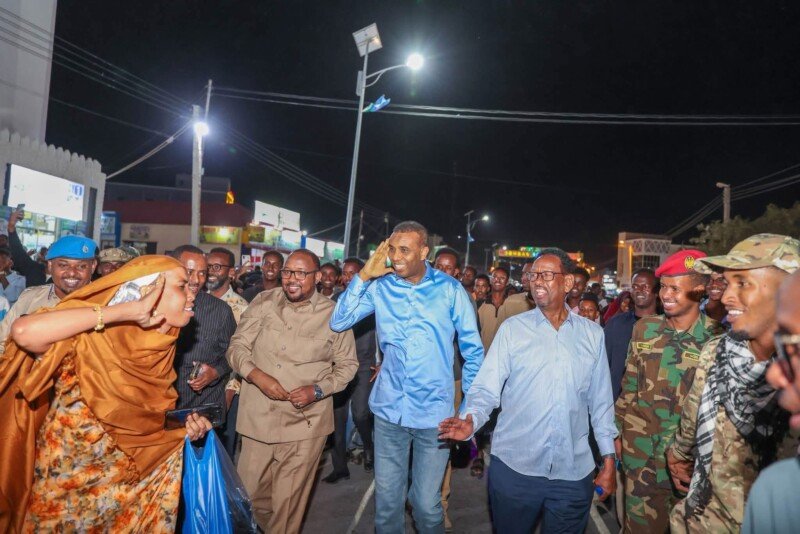
MOGADISHU — Somalia’s Minister of Planning, Mohamud Abdirahman Beene Beene, warned Monday that Mogadishu could face a renewed wave of car bombings and the familiar cycle of mourning if residents fail to confront opposition figures. He accused opposition figures — including two former presidents and prime ministers — of endangering security in the capital.
The minister urged residents to push back against them, saying failure to do so would leave the city vulnerable to more explosions and violence in its streets. The remarks, widely seen as an attempt to pressure residents not to support the opposition or to turn public sentiment against political rivals, have drawn mixed reactions on social media.
Former President Sharif Expresses Pessimism
The minister’s warning comes just days after former President Sharif Sheikh Ahmed voiced little hope for a political settlement between the opposition and the government, as the current president’s term expires next month. Sharif called on clan leaders to unite and take the lead in mediating an end to the ongoing electoral dispute.
Somalia’s opposition leaders have stated that President Hassan Sheikh Mohamud will not be recognized as head of state once his term concludes on May 15, signaling an escalating political dispute over the nation’s electoral schedule. This stance directly contradicts Prime Minister Hamza Abdi Barre, who asserts that the government’s authority remains valid beyond that date.
Government Downplays Crisis
Speaking at the same event, President Hassan Sheikh Mohamud downplayed the crisis, framing it as a routine political disagreement seen in many countries. He expressed confidence that it would be resolved calmly and without escalation.
The Somali Future Council has warned that if both parliamentary and presidential terms lapse without elections or a political agreement, they would move ahead with organizing their own polls and establish a parallel federal administration. Their position is anchored in Somalia’s 2012 provisional constitution, which sets four-year terms for both parliament and the presidency.
Opposition Threatens Parallel Government
In recent weeks, rhetoric on both sides has intensified. Opposition leaders have said they will no longer recognize the president once his term expires in May and have threatened to form a parallel government. Authorities, in turn, have warned of action if the opposition attempts to organize protests or mobilize forces in Mogadishu after the term ends.
Former President Mohamed Abdullahi Farmaajo has declared that the constitutional mandate of the Federal Parliament officially expired on April 14, 2026, warning that Somalia has entered a period of “rising political uncertainty.” Farmaajo argued that legislative activities can only resume after new elections are held, challenging a recent one-year term extension announced by the leadership of the House of the People.
“A month before the end of his term, outgoing President Hassan Sheikh Mohamud must urgently present a credible plan for the upcoming elections. Failing to do so will destabilize the country in ways that will have lasting political, social, security, and economic implications,” Farmaajo said.
Government Deploys Elite Forces to Prevent Rebellion
The federal government recently deployed heavily armed, Turkish-trained Gorgor special forces around a military camp led by army officer Colonel Saney Abdulle, an opposition-aligned figure and relative of former President Sharif Sheikh Ahmed. The deployment aims to prevent potential rebellion within military ranks as President Mohamud’s term concludes next month.
Troops were stationed in the Geed Timir area of the Gubadley neighborhood, north of Mogadishu, an area historically under the general’s control. The camp reportedly contains numerous fighters and significant weapons, raising fears that Abdulle might deploy forces into central Mogadishu to support opposition efforts and challenge presidential authority when his term ends on May 15.
Concurrently, authorities established entry checkpoints around the capital to inspect military vehicles and limit the movement of army units into the city. These measures aim to prevent troops from the two Shabelle regions, many of whom are expected to align with opposition forces, from entering Mogadishu.
Puntland Warns of Constitutional Vacuum
Authorities in Puntland have expressed concern that Somalia is experiencing a constitutional vacuum with escalating political uncertainty, advocating for immediate consultations to avert potential instability. According to a statement released by the Puntland Council of Ministers, Somalia’s provisional constitution mandates the expiration of the Federal Parliament’s constitutional mandate on April 14, 2026, as stipulated in Article 60. The statement further highlighted that the presidential term concludes on May 15, 2026, as outlined in Article 91.
Puntland has called upon President Mohamud to protect national unity by organizing an urgent conference prior to the end of his term. The objective is to establish mutual agreement on elections for federal institutions, including parliament and the presidency, along with electoral processes for federal member states.
Senate Speaker Accuses Government of Lawlessness
The Speaker of Somalia’s Upper House of parliament has accused the country’s government institutions of systemic lawlessness, ending a months-long political absence as the nation approaches a critical electoral deadline. Senator Abdi Hashi Abdullahi, a veteran influential figure in Somali politics, stated that his return to public life followed a period of recovery from health-related issues.
“The government must enforce the law, but we ourselves are the government, and yet we do not follow the law,” Abdullahi stated, directing broad criticism at state organs for failing to adhere to the country’s legal statutes.
Outlook
The escalating confrontation between Mogadishu and opposition figures recalls the political crisis of 2021, when prolonged disputes over delayed elections escalated into armed clashes on the streets of the capital. The coming weeks will be critical in determining whether dialogue or further confrontation defines Somalia’s political future.
The federal government has yet to issue a formal response to the planning minister’s remarks. The international community, including the United Nations, African Union, and European Union, continues to monitor the situation closely and has urged all stakeholders to engage in constructive dialogue to resolve the deepening political impasse.