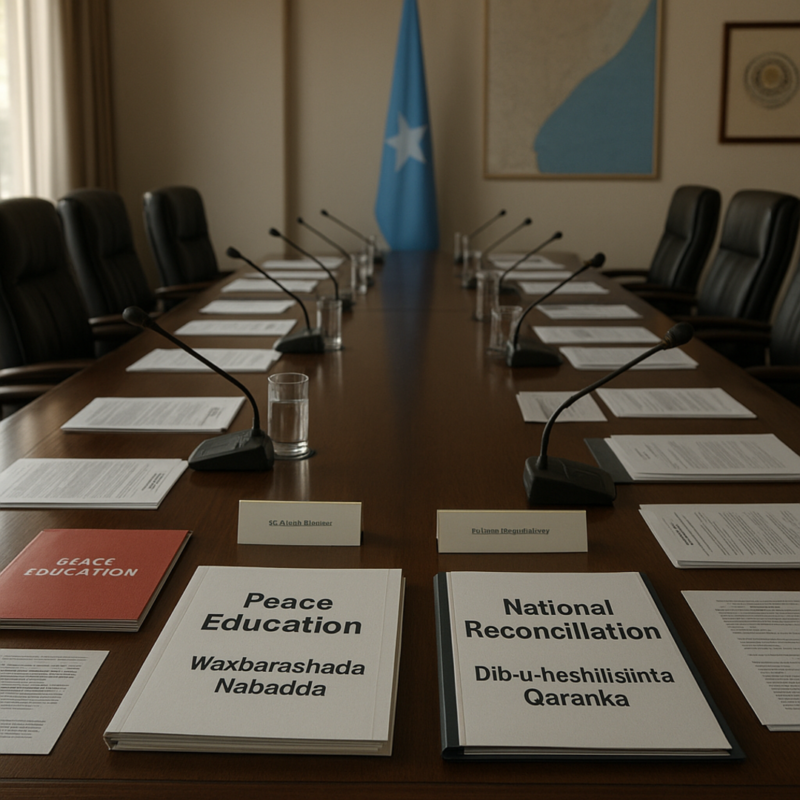
MOGADISHU — The Ministry of Interior, Federal Affairs and Reconciliation convened the National Peace Education Steering Committee meeting in Mogadishu, focused on enhancing coordination and advancing peace education initiatives nationwide.
The meeting was presided over by Kamal Gutale, Permanent Secretary at the Office of the Prime Minister, and assembled senior government officials and key stakeholders from federal and state institutions.
Among attendees was Abdulkadir Ali, Director General of the Ministry of Interior, Federal Affairs and Reconciliation, along with senior representatives from the Ministry of Endowments and Islamic Affairs, the National Security Office, and the Higher Education Commission. The gathering illustrated a whole-of-government approach to domestic reconciliation, with officials heavily highlighting the essential, foundational function of Peace Education in stabilizing the nation.
Discussions centered on aligning national priorities, improving institutional coordination, and accelerating the implementation of peace education programs as a core pillar within the broader National Reconciliation Framework (NRF). Officials stressed that cultivating a deeply stable, peaceful community requires robust collaborative efforts to execute the educational initiative at the grassroots level, focusing on enhancing social unity and proactively preventing localized conflicts before they escalate.
Establishment of a Dedicated Steering Committee
To guarantee the strategic framework transitions effectively from policy discussion to tangible action, the high-level meeting officially concluded with a unanimous decision to immediately create a dedicated Peace Education Steering Committee. This specialized, inter-ministerial committee will be entirely responsible for directing, coordinating, and hastening the widespread implementation of this nationwide educational program across both federal and regional administrative levels.
Strengthening Governance and Peacebuilding
This coordinated push for social cohesion directly complements the Director General’s ongoing leadership within the Inter-Ministerial Committee on Stabilization, which works to rapidly broaden governmental service provision and humanitarian support to recovering populations.
The Ministry of Interior, Federal Affairs and Reconciliation officially launched the Bulsho Project in Mogadishu, a major initiative aimed at strengthening inclusive governance, enhancing service delivery, and advancing peacebuilding efforts across the country. Speaking at that launch, Abdulkadir Ali, Director General of the Ministry, described the project as a significant milestone in Somalia’s journey toward sustainable peace, reconciliation, and national unity, emphasizing that the initiative is fundamentally a peacebuilding program aimed at addressing the root causes of conflict, strengthening social cohesion, and fostering a shared national identity.
Stabilization Efforts in Liberated Regions
The Director General has also presided over high-level meetings of the Inter-Ministerial Committee on Stabilization, which thoroughly covered the essential requirements and strategic methods needed to hasten government programs in recently recovered zones. The committee placed a particular emphasis on stabilization efforts in the Lower Shabelle and Middle Shabelle regions, where national forces have recently ousted militant elements.
The “Wadajiir Nabadeed” (Together for Peace) project, implemented in partnership with UNDP and IOM, targets Hirshabelle and Galmudug states and focuses on strengthening local governance structures, enhancing security, and promoting restorative justice systems that address community needs. Officials from MoIFAR noted that this approach brings security, governance, and development “hand in hand” to ensure lasting peace.
Civil Registration and Institutional Capacity
The Ministry has also been actively working to modernize Civil Registration and Vital Statistics (CRVS) services across the country. A reliable CRVS system—which accurately records essential life events such as births, deaths, marriages, and divorces—is widely considered the foundational backbone for effective governance and equitable resource distribution.
The Director General recently toured the construction site of the ministry’s new headquarters, which marks a significant milestone in boosting the federal government’s institutional capacity. The expanded infrastructure is specifically designed to dramatically improve internal coordination and enhance overall administrative efficiency across various departmental branches.
Commitment to National Reconciliation
The National Peace Education Steering Committee meeting represents a significant step forward in Somalia’s efforts to institutionalize peace education as a fundamental element for stability and reconciliation. The initiative aligns with the government’s broader strategy of addressing the root causes of conflict and fostering a shared national identity through long-term, nationally driven approaches.
The meeting was presided over by Kamal Gutale, Permanent Secretary at the Office of the Prime Minister, who has also previously chaired high-level technical meetings on trade facilitation reforms aimed at accelerating economic growth. The gathering assembled senior government officials and key stakeholders from federal and state institutions dedicated to improving collaboration and promoting peace education across Somalia.