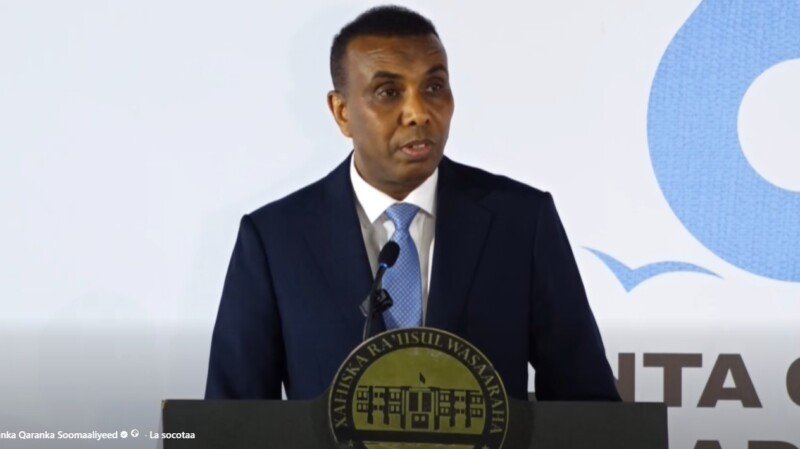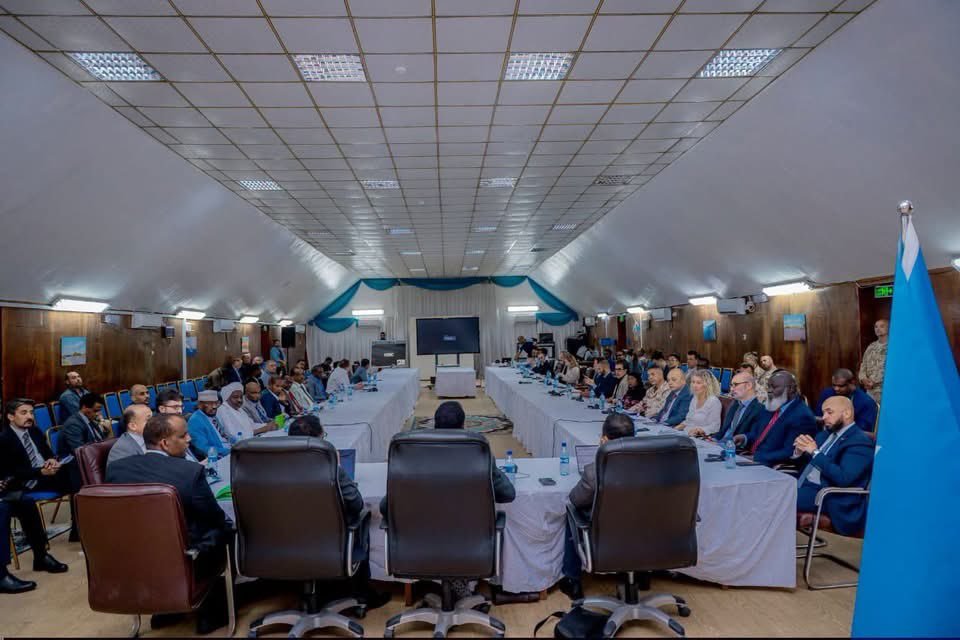
MOGADISHU — The Chairman of the National Independent Electoral and Boundaries Commission (NIEBC), Abdikarim Ahmed Hassan, has briefed members of the international community in Mogadishu on Somalia’s electoral progress, highlighting the recent local council elections in Banadir, the integrated local council and state assembly elections in Southwest and Galmudug states, and preparations for the planned polls in Hirshabelle.
The briefing was attended by ambassadors from the United States, United Kingdom, China, Türkiye, Ethiopia, Kenya, Sudan and Egypt, as well as representatives of the United Nations, USA, African Union and Organization of Islamic Cooperation. Chairman Hassan outlined the key achievements of the NIEBC, including the local council elections held in Banadir Region, as well as the integrated local council and state assembly elections conducted in Southwest State and Galmudug State.
Galmudug Elections and Allegations of Irregularities
The Galmudug elections, held on July 30, 2026, were conducted under the “one person, one vote” system. The Justice and Solidarity Party (JSP) secured 115 local council seats and 63 seats in the regional parliament, with 106,388 votes representing 55.55 percent of all valid votes cast. A total of 16 political parties participated in the elections, with 197,971 voters casting their ballots across 11 towns and cities.
However, the elections have been overshadowed by allegations of irregularities and federal interference. Galmudug election results were announced amid allegations of irregularities and federal interference, with the Towfiiq Party formally rejecting the outcome. The Towfiiq Party claimed that mismanagement and a flawed process affected the election and called for an independent review of the results. The party alleged that the electoral process had “undermined the one-person, one-vote system” and was “inferior to the 4.5 clan-based elections” that preceded it.
Southwest State Elections and Supreme Court Validation
The Southwest State elections, which followed a similar model, saw 132,430 voters participate, with 95 seats contested by 32 political organizations. The Somali Supreme Court formally validated the South West State election results, granting full legal authority to the newly elected regional leadership after confirming the legal and procedural soundness of the democratic processes.
The ruling Justice and Solidarity Party (JSP) secured 51 of the 95 parliamentary seats. However, women’s representation fell to just 17 percent of the parliament, far below the agreed 30 percent quota. Only 16 of the 92 elected lawmakers are women, a deficit of 12 seats that has sparked immediate concern among civil society groups and advocates for women’s political participation.
Banadir Local Council Elections
The Banadir local council elections, held in December 2025, marked the first direct local elections in Mogadishu in nearly 60 years. The Ministry of Interior congratulated the people of Banadir Region on the successful elections, describing the polls as a sign of democratic progress, strong public participation, and political maturity. The Supreme Court formally upheld the results, issuing a final ruling that confirmed the outcome despite a boycott by key opposition groups.
Preparations for Hirshabelle Elections
Chairman Hassan also briefed the international representatives on preparations for the planned integrated local council and state assembly elections in Hirshabelle State. The NIEBC has released the Hirshabelle election timetable, setting August 20, 2026, as polling day. The commission has urged political associations, candidates and all stakeholders to comply with the electoral calendar and established procedures to help ensure a transparent and credible vote.
However, the process has been overshadowed by growing concerns over federal interference. President Hassan Sheikh Mohamud has signaled his intention to proceed with elections in allied regional states before initiating broader federal electoral negotiations, a strategy that critics argue undermines the inclusive consensus needed for a legitimate national electoral framework.
The Hirshabelle Cabinet has discussed election preparations, with President Ali Gudlawe Hussein describing the transition to one-person, one-vote elections as a turning point for inclusive governance. However, the electoral timetable faces significant security and logistical hurdles, with Al-Shabaab continuing to control large areas of southern and central Somalia.
Critical Note
While the NIEBC’s progress toward expanding direct elections marks a significant step in Somalia’s democratic transition, the process remains deeply contested. The boycott by key opposition groups, allegations of manipulation, and concerns about the independence of electoral institutions continue to cast a shadow over the process. The government’s ability to build broad political consensus around the electoral framework will be critical to ensuring that these elections are seen as legitimate by all stakeholders. The international community, while supporting electoral reforms, must continue to press for transparency, inclusivity, and accountability to prevent further political polarization.
Recommended Reading On ftlsomalia.com
- Galmudug Election Results Announced Amid Allegations of Irregularities
- Supreme Court Validates South West State Election Results
- Women’s Representation Falls to 17% in South West Parliament
- Hirshabelle Election Timetable Released Amid Growing Concerns
- President Hassan Sheikh Seeks Regional Allies Before Federal Election Talks
- Banadir Region Residents Congratulated on Successful Elections