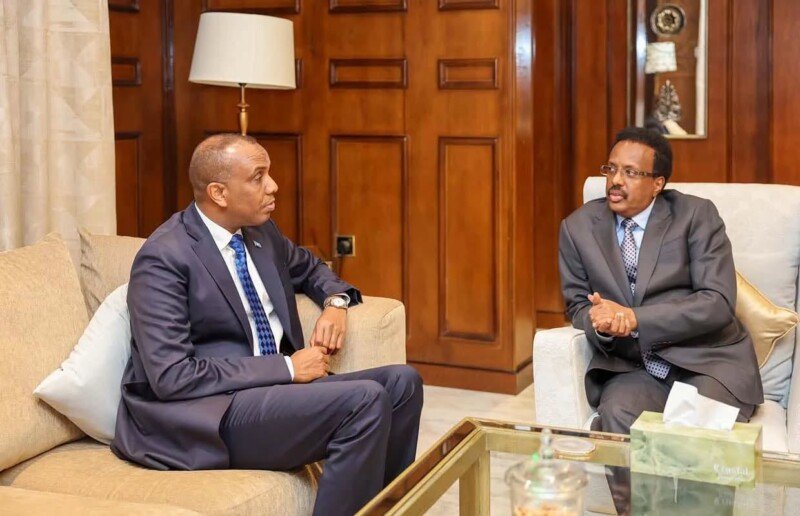
MOGADISHU — Prime Minister Hamza Abdi Barre paid a late-night visit to former President Mohamed Abdullahi Mohamed (Farmaajo) at his residence in Mogadishu on Sunday, August 9, 2026, in what sources described as a courtesy visit and information-sharing meeting on the country’s political situation and electoral matters.
The meeting comes at a particularly sensitive moment, as the Federal Government and opposition groups prepare for another round of discussions aimed at resolving long-running disagreements over Somalia’s next elections. According to sources familiar with the meeting, the Prime Minister and the former president discussed the country’s political situation, with electoral arrangements reportedly featuring prominently in their conversation.
Prime Minister Hamza has repeatedly called for dialogue and has extended invitations to opposition leaders, political figures with differing views, and representatives of political parties to participate in discussions on Somalia’s electoral future.
Turkey has played an active role in facilitating and sustaining dialogue between Somalia’s federal government and opposition groups during a period of debate over constitutional amendments and the future electoral system. Turkish mediators have conducted separate meetings with both federal government officials and opposition leaders, though their efforts have faced setbacks amid disagreements over which political actors should be officially recognized as part of the opposition.
A Possible Opening for Compromise
For months, repeated attempts to bring the government and opposition together have produced little progress. Previous negotiations frequently stalled over disagreements about the electoral model, with the Federal Government insisting on a one-person, one-vote system while opposition groups questioned whether the necessary political, administrative, and security conditions existed to implement it.
The political landscape may now be shifting. Sources say a significant portion of the opposition has moved closer to accepting the principle of direct elections but has demanded that the process be administered by a joint or broadly representative electoral commission capable of winning the confidence of all major political stakeholders.
That demand could provide the basis for a compromise. There is growing speculation that the government and opposition may soon agree on the establishment of a mixed electoral body tasked with negotiating and implementing the practical arrangements required for the next election.
The Somali Future Council has unveiled a “Transitional Direct Elections Model” that seeks to gradually transition Somalia from its current indirect electoral system toward direct popular voting while maintaining the 4.5 clan power-sharing system during the transition period. The proposal attempts to balance the need for popular elections with the country’s political realities, aiming to avoid conflict or disputes that could arise from a sudden change to the electoral system.
The dispute over the electoral model has deepened mistrust between the government and opposition figures, with the opposition accusing President Hassan Sheikh Mohamud of seeking a unilateral extension without broad political consensus.
A Fragile Opportunity
The participation of Farmaajo adds another important dimension to the political calculations. As a former president and one of Hassan Sheikh’s principal political rivals, his involvement could help broaden the opposition’s negotiating position while also providing an additional channel for dialogue with the Federal Government.
Turkish mediators had previously suggested giving seats on technical committees to figures aligned with Farmaajo, a proposal that was rejected by the opposition’s Future Council. The disagreement has led Turkish mediators to consider returning to Ankara.
Prime Minister Hamza’s decision to meet Farmaajo privately is also significant because Somalia’s political disputes have increasingly become intertwined with personal rivalries among the country’s former and current leaders. Farmaajo remains an influential political figure with a substantial constituency, particularly among those critical of the current administration.
Farmaajo’s technical committee has been participating in negotiations under the “Nabad iyo Nolol” umbrella, guided by Farmaajo’s vision of achieving national unity and consensus to navigate the country’s current political crisis.
According to sources, there is growing optimism that an agreement on the election model and electoral commission could pave the way for a direct meeting between President Hassan Sheikh Mohamud and senior opposition leaders. Such a meeting would carry considerable political significance after months of confrontation and failed negotiations.
Critical Note
While the meeting between Prime Minister Hamza and former President Farmaajo may signal a new phase of political engagement, significant obstacles remain. Previous attempts at dialogue have repeatedly collapsed after initial signs of progress. Questions surrounding the composition of the electoral commission, constitutional authority, the electoral timetable, federal-state relations, and the distribution of political power could all return to the negotiating table.
The meeting occurs as the Federal Government faces significant political pressure from multiple fronts. The opposition, under the Somali Future Council, has maintained that President Hassan Sheikh Mohamud’s mandate expired on May 15, 2026, while the government insists on a five-year term under recent constitutional amendments. The credibility of any future agreement will ultimately depend on whether the major political actors believe that the electoral process is genuinely impartial.