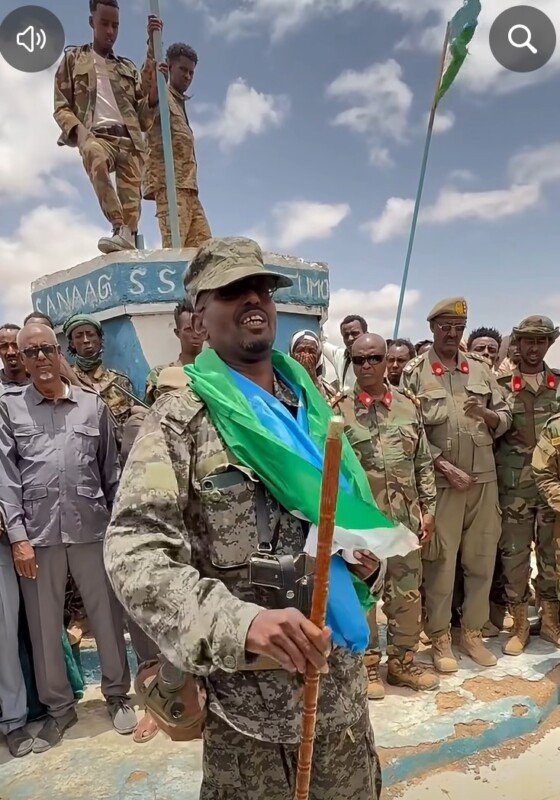
CEERIGAABO — A senior military officer serving with Somaliland’s security forces has publicly defected to the North Eastern State, crossing into territory administered by the newly established federal member state with a contingent of soldiers and a military vehicle.
Colonel Ali Ahmed Ismail, known as Ashkato, who served as Somaliland’s military commander in the Yubbe area of the Sanaag region, reportedly announced his decision publicly before departing his post with approximately 10 soldiers and a military vehicle equipped with a heavy weapon. He was received in the Fiqi-Fuliye area at the headquarters of the 12th Division of the North Eastern State’s Darwish forces.
Speaking about his decision, Colonel Ashkato said he had taken into consideration the views of the community he comes from, as well as the recent position of local traditional elders who expressed support for North Eastern State. He stated that discussions with officials from the administration ultimately led him to formally join its Darwish forces.
A Defection with Political Significance
The defection comes as the Sanaag region has emerged as a major area of political and military competition between Somaliland and the newly established North Eastern State. The move is notable not simply for the number of personnel involved, but for the manner in which it unfolded. Rather than quietly abandoning his post, Colonel Ashkato reportedly announced his decision publicly while still in Yubbe, deliberately transforming his departure into a political statement.
The defection follows a similar move by North Eastern State MP Fahiima Yuusuf Abdullahi Quuje, who announced her resignation and defection to Somaliland in July 2026, a dramatic reversal for a figure who was a prominent voice in the region’s resistance against Hargeisa’s authority . Quuje, who was a vocal supporter of the North Eastern State movement during the 2023 Laascaanood conflict, declared that she had renounced the cause of Somaliweyn (Greater Somalia) and has “returned” to Somaliland .
The North Eastern State parliament subsequently took disciplinary action against five more lawmakers who resigned on Saturday and are believed to have defected to Somaliland . The parliament convened an emergency session and voted to strip them of their privileges and immunity, with 57 members approving the measure, according to Speaker Dr. Aadan Abdullahi Aw-Hassan .
These defections highlight the fluid nature of political allegiances in the region, where clan loyalties and territorial claims remain deeply contested . The North Eastern State, formally recognized by the Federal Government of Somalia as a federal member state, has been at the centre of a broader struggle over Somalia’s territorial integrity .
North Eastern State: A Fragile Institution Under Strain
The North Eastern State was established as the latest federal member state of Somalia, with Minister of Interior Ali Yusuf Ali Hosh describing its formation as a “historic milestone” that strengthens Somalia’s federal system and promotes reconciliation among its people . The state was formed from the SSC-Khatumo movement, whose political and military influence expanded significantly following the 2023 Laascaanood conflict .
The North Eastern State parliament elected Adan Abdullahi Aw-Hassan as its inaugural Speaker in August 2025, marking a key milestone in the state’s political journey . However, the resignations and defections of six MPs raise serious questions about the stability of the regional administration and its capacity to govern effectively .
Somaliland has strongly opposed the establishment of North Eastern State, with senior officials accusing Mogadishu of politically sidelining the region and breaking earlier pledges. Deputy Prime Minister Salah Ahmed Jama and other federal officials from Somaliland have asserted that the federal arrangement had not delivered fair power-sharing for Somalilanders .
President Hassan Sheikh Mohamud has called upon Somaliland’s leadership to reintegrate with the nation, expressing willingness to make substantial concessions for unity while firmly rejecting any international recognition of Somaliland as an independent entity .
Sanaag: A Complex and Contested Region
The dispute over Sanaag is particularly complex, as the region has long been contested by Somaliland and Puntland, with North Eastern State now emerging as another claimant. Somaliland has been actively engaged in stabilizing the region, with Minister of Education Prof. Ismail Duale Yusuf recently conducting a working visit to Sanaag and Saraar to assess the security situation following clashes between Somaliland forces and SSC-Khaatumo militants in Erigavo in December 2024 .
Somaliland President Abdirahman Mohamed Abdullahi “Irro” has called for a comprehensive peace agreement and unconditional prisoner exchange with the Las Anod-based administration, signaling a significant effort to de-escalate regional tensions .
Prime Minister Hamza Abdi Barre visited Laascaanood in August 2026 for the inaugural anniversary celebrations of the North Eastern State’s establishment, leading a high-level delegation of ministers to mark the occasion . The visit drew strong condemnation from Somaliland, which described it as a “clear provocation” and a violation of its claimed territorial sovereignty .
Critical Note
The defection of Colonel Ashkato and his troops is a significant development that underscores the shifting political and military dynamics in the contested regions of Sool, Sanaag and Cayn. While the number of soldiers involved is small, the symbolic weight of the defection is substantial. A Somaliland military officer publicly declaring his departure, taking personnel and equipment with him, and receiving an official welcome from a rival administration inevitably raises questions about the effectiveness of Somaliland’s command structures in contested territories.
The emergence of North Eastern State as a federal member state has fundamentally altered the political landscape of northern Somalia. However, the defections of six MPs and a senior military officer to Somaliland suggest that the region’s political institutions remain fragile and vulnerable to internal fractures. The Federal Government’s recognition of the state represents a strategic victory in its efforts to counter Somaliland’s secessionist claims, but it also risks escalating tensions in an already volatile region.
For Somaliland, the defection is a warning sign that its control over contested areas may be more fragile than assumed. The move also comes as rival sides in Sanaag increasingly focus on winning the support of traditional elders, military officers and local communities, whose positions could play an important role in shaping the future of the region. Whether the incident remains an isolated defection or becomes the beginning of a wider movement among security personnel remains unclear, but it is a development with potentially much larger political implications.
Recommended Reading On ftlsomalia.com
- Somaliland Welcomes Defection of North Eastern State MP Who Once Fought Against Hargeisa
- Five Northeastern State MPs Lose Parliamentary Privileges After Resigning and Allegedly Defecting to Somaliland
- Somaliland Criticises UN Delegation’s Visit to Las Anod Amid Territorial Dispute
- Prime Minister Hamse Arrives in Las Anod for North Eastern State Anniversary Celebrations
- Hosh Returns to Mogadishu After Leading Creation of Somalia’s Newest State
- Somali President Urges Somaliland to Drop Israel Relations and Reunify