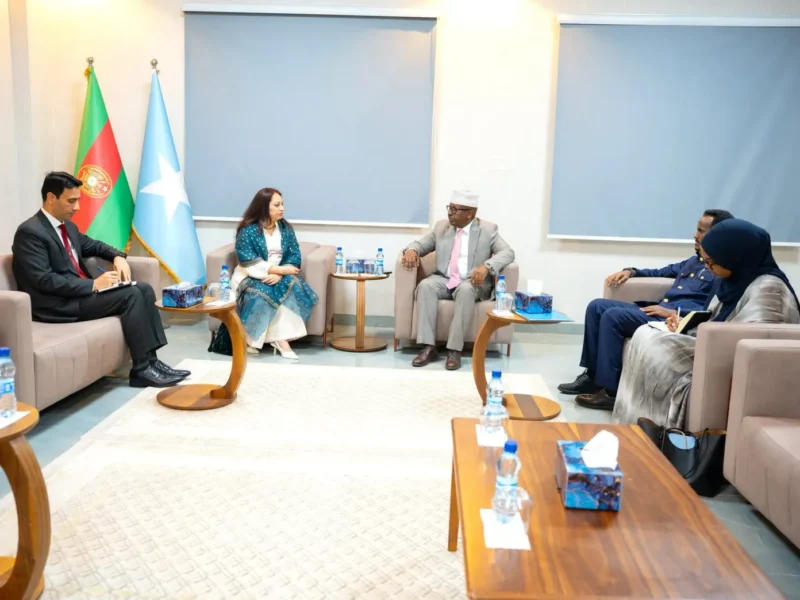
MOGADISHU — Somalia’s Minister of Defense, Ahmed Moallim Fiqi, has held a meeting with Pakistan’s Ambassador to Somalia, Aqsa Nawaz, to discuss strengthening defense cooperation between the two countries and implementing their recent Memorandum of Understanding on defense and security.
The meeting focused on enhancing bilateral defense cooperation, implementing the MoU signed between the two countries, and accelerating collaboration in training, capacity building, and strengthening the Somali National Army. The two sides also discussed developing the Somali Air Force and expanding security cooperation and counterterrorism efforts, based on shared interests and mutual respect.
The meeting follows a landmark defense MoU signed in Islamabad earlier this month between Minister Fiqi and Pakistan’s Defense Minister Khawaja Muhammad Asif. The agreement establishes a framework for cooperation in counterterrorism, military training, exchange of expertise and professional knowledge, defense capacity building, and broader security collaboration to support efforts aimed at promoting peace and stability . The agreement reflects the shared commitment of both nations to deepening their strategic partnership and expanding defense and security cooperation .
High-Level Military Engagements
During his visit to Pakistan, Minister Fiqi held separate meetings with Pakistan’s top military leadership. At Air Headquarters in Islamabad, Minister Fiqi met with Air Chief Marshal Zaheer Ahmed Baber Sidhu, the Chief of the Air Staff . The meeting focused on strengthening bilateral military cooperation, enhancing air force capabilities, expanding training opportunities, and promoting the exchange of expertise . The Air Chief highlighted the Pakistan Air Force’s indigenous capability development, advanced training infrastructure and professional exchange programmes, reaffirming the PAF’s commitment to strengthening institutional cooperation with the Somali Air Force .
At Naval Headquarters, Minister Fiqi met with Chief of the Naval Staff Admiral Naveed Ashraf . The two sides discussed matters of mutual professional interest, regional maritime security and avenues for expanding bilateral defense collaboration . Admiral Ashraf reaffirmed Pakistan’s commitment to further strengthening defense ties with Somalia and promoting closer naval cooperation . The Somali defence minister appreciated the Pakistan Navy’s contributions to regional maritime security and praised the Pakistan Air Force’s professionalism and operational capabilities .
Minister Fiqi also visited the headquarters of Global Industrial & Defence Solutions (GIDS), a state-owned defence manufacturer, where he was received by Chief Executive Officer Asad Kamal, who briefed him on the company’s capabilities in defence manufacturing, military technology, and advanced defence solutions . Both sides explored how Somalia could benefit from Pakistan’s expertise in advanced defence systems and defence industry development .
Expanding Bilateral Relations
Ambassador Aqsa Nawaz’s appointment as Pakistan’s ambassador to Somalia marks a significant milestone, as she is the first woman to serve in this role, representing a new development in diplomatic representation between Mogadishu and Islamabad .
Somalia and Pakistan have been strengthening bilateral relations across multiple sectors. Foreign Minister Abdisalam Abdi Ali has conducted telephone discussions with Pakistan’s Deputy Prime Minister and Foreign Minister Mohammad Ishaq Dar, assessing ongoing initiatives to secure the release of Pakistani nationals aboard the MT Honour 25, which was hijacked off Somalia’s Puntland region with 17 crew members aboard, including ten Pakistani sailors . The Minister reiterated the Somali Government’s persistent dedication to supporting measures ensuring the safety and prompt release of the hostages .
The two foreign ministers also met on the sidelines of the 4th EU Indo-Pacific Ministerial Forum in Brussels, where they reaffirmed robust fraternal bonds and vowed to broaden collaboration in diplomacy, security, trade, education, health, and institutional capacity-building .
In January 2026, Somalia and Pakistan officially reached an agreement to eliminate visa requirements for diplomatic passport holders, a significant measure designed to enhance bilateral relations . Pakistani President Asif Ali Zardari confirmed Pakistan’s continued backing for Somalia’s sovereignty, unity, and territorial integrity, stating that Islamabad remains prepared to enhance political and diplomatic collaboration to promote peace, stability, and state-building efforts in the Horn of Africa .
Somalia has also condemned the terrorist bomb attack targeting a passenger train in Quetta, Balochistan, Pakistan, which claimed the lives of innocent civilians, including women and children . The Federal Government extended its deepest condolences to the Government and people of Pakistan and reaffirmed its firm rejection of all forms of terrorism targeting innocent civilians .
Strategic Significance
Somalia is currently in advanced negotiations with Pakistan to purchase up to 24 JF-17 Thunder fighter jets in a potential $900 million agreement that would mark the nation’s most ambitious attempt since 1991 to reestablish a sovereign air combat capability . The JF-17 offers a cost-effective alternative to Western options that cost more than three times as much .
Critical Note
The defense cooperation agreement between Somalia and Pakistan represents a significant expansion of Mogadishu’s military partnerships, following similar agreements with Turkey, Egypt, and Saudi Arabia. While the MoU provides a framework for training and capacity building, the practical impact of these agreements remains uncertain. Pakistan brings valuable counterterrorism experience and military training capacity, but its ability to deliver on these commitments is constrained by its own financial challenges.
Somalia’s pursuit of multiple defense partnerships reflects a strategy of diversifying its security relationships, but it also risks creating coordination challenges and competing interests. The reported interest in JF-17 fighter jets, while ambitious, raises questions about Somalia’s ability to sustain and operate advanced military equipment given its limited resources and institutional capacity.
The government must ensure that these defense partnerships translate into tangible improvements in Somalia’s security institutions and counterterrorism capabilities, rather than serving primarily as diplomatic symbols. Without sustained investment in institutional reforms and maintenance capacity, the risk is that these agreements will remain largely aspirational.
Recommended Reading On ftlsomalia.com
- Defence Minister Fiqi Visits Pakistan’s Air and Naval Headquarters
- President Hassan Sheikh Receives Pakistan’s First Woman Ambassador
- Somalia’s Foreign Minister Discusses Bilateral Relations with Pakistan
- Somalia Condemns Pakistan Train Bombing, Expresses Solidarity
- Somalia and Pakistan Establish Visa-Free Travel for Diplomats
- Somali Interior Minister Visits Islamabad for ID Infrastructure Talks