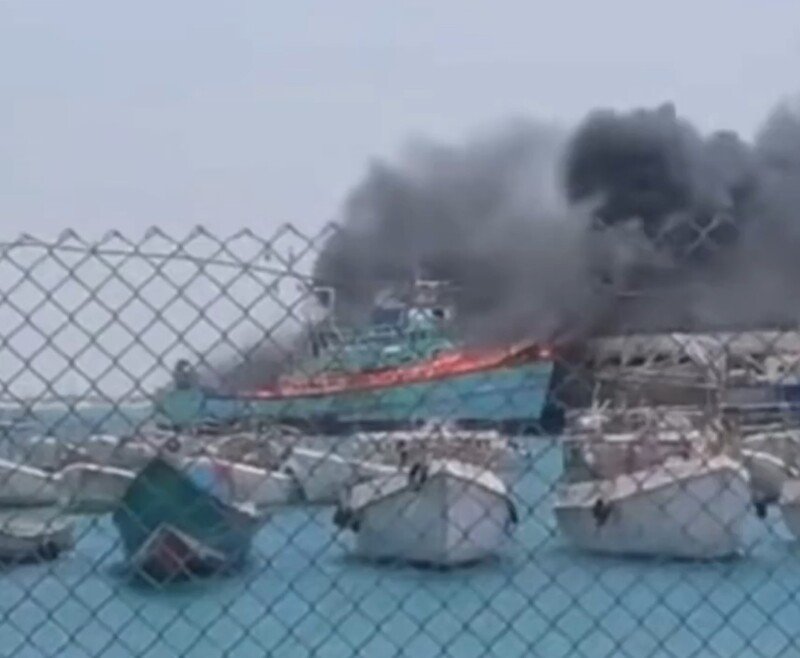
BERBERA — A ship docked at the Port of Berbera has been engulfed in a major fire this morning, with thick flames and smoke reported rising from the vessel. Firefighting crews are currently battling to bring the blaze under control, according to a breaking news report from Uubaale News (@CivicPulseh6nc) on the social media platform X.
The cause of the fire and whether there are any casualties remain unknown as the situation continues to develop. The Port of Berbera, located in the self-declared Republic of Somaliland, is a strategically significant deep-water port on the Gulf of Aden and one of the busiest commercial hubs in the Horn of Africa.
The incident comes at a time of heightened geopolitical tensions surrounding the port and follows a period of sustained threats from Yemen’s Houthi movement against what it describes as Israeli engagement in Somaliland. The Houthi leadership has previously threatened to treat any Israeli installation in Somaliland as a legitimate military target, raising the spectre of regional conflict spilling directly onto Somali soil.
Global shipping giant Maersk recently suspended new cargo bookings to Berbera, citing “scheduling changes” at a time when the port has been positioning itself as a rising hub for regional commerce. The suspension added pressure to supply chains in the Horn of Africa, particularly for landlocked Ethiopia, which has increasingly turned to Berbera as an alternative maritime gateway.
Reports have emerged of an Israeli intelligence presence in Somaliland, with discussions reportedly including the possibility of a military foothold near the Bab al-Mandab Strait—a maritime chokepoint comparable in importance to the Strait of Hormuz. Yemen’s Houthi movement has already closed the Red Sea to Israeli ships and has threatened to close the strait entirely amid regional tensions.
The United Nations Security Council has extended monthly reporting on Houthi attacks in the Red Sea, with Somalia’s representative emphasising that instability in the Red Sea extends beyond regional boundaries and is closely connected to global peace and prosperity.
The Houthis have previously targeted a UN-flagged aid vessel carrying humanitarian supplies from Somalia, killing four crew members and detaining ten others in an attack that Human Rights Watch labelled a possible war crime.
In a separate incident, the wreckage of a cruise missile was found in Somalia’s Sool region, with authorities believing it was launched by Houthis in Yemen, underscoring the direct security risks facing Somalia from the ongoing conflict.
Port of Berbera: A Strategic Asset Under Pressure
Berbera is one of the few deep-water ports in the Horn of Africa and holds significant strategic importance due to its location on the Bab-el-Mandeb strait. The UAE has controlled a major deep-water port and an airport at Berbera through its partnership with DP World, which won a 30-year concession in 2016 valued at $442 million.
The port has previously experienced fires. In 2017, a container full of acids caught fire at the port, though it was extinguished without major damage. In 2012, the MV Al-Iimaan ship caught fire at the port, destroying some facilities. In 2009, a cargo ship carrying goods for Somaliland business owners burned to ashes at the port.
Somalia has previously blocked UAE military flights amid reports that Yemen’s Southern Transitional Council leader travelled to the UAE via Somaliland, entering through Berbera port.
Unverified Reports and Security Context
At the time of writing, no official statement had been issued by Somaliland authorities, DP World, or the Federal Government of Somalia regarding the fire. The cause of the blaze, whether accidental or deliberate, remains unconfirmed. The lack of official communication from port authorities has left the situation shrouded in uncertainty, with unverified reports circulating on social media.
The incident follows a period of heightened regional tensions, including a Houthi attack on a Singapore-flagged ship docked at Berbera in 2024, which Somaliland officials addressed by urging global action to protect Red Sea trade. Berbera has been increasingly drawn into the broader security dynamics of the Red Sea, where Iran-backed Houthi militants have escalated attacks on shipping routes.
Somaliland has been pursuing international recognition, with Israel becoming the first country to recognise it as an independent state in December 2025, a move that has further complicated its international relations and drawn opposition from the Federal Government of Somalia and many Islamic nations.
Critical Note
The fire at the Port of Berbera, while still under investigation, highlights the vulnerabilities of critical infrastructure in a region marked by political contestation, limited regulatory oversight, and escalating security threats. The port’s strategic importance, combined with the ongoing dispute over its management between the Federal Government of Somalia and the Somaliland administration, raises questions about accountability and safety standards. The lack of immediate official communication undermines public confidence and allows speculation to fill the information vacuum. The broader context of Houthi threats, Israeli engagement in the region, and the diversion of international naval assets to the Red Sea has created a volatile security environment in which a seemingly isolated incident at a port could have far-reaching consequences. The international community must press for transparent investigations, robust safety standards, and de-escalation of the geopolitical rivalries that threaten to turn the Horn of Africa’s maritime assets into flashpoints for wider conflict.