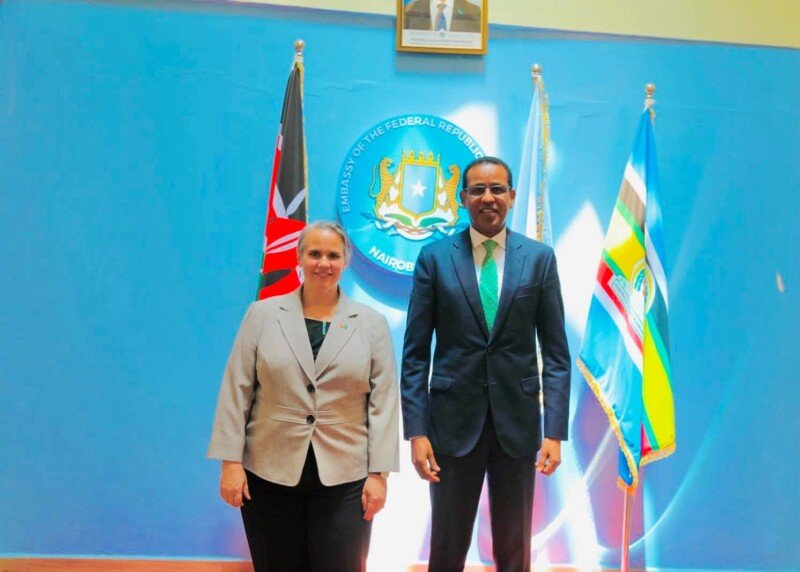
NAIROBI — The Somali Ambassador to Kenya, Jabriil Ibrahim Cabdulle, has welcomed Ruth Anne Stevens-Klitz, the newly appointed Deputy Chief of Mission and Chargé d’Affaires ad interim of the U.S. Embassy to Somalia, at the Somali Embassy in Nairobi.
During the meeting, the two diplomats discussed bilateral relations and cooperation between Somalia and the United States, with a particular focus on the critical role the U.S. plays in supporting Somali security forces and counter-terrorism operations against groups like Al-Shabaab. The discussions also covered broader mutual interests and ways to further strengthen diplomatic and security cooperation.
The U.S. has been a key partner in Somalia’s security sector reform. The United States recently supported a forensics training program that graduated 160 Somali security personnel, bringing together NISA and the Somali Police Force to develop common investigative skills and improve cooperation.
A History of U.S. Ambassadors to Somalia
Stevens-Klitz’s appointment comes amid a period of transition in U.S.-Somalia diplomatic relations. Ambassador Richard H. Riley was recalled in December 2025 as part of a Trump administration diplomatic shake-up affecting approximately 30 career diplomats. Riley had assumed his position in June 2024 and had overseen the American mission in Somalia during a politically sensitive time, focusing on enhancing collaboration with Somali government officials regarding security, governance, and development initiatives.
Riley succeeded Ambassador Larry E. André Jr., who had a notably different relationship with Mogadishu. André served as U.S. Ambassador to Somalia from April 2021 to 2023. He had presented his credentials to former President Mohamed Abdullahi Farmaajo on February 7, 2022, during the electioneering period. André, who retired after a 38-year government career, had previously served as ambassador to Mauritania and Djibouti and was regarded as being close to President Farmaajo’s administration.
Prior to André, Ambassador Donald Yamamoto served as the top U.S. diplomat in Mogadishu from 2018 to 2021. Yamamoto, a career diplomat with over 40 years of service, was involved in high-level diplomatic efforts in the region, including on the Ethiopia-Eritrea rapprochement and was seen as a mentor to U.S. envoy James Swan.
The Current Diplomatic Gap
Stevens-Klitz’s role as Chargé d’Affaires ad interim highlights a significant gap in U.S. diplomatic representation. Currently, there is no Senate-confirmed U.S. Ambassador to Somalia. Following the recall of Ambassador Riley, the U.S. Embassy in Mogadishu has been led by a Chargé d’Affaires. Justin Davis, who served as the first Chargé d’Affaires ad interim in early 2026, has been a key figure in maintaining diplomatic continuity.
This vacancy is part of a broader global trend. A report by the U.S. Department of State indicated that as of April 2026, ambassadorial positions in 117 countries, including Somalia, were vacant. This diplomatic gap places the U.S. mission in a complex position, requiring the Chargé d’Affaires to manage a full spectrum of diplomatic, security, and development affairs without Senate-confirmed leadership.
Riley, before his departure, had met with Jubbaland President Ahmed Mohamed Islam Madobe and emphasized the importance of national unity in the fight against terrorism. His recall marked the end of a brief but active tenure focused on security and governance.
During Riley’s tenure, the U.S. also waived Somalia’s debt worth $1.14 billion, a significant financial milestone formalized by Finance Minister Bihi Egeh. The U.S. has also supported the National Disability Agency and held talks with opposition figures from Southwest State, emphasizing the importance of inclusive democratic processes.
Critical Note
The meeting between Ambassador Cabdulle and Deputy Chief of Mission Stevens-Klitz reflects the continued importance of U.S.-Somalia relations, particularly in the security and counter-terrorism domains. The United States remains a critical partner in Somalia’s fight against Al-Shabaab. However, the absence of a Senate-confirmed ambassador for a significant period raises concerns about the depth of diplomatic engagement and the ability to pursue long-term strategic goals.
Historically, the U.S. has had varied relationships with Somali administrations, from Ambassador André’s closeness to President Farmaajo’s government to Ambassador Riley’s engagement with the current administration. The current vacuum in leadership comes at a sensitive time for Somalia, which is navigating political transitions and persistent security threats. The Somali government must continue to work effectively with the Chargé d’Affaires while also engaging with the U.S. to ensure that the partnership addresses the country’s long-term stability and development needs.
Recommended Reading On ftlsomalia.com
- U.S.-Supported Forensics Training Graduates 160 Somali Security Personnel
- U.S. Somalia Ambassador Richard H. Riley Recalled
- Puntland President Meets U.S. Delegation in Garowe
- US Ambassador Meets Jubbaland Leader in Kismayo
- US Embassy Holds Talks with Opposition Figures
- US Waives Somalia Debt Worth $1.14 Billion
- United States Embassy in Mogadishu Leadership Transition
- New US Ambassador Presents Credentials to Somali President