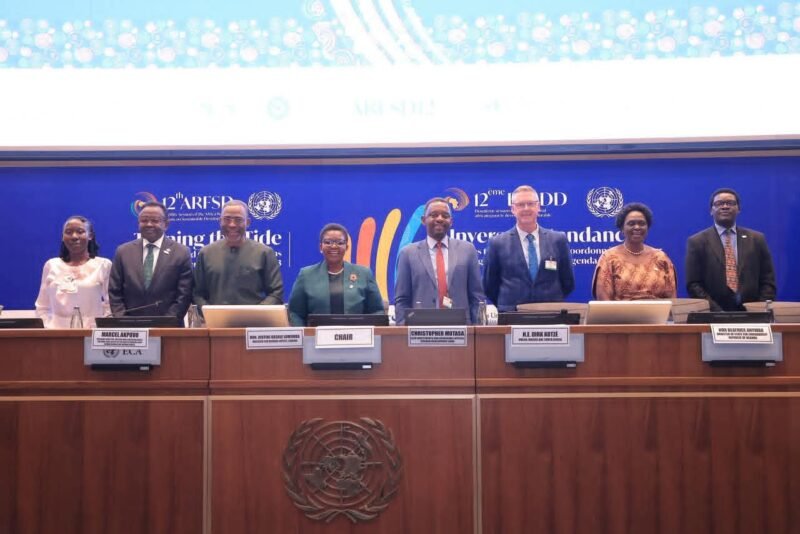
ADDIS ABABA — Somalia’s Minister of Environment and Climate Change, Bashir Mohamed Jama, delivered a key address at the SDG6 session of the 12th Arab Forum for Sustainable Development (ARFSD12) in Addis Ababa, focusing on the impact of climate change on access to clean water.
The Minister pointed out that factors including climate change, rapid urbanization, and insufficient investment have severely impacted water security throughout Africa, creating a significant barrier to sustainable development. He emphasized the critical importance of enhancing community capacity to manage these challenges more effectively.
He further explained that clean water access is intrinsically connected to climate change adaptation abilities of communities, highlighting its essential function in supporting livelihoods and broader development objectives.
The Minister concluded by advocating for greater international collaboration and increased funding to fulfill SDG6, with the goal of guaranteeing safe and consistent water resources for everyone.
Somalia’s Climate Resilience Commitments
The forum, which convened stakeholders from the UN system, African Union, and United Nations Economic Commission for Africa (ECA), focused on accelerating progress on Africa’s sustainable development priorities, including climate action, water security, and green growth. Minister Jama reaffirmed Somalia’s commitment to climate resilience, environmental sustainability, and regional cooperation, aligning Africa’s priorities with the UN’s Agenda 2030 and the African Union’s Agenda 2063.
Somalia has consistently renewed its climate pledges on the international stage, reaffirming the nation’s commitment to global efforts aimed at protecting ecosystems, combating desertification, and promoting sustainable development. The country launched its Long-Term Low-Emission Development Strategy (LT-LEDS), outlining Somalia’s development directions for the next ten years.
Lt. Gen. Bashir Mohamed Jama assumed office as Minister of Environment and Climate Change in 2024, bringing a wealth of experience in governance, security, human rights, and national development to his role. He is a distinguished member of the Somali Federal Parliament and holds the nation’s highest military rank. The Federal Government launched its National Biodiversity Finance Plan, outlining a comprehensive roadmap for mobilizing domestic and international resources to protect the country’s unique ecosystems and endangered species. Parliament endorsed the National Climate Change Policy earlier this year, providing a comprehensive framework for strengthening resilience, fostering low-carbon growth, and ensuring coordinated climate action across all sectors.
On October 21, 2025, the Government of Somalia hosted a workshop in Mogadishu, where key actors validated the country’s first National Climate Change Action Plan 2025–2030 (NCCAP). The plan facilitates the implementation of Somalia’s national and international commitments on climate change, including priority actions identified in its National Adaptation Plan (NAP), Nationally Determined Contribution 3.0, and National Transformation Plan 2025–2029. The workshop convened over 40 representatives from government, civil society, academia, development partner organizations, and the private sector to confirm key actions in seven priority sectors: Agriculture, Livestock, Fisheries and Food Security; Water Resources Management; Forestry and Biodiversity; Health, Sanitation and Human Settlements; Municipalities and Urban Development; Disaster Risk Management; and Energy and Transport.