JOWHAR – President Hassan Sheikh Mohamud has arrived in Jowhar, the capital of Hirshabelle State, where he and a high-level federal delegation were warmly received before officially inaugurating a suite of landmark government and infrastructure projects designed to cement institutional permanence and accelerate regional development.
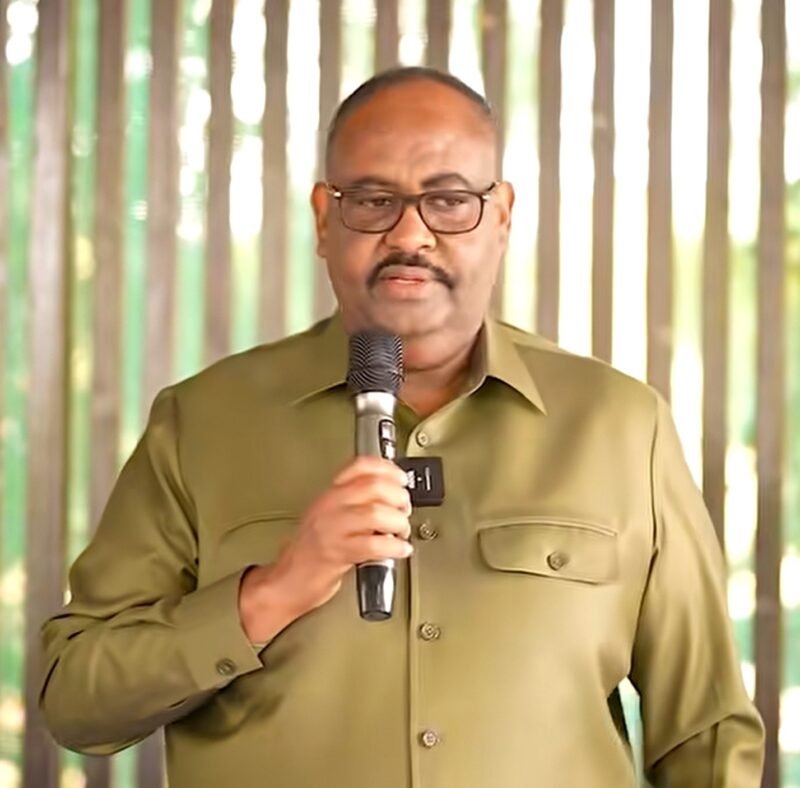
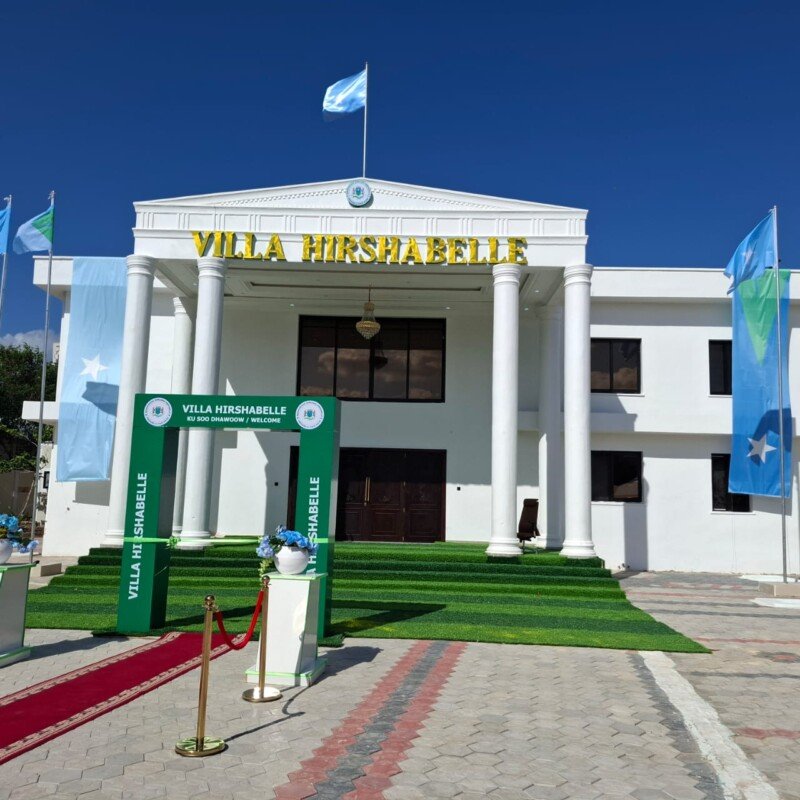
Accompanied by Hirshabelle State President Ali Abdullahi Hussein (Ali Guudlaawe), the President cut the ribbon on the newly constructed Villa Hirshabelle Presidential Palace, a modern executive complex that now houses the administrative wing for the presidency, vice-presidency, cabinet offices, a corporate meeting hall, and a secure residential section for state leadership and foreign dignitaries. The facility marks a decisive shift from temporary or makeshift governance structures to permanent, purpose-built state architecture.
Simultaneously, President Mohamud inaugurated the brand-new headquarters of the Hirshabelle Ministry of Finance, a modern two-storey facility equipped with 18 offices and two conference halls. Minister of Finance Cabdiraxiin Ciise Caddow detailed that the new building will “drastically enhance regional revenue generation and fiscal management,” signalling to domestic and international investors that the region’s fiscal environment is regulated, secure, and ready for capital absorption.
The President also opened the new Ministry of Education headquarters, which, according to Minister of Education Siciid Xagar Xagaley, will serve over 100,000 students. The education push has already seen 23 new schools built from Mataban to Balcad, 11 existing facilities fully renovated, and classroom capacity expanded in 15 others. Former Prime Minister Prof. Ali Mohamed Gedi praised this evolution, observing that the administration now commands “specialized, permanent public service offices” instead of makeshift educational spaces.
Infrastructure That Builds Economic Connectivity
The regional operational tour began with the official ribbon-cutting of the newly completed Hanti-Wadaag Road, a critical artery connecting local agricultural producers directly to wider national markets and sharply reducing logistical friction for the region’s economic base. This was complemented by the reconstruction of three other key transport corridors: the Horseed Road, Jowhar Bile Road, and Suubiye Road.
According to World Bank project documents, these roads—specifically the 1.46‑km Wareegi Doodije road, the 1.365‑km Suubiye road, and the 1.460‑km Horseed road—were rehabilitated as part of the Somalia Crisis Recovery Project, a World Bank‑financed initiative designed to support the construction and reconstruction of critical infrastructure in Jowhar District, Hirshabelle State. The roads are engineered to withstand severe weather and flood conditions, accelerating commercial transit, bolstering local security operations, and elevating adjacent real estate valuation.
The Jowhar Offstream Storage Programme (JOSP), a $140 million climate resilience initiative involving the rehabilitation of a huge irrigation scheme, was relaunched to reduce flood risk while mitigating drought, reaching more than 1.5 million people
Somalia has launched a World Bank‑backed Catastrophe Deferred Drawdown Option (Cat DDO) project to strengthen the nation’s ability to respond to natural and climate-induced disasters
Hirshabelle’s Cabinet has convened to discuss electoral preparations, security sector updates, and the potential for heavy rainfall and flooding
Political and Security Validation
The development agenda secured broad cross-regional validation. Former Mogadishu Mayor Maxamed Cismaan Cali Dhagaxtuur openly commended the visible progress, while former National Intelligence Chief Jeneraal Cabdiraxmaan Tuuryare noted that the successful execution of these large-scale projects “confirms the region’s operational security and systemic growth.” Political figure Muxudiin Saabeey highlighted the self-reliance and collaboration between the Hirshabelle administration and its citizens as the core driver of success, while Chairman of the Somali Chamber of Commerce Abdikariin Gabeyre urged private sector actors to target Jowhar’s historical agricultural and industrial sectors for immediate investment and job creation.
To ensure sustained momentum, the President concluded the regional tour by laying foundation stones for upcoming development projects, including the new headquarters of the Hirshabelle Civil Service Commission and other government facilities aimed at improving governance, transparency, and the delivery of social services.
In July 2025, President Guudlaawe officially launched voter registration for what he declared the region’s first‑ever universal suffrage local elections
President Mohamud arrived in Hirshabelle to mobilise ongoing operations against extremist groups, underscoring the federal government’s dedication to military operations and the stabilisation of liberated regions
Hirshabelle President Ali Guudlaawe visited the frontlines to assess ongoing operations against terrorist groups, praising the Somali National Army and local militias for their bravery and commitment
International Financial and Technical Backing
The scale of Jowhar’s transformation would not be possible without substantial international financial and technical backing. The European Union, as part of a €102 million cooperation agreement, has allocated significant budget support linked to progress in key reform areas, with a new budget support operation planned for 2026‑2027. The EU’s long‑standing engagement is also reflected in the €75 million contribution to AUSSOM under the European Peace Facility, which has brought total EU support to successive AU‑led missions in Somalia to nearly €2.8 billion over two decades.
Italy has been a key bilateral partner, financing three major hospital construction projects in Afmadow (Lower Juba), Xarardheere (Mudug), and Cadale (Middle Shabelle), and launching the “Quality and Equal Primary Health Services for All in Somalia” initiative to strengthen De Martino National Referral Hospital, the National Blood Bank, and the National Health Professionals Council.
The World Bank, through the Somalia Crisis Recovery Project and the Barwaaqo – Somalia Water for Rural Resilience Project, has financed not only the rehabilitation of Jowhar’s roads but also the construction of line ministries’ offices in Jowhar, directly supporting the very governance buildings inaugurated by the President.
The Federal Government and the EU held a high‑level Partnership Dialogue under Article 3 of the Samoa Agreement, reaffirming their commitment to security, governance, migration, and economic development
The EU approved a €75 million contribution to AUSSOM, making the bloc the mission’s largest financial donor
Somalia and the EU sealed a €102 million financial package to bolster state‑building and fiscal stability, aligning EU aid with the National Development Plan
Climate Resilience and Human Capital Development
Long‑term economic dominance requires human capital development and climate‑resilient infrastructure. The new Ministry of Education headquarters provides the bureaucratic infrastructure to overhaul regional learning services and efficiently manage administrative workflows. The administration has already built 23 new schools, renovated 11, and expanded classroom capacity in 15 others, while the Ministry of Finance’s new facility will enhance revenue generation and fiscal management.
Parallel to this, the administration launched a comprehensive Youth Centre in Jowhar, featuring a lighted basketball court designed to neutralise radicalisation risks by engaging youth through sports day and night, and an administrative wing with a modern library and offices providing CV writing workshops, job application assistance, and business consulting to connect young entrepreneurs with investment capital.
The ACALS climate resilience project, funded by the African Development Bank and implemented jointly by WFP and UNOPS, is strengthening resilience and empowering 30,000 people across Hirshabelle and Puntland through restored agricultural systems, climate‑adapted infrastructure, and anticipatory action.
The Federal Ministry of Livestock, Forestry and Range launched the ACALS project to provide climate‑resilient technologies and livelihood support for pastoralists, farmers, women, and youth
Somalia launched a World Bank‑backed Catastrophe Deferred Drawdown Option (Cat DDO) project to strengthen disaster preparedness
The Hirshabelle Council of Ministers convened to discuss preparations for upcoming regional elections, security sector updates, and flood‑preparedness measures
A Coherent National Strategy
The synergy between constructing permanent government headquarters and finalising the constitutional framework for universal elections demonstrates a highly cohesive national strategy. As one analyst observed, “The synergy between constructing permanent government headquarters – such as the newly opened Villa Hirshabelle and the regional Ministry of Finance – and finalising the constitutional framework for universal elections demonstrates a highly cohesive national strategy.”
This deep political capital is essential for protecting and expanding the massive infrastructure investments currently being deployed across federal member states like Hirshabelle. The federal government is proving its operational capacity to simultaneously advance physical infrastructure and democratic institutional reforms, a dual approach that positions Somalia to transition from fragile recovery to robust bureaucratic authority.
Conclusion
President Hassan Sheikh Mohamud’s visit to Jowhar has delivered a clear message: Somalia is transitioning from a decade of crisis response to a phase of permanent institutional consolidation. The inauguration of Villa Hirshabelle, the new Finance and Education ministries, and the modernised road network signals a decisive shift from makeshift governance to purpose‑built, enduring state architecture. These projects, backed by substantial international financing from the World Bank, the European Union, and Italy, are designed not just to serve today’s administrators but to anchor long‑term economic growth and democratic stability.
The simultaneous investment in climate‑resilient infrastructure – including the JOSP irrigation scheme and the ACALS project – and in human capital, through new schools and a youth centre, reflects a holistic understanding of state‑building that goes beyond bricks and mortar. It acknowledges that lasting stability requires educated citizens, economically engaged youth, and a fiscal environment capable of attracting private investment. By laying the foundation for the Civil Service Commission headquarters and other government facilities, the administration is also prioritising transparency, accountability, and efficient public service delivery.
This infrastructure surge is inseparable from Somalia’s wider political transformation. The same week that Villa Hirshabelle was inaugurated, the federal government finalised constitutional amendments paving the way for universal suffrage and a formal party‑based political system. The physical consolidation of state authority in Jowhar is thus both a symbol and a practical enabler of the democratic transition that the country has embarked upon – a transition that requires not only legal frameworks but also the institutional capacity to deliver services, collect revenue, and maintain security.
The administration’s ability to mobilise broad cross‑regional validation – from former mayors and intelligence chiefs to business leaders and traditional elders – demonstrates that this vision enjoys domestic political traction. The endorsement of figures such as former Mogadishu Mayor Maxamed Cismaan Cali Dhagaxtuur and former National Intelligence Chief Cabdiraxmaan Tuuryare helps consolidate the legitimacy of the state‑building project across Somalia’s often‑fragmented political landscape.
Finally, the success of the Jowhar projects offers a replicable model for other federal member states. By leveraging international development finance, coordinating closely with federal institutions, and engaging local communities, Hirshabelle has shown that state‑building is not a distant aspiration but a tangible, ongoing process. As President Mohamud laid foundation stones for future projects, the message was clear: the era of Somalia’s permanent governance architecture has begun, and Jowhar is leading the way.
Recommended Reading On ftlsomalia.com:
- JOSP Project Relaunched in Hirshabelle to Tackle Floods and Drought
- Somalia Launches World Bank‑Backed Project to Bolster Disaster Preparedness
- Hirshabelle Cabinet Discusses Elections, Security, and Flood Risks
- Hirshabelle President in the Frontlines in Operations Against Al‑Shabaab
- Somalia’s Livestock Ministry Launches ACALS Climate Resilience Project
- Hirshabelle Launches Historic Voter Registration for One‑Person, One‑Vote Elections
- President Mohamud Arrived in Hirshabelle to Mobilize Ongoing Operations
- Somalia Couples Regional Infrastructure Expansion with Historic Democratic Reforms
- Somalia and EU Hold High‑Level Partnership Dialogue in Mogadishu
- EU Approves €75 Million for AU Mission in Somalia