Yet the landmark visit unfolds against a backdrop of fierce international opposition, unresolved legal questions and growing concern that Israel is importing Middle East conflicts into the Horn of Africa. Mogadishu has condemned the move as a violation of its sovereignty, while the African Union, the Arab League, Turkey, Egypt and others have all rejected the recognition and called for its immediate revocation.
A Diplomatic Milestone Shadowed by Controversy
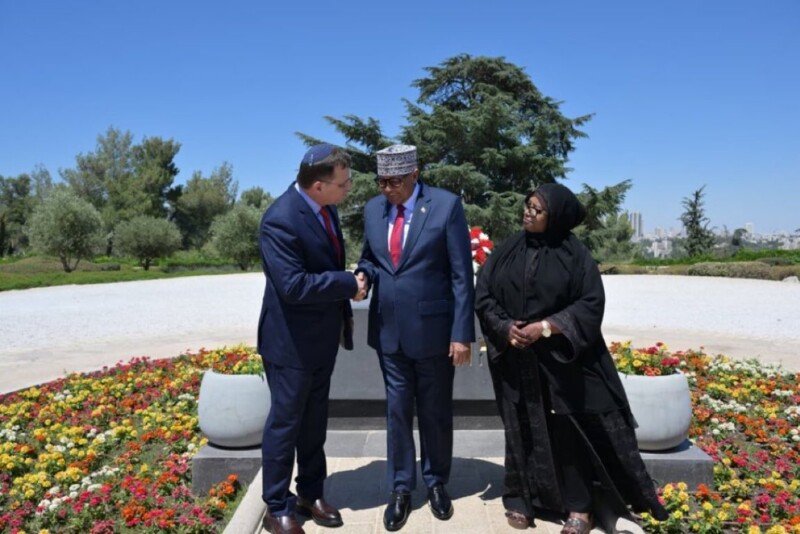
The main events of the visit include a formal welcome by Israeli President Isaac Herzog, a state luncheon attended by Foreign Minister Gideon Sa’ar, the opening of a Somaliland embassy in Jerusalem on Monday evening, and planned talks with Prime Minister Benjamin Netanyahu. Somaliland also intends to participate in an economic forum organised by the Israeli Export Institute.
“Today marks a historic milestone in our journey and the beginning of a new chapter in the relationship between Somaliland and Israel,” Herzog said.
The diplomatic opening, however, remains on shaky legal ground. Former Somali intelligence chief Fahad Yasin has argued that the recognition has no legal weight, noting that it was not passed by the Israeli executive or the Knesset and that it has no basis in Israel’s own charters or laws. “If Netanyahu leaves office or any new developments occur in the region, a new decree could be issued to reverse it, or it could simply be ignored,” Yasin wrote.
Mogadishu has consistently maintained that the recognition is “null and void”. Somalia’s Foreign Minister Abdisalam Abdi Ali told an emergency session of the African Union Peace and Security Council that the move violates Somalia’s provisional constitution, the AU Constitutive Act and the UN Charter, warning that eroding Somalia’s integrity would destabilise the Horn of Africa and undermine regional counter‑terrorism and maritime security.
“A Trap, Not a Diplomatic Breakthrough”
President Hassan Sheikh Mohamud has described Israel’s recognition as “one of the darkest days in Somalia’s history” and said Mogadishu had considered using force but ultimately chose dialogue and persuasion. “Somaliland did not secure recognition and will not secure recognition; what it received was not recognition at all, but a trap laid by Israel,” he said. In an interview with Dawan TV, Mohamud explained that the government had weighed different approaches to Somaliland and concluded that peaceful engagement remained the most suitable option under the circumstances.
The Somali leader has repeatedly cautioned that Israel’s engagement with Somaliland risks importing the Middle East’s conflicts into the Horn of Africa. He has vowed to resist any Israeli military presence in Somaliland, warning that an Israeli foothold could reignite conflict around the Gulf of Aden and the Red Sea, especially given the hostile relations that Yemen’s Houthis and Iran have with Israel. “If Israel uses Somaliland as a proxy territory to attack others, they may retaliate in Somaliland and Somalia, creating a dangerous dynamic,” Mohamud said. He has also reiterated Somalia’s support for the Palestinian cause, stating that Mogadishu views Israel as an “aggressor” against the Palestinian people.
Regional and International Condemnation
The recognition has drawn widespread condemnation. The African Union, IGAD, Qatar, Saudi Arabia, Jordan, Iraq, China and others have all rejected the move. Even the United States, while not formally condemning the recognition, has reaffirmed its “One Somalia” policy and declined to follow Israel’s lead.
The decision to locate Somaliland’s embassy in Jerusalem has also drawn fire. Nineteen Muslim‑majority countries issued a joint statement condemning the planned embassy as a “flagrant violation” of international law and United Nations resolutions. Somaliland will become only the second Muslim‑majority entity to open an embassy in Jerusalem, a choice that has been widely criticised as an unacceptable provocation.
Strategic Calculations and Economic Outreach
For Somaliland, the visit is a calculated gamble. President Irro has indicated that Somaliland is prepared to offer Israel rights to valuable mineral deposits in exchange for technology and investment, and the delegation is arranging meetings with Israeli business leaders to attract foreign investment to the territory.
Israel, for its part, sees Somaliland as a strategic partner near the Bab al‑Mandeb Strait. Intelligence reports suggest Israel has considered establishing a presence at Berbera Port to counter Houthi missile and drone threats, though Somaliland officials have offered contradictory statements on whether an Israeli military base is under discussion.
A Sharp Domestic and International Divide
Even within Somaliland, the deepening ties with Israel have provoked unease. Religious leaders who have criticised the relationship have been arrested, and the self‑declared state has faced criticism from influential Islamic clerics who warn that engaging with Israel conflicts with Somali religious and humanitarian values.
For Mogadishu, the visit represents the realisation of its worst fears: that Israel is using Somaliland’s quest for recognition to insert itself into the Horn of Africa, bringing with it the conflicts of the Middle East and exposing Somali territory to retaliation by the Houthis and Iran.
Recommended Reading On ftlsomalia.com:
- Somalia President Calls Israel’s Recognition of Somaliland a ‘Dark Day’
- Mogadishu Cautions Israel Over Somaliland Engagement
- President Mohamud Threatens to ‘Confront’ Any Israeli Military Presence in Somaliland
- Somaliland Leader Speaks with Israeli PM Amid Middle East Tensions
- Former Spy Chief Claims Somaliland’s Israel Recognition is Legally Void
- The Somaliland Recognition Crisis: Israel Stands Alone Amid Global Condemnation
- Somaliland to Open Jerusalem Embassy as Second Muslim Nation in Israel Deal
- Somaliland Eyes Trade Pact with Israel; Offers Mineral Rights in Exchange for Tech